


A TeaLamp book review. Prepared by the TeaLamp Editorial Team with the help of AI.
This The Little Prince review looks at a very small book with a very large heart. Antoine de Saint-Exupéry’s story of a pilot stranded in the desert and a small boy from another planet takes about an hour to read, yet readers have been returning to it for more than eighty years. It is a children’s book that adults keep on their shelves, a fable about friendship and love that never talks down to anyone, and one of the most translated books ever written.
Key takeaways on The Little Prince review
- A pilot who crashes in the Sahara meets a small prince from a tiny asteroid, and the boy’s questions slowly change how the pilot sees his own life.
- The fox and the rose carry the book’s heart: we make things special by the time and care we give them.
- Saint-Exupéry drew the pictures himself, and the drawings are part of the story, not decoration.
- The book grew out of the author’s own life as a pilot, including a real crash in the desert in 1935.
- It suits readers of almost any age, and it reads just as well aloud as it does on the page.
The story
The book opens with a pilot, much like Saint-Exupéry himself, whose plane comes down in the Sahara desert. He has little water and eight days to repair the engine before it runs out. On the first morning a small boy appears out of nowhere and asks him, politely and firmly, to draw him a sheep. The boy is the little prince, and he has travelled from a planet so small that it holds just three tiny volcanoes, a few plants, and one rose.
Over the days it takes to fix the plane, the prince tells the pilot how he came to be there. He left his little planet after a quarrel with his rose, and on the way to Earth he visited six other tiny planets. Each one holds a single grown-up: a king who rules over nothing, a man who only wants to be admired, a tippler who drinks to forget that he drinks, a businessman who counts the stars and believes he owns them, a lamplighter whose planet turns so fast that a day lasts a minute, and a geographer who writes down places he has never seen. Each visit is short, gentle, and a little sad, and each one shows the prince something about how grown-ups lose sight of what matters.
On Earth the prince meets a snake, a flower, a mountain, and a garden full of roses, and he learns that the rose he left behind is not the only one of her kind. What follows is the part of the book most readers carry with them for the rest of their lives.
The fox and the rose
In a field on Earth, the prince meets a fox, and the fox asks to be tamed. Taming, the fox explains, means making a bond: spending time together, coming back at the same hour, learning each other’s ways until an ordinary creature becomes the only one of its kind in the world. The prince realises that his rose is special not because she is the only rose, but because he watered her, sheltered her, and listened to her. She is his because of the time he gave her.
The fox’s parting secret is the book’s most famous line. In Katherine Woods’s 1943 translation, chapter twenty-one, it reads: “It is only with the heart that one can see rightly; what is essential is invisible to the eye.” It is the one short quotation this review needs, because the whole book gathers around it. The prince goes back to his roses knowing that what makes his flower different is not her petals but his care, and he sets out for home with a lighter heart.

A rose kept safe under glass. Image generated by AI.
What the drawings add
Saint-Exupéry illustrated the book himself, in simple watercolours, and the pictures do real work in the story. The first drawing in the book is a boa constrictor that has swallowed an elephant, which every grown-up mistakes for a hat. The prince is the only one who sees it correctly, and that small joke sets up the whole book: children see what grown-ups have learned not to see. Later drawings show the sheep that lives inside a box, the prince’s tiny planet with its volcanoes, and the fox sitting at a careful distance, waiting to be tamed.
The drawings are plain and a little rough, and that is part of their charm. They look like the work of a man who drew them for himself, not for a publisher, and they make the book feel personal, as if the pilot is showing you his sketchbook. No other edition needs them explained: the pictures and the words belong together, and this review’s own images are new pictures made for the occasion, not copies of Saint-Exupéry’s drawings.
The pilot behind the story
Much of the book comes from Saint-Exupéry’s own life. He was born in Lyon on 29 June 1900, and he flew airmail routes across the Sahara and the South Atlantic for the airline that became the Aéropostale, working for a time as station chief at the lonely desert airstrip of Cap Juby. On 30 December 1935, while trying to break a Paris to Saigon speed record with his navigator André Prévot, he crashed in the Libyan desert. The two men walked for days with almost no water before a Bedouin on a camel found them and saved their lives. He wrote about that ordeal in his memoir Wind, Sand and Stars, published in 1939, and the desert opening of The Little Prince grows straight out of it.
He wrote the book in New York, where he was living in exile during the Second World War. Reynal and Hitchcock published it there in April 1943, in French and English at the same time, with Katherine Woods’s English translation. His own country did not see it until after the war, when Gallimard published it in France; his work had been banned under the Vichy regime. He never saw that French edition. On 31 July 1944 he took off from Corsica on a reconnaissance mission in a Lockheed P-38 Lightning and never came back. Wreckage of his plane was found off the coast of Marseille in 2000 and formally identified in 2003.
Why it matters
The Little Prince matters because it is short, plain, and deep all at once. A child can follow the story of a boy, a fox, and a rose, and an adult can find in the same pages a quiet argument about how grown-ups trade wonder for busyness. The six little planets are gentle satire, never bitter. The book never lectures, and it never tells the reader what to feel. It simply asks its questions and lets them sit.
It suits almost any reader. Children from about eight or nine enjoy the adventure and the drawings, and they understand the fox at once. Adults who read it again after many years often find a different book waiting for them, because the questions about time, care, and what is essential land differently with age. It is also a lovely book to read aloud, a chapter at a time, with tea. Best for readers who like short books with long afterlives, and for anyone who wants a story to share across generations.
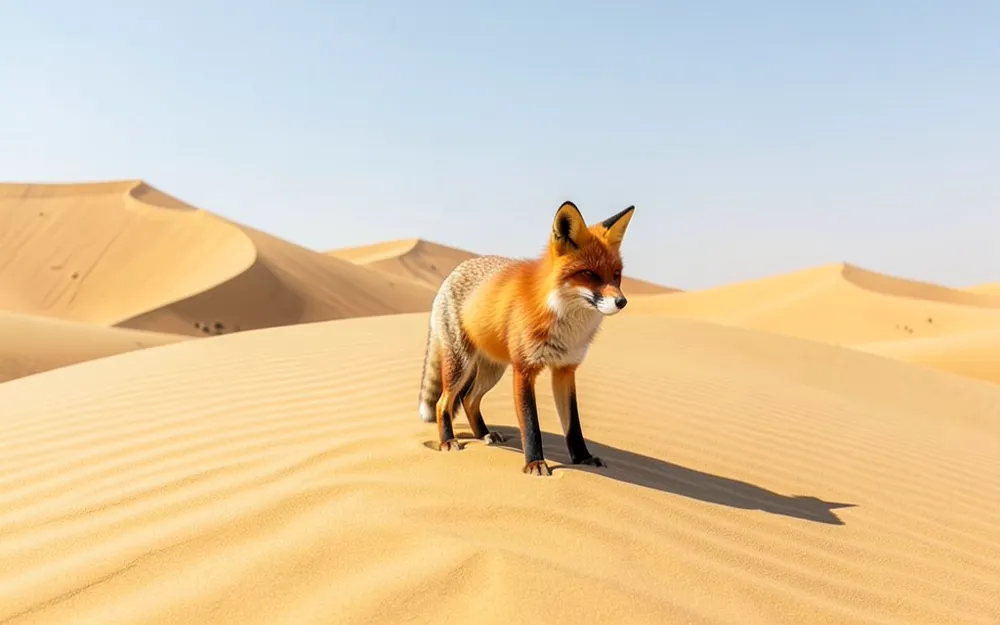
A fox on a dune in daylight. Image generated by AI.
For more books about friendship, read our list of Five Books About Friendship, where The Little Prince appears alongside four other stories about friends who matter.
Frequently asked questions
Is The Little Prince a children’s book?
It is written simply enough for children, and many readers meet it young, but it was written for readers of every age. Children enjoy the adventure, the planets, and the fox. Adults find the reflections on friendship, work, and what is essential. It belongs on both shelves.
Which translation should I read?
Katherine Woods’s 1943 translation was the first English version, published alongside the French original, and it is the one most English-speaking readers grew up with, including the famous line about seeing with the heart. Newer translations exist, and any good one will do. If you read French, the original Le Petit Prince is short and clear, and it makes a fine first French book.
Is the ending sad?
The ending is tender rather than sad. The prince leaves the pilot to return to his rose, and the pilot is left looking at the stars and listening for laughter. Younger readers may need a hug and a talk afterwards, and that talk is part of the book’s gift. Read it with someone, and the ending feels hopeful.
Sources
- The Little Prince, Wikipedia (first published April 1943, Reynal & Hitchcock, New York, in French and English; estimated 140 million copies sold; 600 languages and dialects by November 2024; 1935 Sahara crash with André Prévot)
- The Little Prince, Encyclopaedia Britannica (fable and modern classic by Antoine de Saint-Exupéry, published 1943 with his own illustrations; over 200 million copies sold)
- Antoine de Saint-Exupéry, Wikipedia (born 29 June 1900, Lyon; Aéropostale pilot; disappeared 31 July 1944 on a reconnaissance mission; wreckage found 2000, identified 2003)
- The Little Prince, Wikiquote (fox’s secret, chapter XXI, Katherine Woods translation: “It is only with the heart that one can see rightly; what is essential is invisible to the eye.”)










0 Comments