


Originally published by Stuart Maudsley in Frontiers for Young Minds on October 22, 2026, under a Creative Commons Attribution licence. Adapted here under that licence: rewritten for a general audience, with new structure, new explanations and a new ending. Frontiers for Young Minds and the author do not endorse TeaLamp. Prepared by the TeaLamp Editorial Team with the help of AI.
Cell messages could change the way doctors treat aging. Many older people live with several long-term illnesses at once, heart disease alongside diabetes, for example, or memory problems alongside high blood pressure. Each illness usually gets its own medicine. A new research direction asks whether some of those illnesses share roots inside aging cells, and whether treatments aimed at those shared roots could help more than one problem at a time.
Key takeaways on cell messages
- Cells listen to the body through receptors on their surfaces, and one large family, the G protein-coupled receptors, or GPCRs, helps control many body systems at once.
- Because GPCR signals overlap and connect, a shift in those signals with age may help explain why chronic diseases often appear together.
- Almost 40 percent of current medicines already act on GPCRs, but most target one problem at a time.
- Researchers propose studying GPCR networks as a whole, tuning signals more precisely, and matching treatments to each person’s changing biology.
- None of this is a treatment yet. Scientists still need to learn which signals change with age, which changes matter, and which can be adjusted safely.
Why diseases pile up with age
Picture a kitchen counter lined with pill bottles: one for blood pressure, one for blood sugar, others for pain, sleep, movement or memory. That image, used in the Frontiers for Young Minds article, captures a common experience of later life. Chronic diseases, illnesses that last a long time and need ongoing care, become more common as people grow older, and they often arrive in groups.
Doctors have usually treated each disease on its own terms, which makes sense when diseases look separate. But researchers are asking whether that picture misses something. As people age, cells can struggle with the same basic jobs in several parts of the body at once: using energy, repairing damage and calming inflammation. If those shared troubles help drive several diseases, then treating the shared trouble, rather than each disease alone, might be a smarter strategy.
The doorbell on the cell
Cells are not sealed boxes. They constantly receive messages from other cells and from the rest of the body, messages that tell them when to use energy, grow, or calm an inflammatory response after an injury. Many of those messages are caught by receptors, proteins that sit in the cell’s outer membrane and recognise one kind of message molecule.
The article compares a receptor to a doorbell. Pressing the button outside sends a signal inside the house. In the same way, when a message molecule attaches to a receptor on the cell surface, the receptor passes the information inward, and the cell responds. Different cells need different messages, so a heart cell, an immune cell and a brain cell do not all listen to the same signals.
One family of receptors, many jobs
GPCRs are one especially important family of receptors. The human body has more than 800 types of them. Some help with smell and taste, but many work deep inside the body, helping cells respond to changing conditions. Each GPCR is a long molecule that crosses the cell membrane seven times, looping back and forth like thread stitched through cloth.
When a message molecule attaches to the outside of a GPCR, the receptor changes shape slightly. That small change switches on a helper protein inside the cell, called a G protein, which passes the message to other proteins until the cell responds. The same family of receptors shows up across the body: in eating and blood-sugar control, in heart rate and blood pressure during stress or exercise, in guiding immune cells to an injury, and in brain signals for movement, motivation and learning.
Because the same kind of signal appears in many systems, GPCR signals can overlap. Scientists call these connected signals GPCR networks. A change in one part of a network may ripple into other parts, which is why a shift in GPCR signalling with age could affect several body systems at the same time.
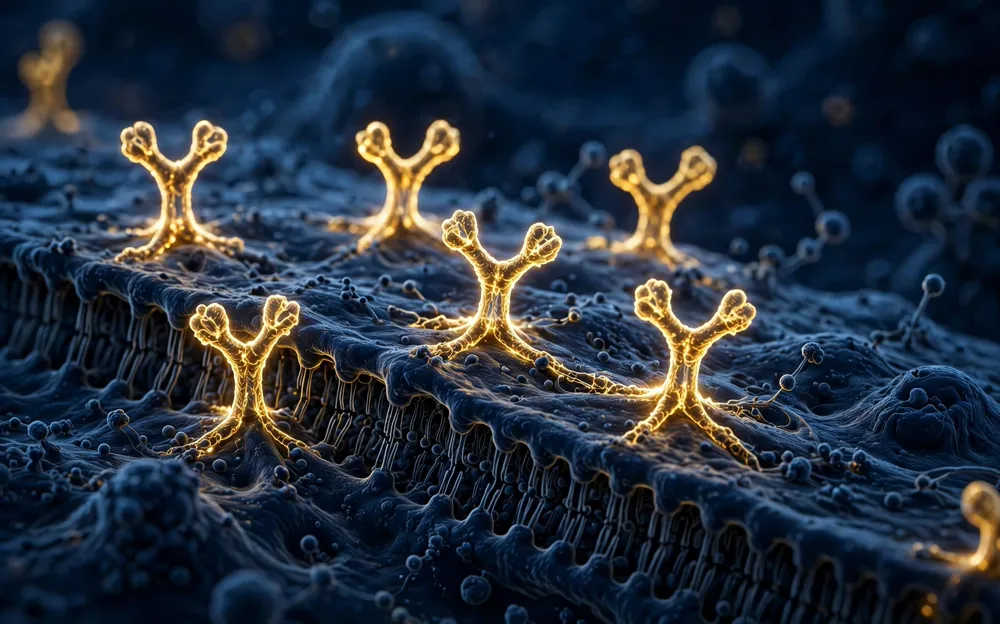
Receptors on a cell surface, like the GPCRs that pass messages into cells. Image generated by AI.
What future medicines might do differently
GPCRs are already major drug targets. The article notes that nearly 40 percent of current medicines act on them, including drugs for high blood pressure, allergies, asthma, migraine, pain, Parkinson’s disease and type 2 diabetes. Most of those medicines, however, are designed to change one main signal for one specific problem, switching it fully on or fully off.
The proposed alternative has three parts. First, treat connected problems together: if energy trouble, damage and inflammation feed on each other, a treatment aimed at a shared GPCR signal might help several problems at once, or a GPCR medicine might be paired with another treatment aimed at inflammation or repair. Second, tune signals more carefully. Two different molecules can bend the same receptor in slightly different ways, one leading to a helpful response and another to side effects, so understanding receptor shapes in fine detail could let scientists steer toward the wanted response. Computer tools that predict protein shapes, such as AlphaFold, can help map where a medicine might attach.
Third, match treatments to people. People do not all age in the same way. In one older adult, the biggest changes might involve blood vessels and energy use; in another, inflammation or brain signals. Doctors would need clues, called biomarkers, about what is changing in each person’s body, from blood tests, genes, medical records and even wearable devices. Researchers are also studying digital twins, computer models of parts of a person’s body, on which treatment ideas could be tested before they are tried in a real patient.
Why it matters, and why caution is needed
It is easy to hear “one treatment for many diseases” and imagine a cure around the corner. The researchers behind this work do not make that claim, and neither should readers. The Frontiers in Science paper at the heart of the article is a proposal and a review of evidence, not a clinical trial of a new drug. Scientists still need to find out which GPCR signals actually change with age, which of those changes add to chronic disease, and which signals can be adjusted safely in people.
That caution is also a strength. It keeps the focus on the hard questions: how to measure a person’s changing biology reliably, how to avoid side effects when a signal touches many systems, and how to test network-level treatments properly. If the research succeeds, the payoff may be less dramatic than a single miracle pill, but more useful: doctors choosing treatments based on the body systems and cell signals changing in each person, instead of giving everyone with the same diagnosis the same medicine.

A pharmacy counter, where today’s GPCR medicines treat one condition at a time. Image generated by AI.
Related reading
For another story about a nutrient the body cannot make on its own, read Vitamin B12: The Vitamin Only Microbes Can Make, which explains why a vitamin made only by microbes matters so much for human health.
Frequently asked questions
Are GPCR treatments for aging available now?
No. Many existing medicines act on GPCRs for specific conditions, but the network-level approach to aging described here is research, not a treatment you can ask a doctor for today.
What is a biomarker?
A biomarker is a measurement that reveals something about what is happening inside the body. Blood pressure and blood sugar are familiar examples. In the future, doctors might use many biomarkers together to judge which body systems are changing most in a person.
What is a digital twin?
A digital twin is a computer model that stands in for parts of a real person’s body, built from information such as blood tests, genes and medical records. Researchers hope to test treatment ideas on such models before trying them in people, but this too is still research.
Sources
- Could Cell Messages Help Treat Diseases of Aging? Frontiers for Young Minds, by Stuart Maudsley, published October 22, 2026.
- Network-level control of G protein-coupled receptors: a panacea for chronic diseases? Boeringer and colleagues, Frontiers in Science, 2026.
- Frontiers in Science: Rebalancing the body’s cellular communication system could slow aging, Frontiers press release, October 22, 2026.
- Using Frontiers for Young Minds Articles in Your Classroom, Frontiers, confirming all Frontiers for Young Minds articles use a Creative Commons CC-BY licence.









0 Comments