

An original TeaLamp book summary. The book is in the public domain (first published 1818). Short quotations are credited to Mary Shelley, Frankenstein; or, The Modern Prometheus. Prepared by the TeaLamp Editorial Team with the help of AI.
She was eighteen, stuck indoors through a freakishly cold summer, when a ghost-story contest gave her a nightmare she could not shake. Mary Shelley turned that nightmare into Frankenstein — a novel about a young scientist who learns to create life and then refuses to take responsibility for it. This Frankenstein summary walks through the story, the ideas that made it immortal, and why a two-hundred-year-old book feels written for our moment.
Key takeaways on Frankenstein
- Mary Shelley conceived Frankenstein in the summer of 1816 — the “Year Without a Summer” — during a ghost-story contest with Lord Byron at Lake Geneva. She was eighteen.
- The plot: Victor Frankenstein animates a creature from dead matter, abandons it in horror, and spends the rest of the novel fleeing the consequences as the creature demands the one thing it was never given — companionship.
- The creature is not born a monster. Taught language by watching a family through a cottage wall, he turns vengeful only after repeated rejection: “I was benevolent and good; misery made me a fiend.”
- The novel’s subtitle, The Modern Prometheus, frames the warning: stealing the fire of creation without a plan for what you have lit.
- Often called the first true science-fiction novel, its questions — what creators owe their creations — now sit at the center of debates about AI and genetic engineering.
The eighteen-year-old who invented a genre
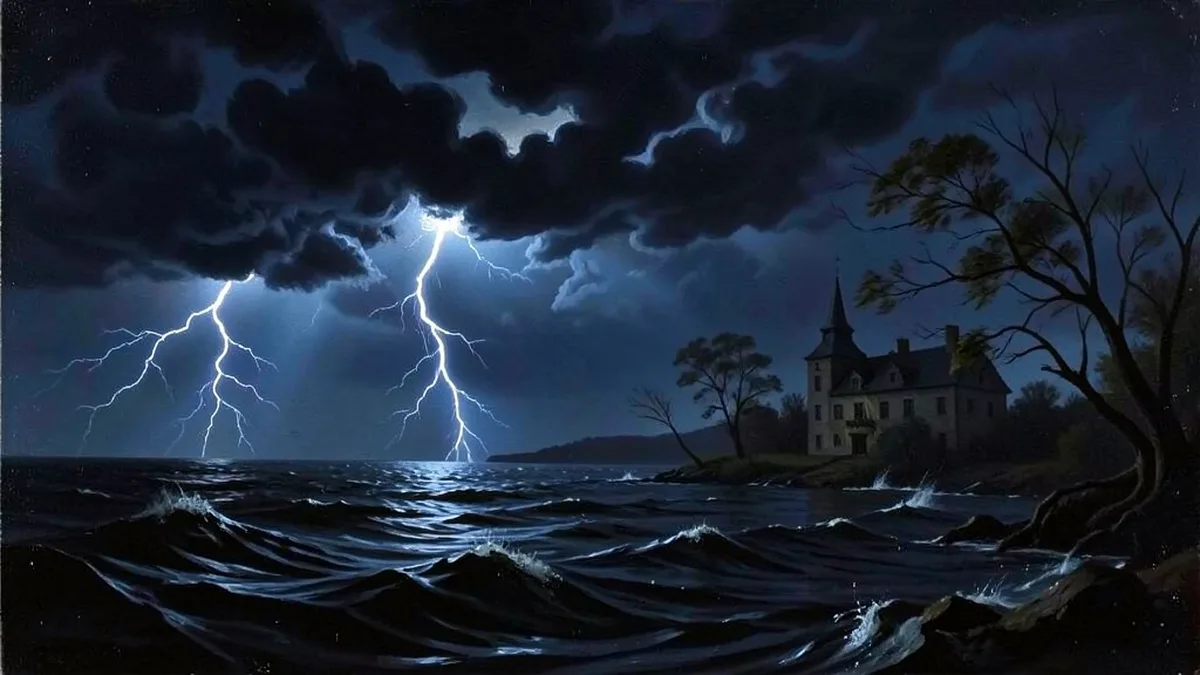
In April 1815, Mount Tambora in Indonesia erupted — the largest volcanic eruption in recorded history. Ash dimmed the sun worldwide, and 1816 became the “Year Without a Summer”: snow fell in July in New England, crops failed across Europe, and a group of young writers trapped indoors near Lake Geneva read German ghost stories to pass the stormy evenings. Lord Byron proposed they each write a ghost story of their own. Mary Godwin — not yet Mary Shelley, not yet nineteen — went to bed and dreamed of “a pale student of unhallowed arts kneeling beside the thing he had put together.”
She woke and began writing. The result appeared anonymously in three volumes on 1 January 1818, in a print run of just 500 copies; many readers assumed her husband Percy had written it. The preface was his. The genius was hers. A substantially revised edition followed in 1831, this time under her own name, with her famous introduction describing exactly how the book came to be.
The story in three acts
The novel opens in the Arctic, where explorer Robert Walton rescues a gaunt, dying man from the ice: Victor Frankenstein of Geneva, who has chased a gigantic figure across the frozen sea. As a cautionary tale for Walton — who is risking his own crew on a reckless quest — Victor tells his story.
As a student at Ingolstadt, Victor becomes obsessed with the boundary between life and death. Working in secret, he assembles a human-like being about eight feet tall and, on a dreary November night, brings it to life: “I saw the dull yellow eye of the creature open; it breathed hard, and a convulsive motion agitated its limbs.” Then, confronted with what he has made, Victor does the defining deed of the novel — he runs away. He abandons his creation without a name, without guidance, without a single word.
While Victor collapses into a nervous fever, the creature wanders into the world alone. Victor’s young brother William is found dead; the family’s servant Justine Moritz is wrongly convicted and executed for it. Victor knows the real killer but says nothing. In the Alps, the creature finally confronts his maker and demands to be heard.

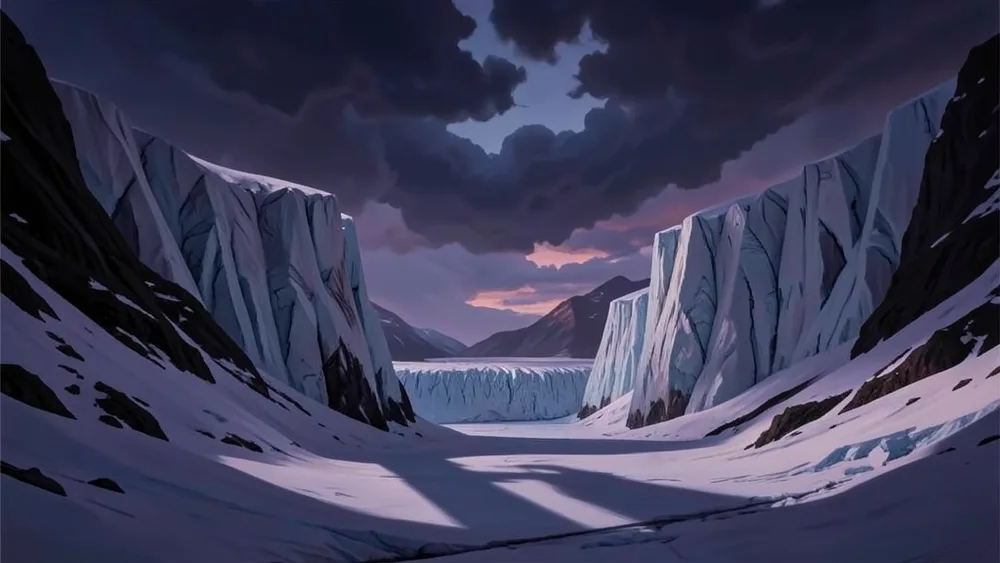
The Arctic waste where Victor chases his creature. Image generated by AI.
The creature’s side of the story
The novel’s middle section belongs to the creature, and it is the most moving part of the book. He describes waking in a forest, learning the moon’s phases, and discovering a family — the De Laceys — through a crack in their cottage wall. In secret he learns their language, gathers their firewood, and comes to love them. When he finally reveals himself, they drive him off in terror.
“I ought to be thy Adam, but I am rather the fallen angel, whom thou drivest from joy for no misdeed,” he tells Victor. He was, by his own account, benevolent at first; rejection taught him cruelty. His demand is modest: build him a companion, another being like himself, and he will disappear with her into the wilderness. Victor agrees, begins the work in the remote Orkney Islands — then destroys the half-finished second creature, unable to bear the thought of a whole race of them.
The retaliation is swift and, within the novel’s logic, inevitable. The creature kills Victor’s closest friend Henry Clerval, then Victor’s bride Elizabeth on their wedding night. Victor’s father dies of grief. Victor pursues the creature across Europe to the Arctic, boards Walton’s ship, and dies there. In the final pages Walton finds the creature weeping over Victor’s body. Declaring his own work done, the creature drifts off into the darkness — “lost in darkness and distance.”
What the book is really about
The subtitle does half the explaining: The Modern Prometheus. Prometheus stole fire from the gods for humanity; Victor steals the fire of creation for himself — but has no plan for what he has lit. Ambition without responsibility is the novel’s engine. The true horror is not that the creature is made of dead matter; it is that his maker abandons him the moment he opens his eyes.
That is why the creature’s story lands so hard. Shelley stacks the deck carefully: he learns kindness before he learns cruelty, and every act of violence follows a rejection. “I was benevolent and good; misery made me a fiend.” The book asks, two centuries early, the nature-versus-nurture question: is the monster made, or is he made monstrous?
Around these ideas Shelley wraps the full apparatus of Romanticism — Alpine storms, Arctic wastes, moonlit forests — nature as a mirror of inner turmoil. And threading through it all is Victor’s warning to Walton, the line the whole novel hangs on: “Learn from me, if not by my precepts, at least by my example, how dangerous is the acquirement of knowledge and how much happier that man is who believes his native town to be the world, than he who aspires to become greater than his nature will allow.”
The Alps, where the creature confronts his maker. Image generated by AI.
Why Frankenstein still matters
The British Library calls Frankenstein sometimes regarded as the first ever science-fiction novel — written decades before the term existed. Every “created thing turns on its creator” story since, from robots to rogue AI, is walking a road Shelley paved.
That is why the book feels more timely than ever. When laboratories edit genes, when companies train systems they cannot fully explain or control, when regulators ask who is responsible for what an invention does in the world — they are asking Victor Frankenstein’s question. Shelley’s answer is unsparing: the sin was not the experiment. It was walking away from it. A creator, the novel insists, owes its creation more than abandonment — a duty of care that outlasts the thrill of discovery.
It is also simply a gripping story, told with unusual narrative daring: letters within a confession within a confession, three narrators handing the tale to one another like a relay torch. For a book written by a teenager in a rainy summer, its confidence is startling — and its warning has never aged a day.
Related reading
If the birth of science fiction interests you, read our story on the writer who put the first T. rex into fiction — another case of imagination running ahead of science.
Frequently asked questions
Is Frankenstein the scientist or the monster?
Frankenstein is Victor Frankenstein, the scientist. His creation is never named in the novel — Shelley calls it “the creature,” “the daemon,” or “the wretch.” Calling the monster “Frankenstein” is a popular mix-up, though an understandable one: the book suggests the creator and his creation share one tangled identity.
Was Frankenstein really written by an eighteen-year-old?
Yes. Mary Shelley conceived the story in the summer of 1816, when she was eighteen, and finished the draft by May 1817. It was published anonymously on 1 January 1818, when she was twenty. The 1831 revised edition carries her name and her own introduction.
Is Frankenstein the first science-fiction novel?
It is often described that way, including by the British Library. Earlier works had fantastical voyages, but Frankenstein was the first major novel to treat a scientific possibility — the artificial creation of life — with psychological realism and to follow its consequences. That formula is the core of science fiction.
Which edition should I read?
Either the 1818 first edition or the revised 1831 edition — both are in the public domain and free to read online. The 1831 text is the more polished and commonly printed; the 1818 text is rawer and closer to the teenage Shelley’s original vision.
Sources
- British Library — “Mary Shelley’s Frankenstein” by Andrew Dickson (publication history, the Villa Diodati summer, the novel’s science-fiction status)
- Encyclopaedia Britannica — Lord Byron biography (the 1816 ghost-story contest, the Year Without a Summer, the 1 January 1818 publication)
- Project Gutenberg — Frankenstein; or, The Modern Prometheus (ebook 84) (full public-domain text; quotations verified against it)
- University of Pennsylvania Online Books Page — Frankenstein edition listing (1818 first edition, 1823 and 1831 revisions)







0 Comments