

An original TeaLamp explainer based on the sources listed below. Prepared by the TeaLamp Editorial Team with the help of AI.
On January 1, 2026, one of the most famous paintings in modern art quietly became free for everyone. The Mondrian public domain milestone arrived with Piet Mondrian’s Composition II with Red, Blue, and Yellow (1930) — 95 years after first publication, confirmed by the calendar, the lawyers, and Duke University’s Center for the Study of the Public Domain. The estate that manages Mondrian’s rights sees it differently, and its warning letter is a small masterclass in how copyright confusion works.
Key takeaways on the Mondrian public domain
- On January 1, 2026, works first published in 1930 entered the US public domain, including Mondrian’s 1930 Composition II with Red, Blue, and Yellow.
- The Mondrian/Holtzman Trust told an art publication the painting is still protected, warning that reproducing it without permission is copyright infringement.
- The Trust’s letter cites invented “dual copyrights” and Spanish law; a copyright lawyer’s analysis calls the argument “more Dada than De Stijl.”
- Under US law, works published before 1978 are protected for 95 years from first publication — a 1930 work’s term ended on December 31, 2025.
- Public Domain Day 2026 also freed Betty Boop, Faulkner’s As I Lay Dying, and “Georgia on My Mind” — and other estates have pushed back on some of those too.
What Public Domain Day actually gives us
Every January 1, a new crop of culture becomes free. Under US copyright law, works published in a given year enter the public domain 95 years later, which is why 2026 opened the gates to everything first published in 1930: Faulkner’s As I Lay Dying, the first four Nancy Drew books, the Marx Brothers’ Animal Crackers, the song “Georgia on My Mind,” sound recordings from 1925 — and paintings by Piet Mondrian and Paul Klee.
Once a work is in the public domain, anyone can copy it, share it, remix it, print it on a tote bag, or build something new from it, without asking permission or paying a fee. That is the whole point of the bargain copyright makes with the public: a limited monopoly for creators, then the work belongs to everyone. Duke’s Center for the Study of the Public Domain publishes a celebrated list each year, and for 2026 it confirmed Mondrian’s painting right on schedule.
The letter from the estate
An art magazine marked the occasion with a Public Domain Day roundup noting that the Mondrian — along with Betty Boop, Faulkner, and The Little Engine That Could — was now free to use and celebrate. Before publishing, it did the responsible thing and contacted the Mondrian/Holtzman Trust to confirm. The Trust’s answer: the painting remains protected in the United States, and reproducing it without permission constitutes infringement.
Mondrian died in New York in 1944 and left his estate to his friend, the artist Harry Holtzman; the Trust is now run by Holtzman’s descendants. The correspondence, shared with the legal writer Aaron Perzanowski by Duke’s Jennifer Jenkins, leans on the Uruguay Round Agreements Act of 1996, which restored US copyright to some foreign works that had lapsed for missing paperwork. So far, the Trust wrote, so good:
“Between 1944 and 1996 the work of Piet Mondrian not meeting the technical requirements of U.S. copyright law, was in public domain in the US. In 1996 the Uruguay Round Agreement Act… gave protection to the images by foreign artists which were first published outside of the United States between 1923 and 1977 (95 years from the date of first publication).”
Then came the turn: “The duration of the U.S. protection for all other works… was for 70 years from the artist’s date of death. This is the reason of the dual copyright’s terms on the works of Piet Mondrian.” The letter then detoured into Spanish law, citing an 1879 statute and a Spanish Supreme Court decision — an unusual choice of authority for a dispute about US copyright in a Dutch painter’s work.
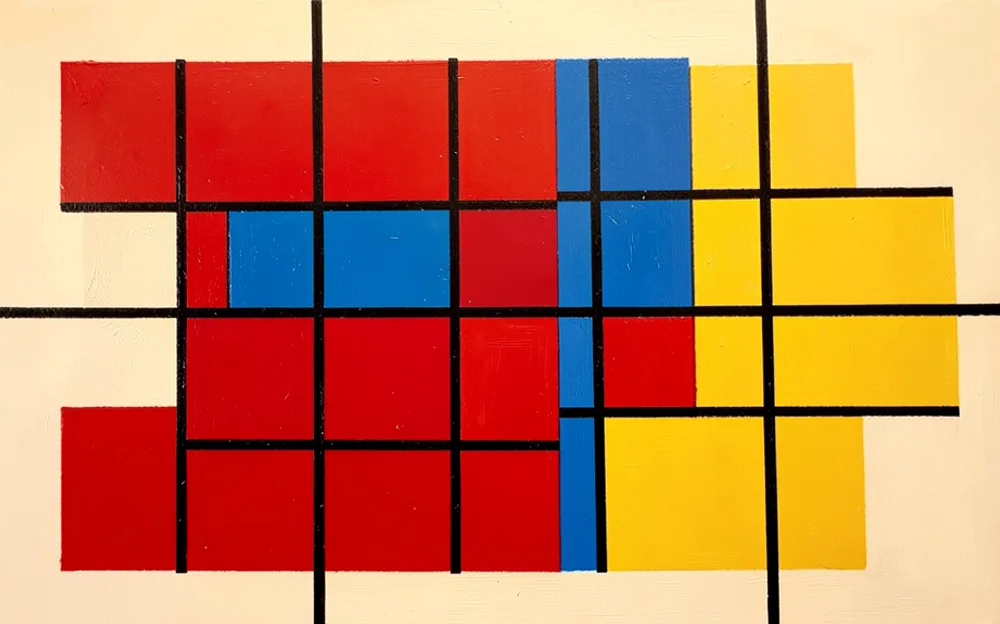
An original homage in the neoplastic style — not the 1930 painting. Image generated by AI.
What the law actually says
There is no such thing as a “dual copyright” regime under US law — no parallel terms running at once, no option to pick whichever lasts longer. Each work falls into one category based on its actual history. For works first published outside the United States between 1923 and 1977, the 1996 restoration law gives the remainder of a 95-year term from first publication. It fills the gap; it does not extend the term. For a work published in 1930, that remainder ran out on December 31, 2025.
And the letter fails even on its own terms. If life-plus-70 applied, Mondrian’s death in 1944 means his works would have entered the public domain on January 1, 2015 — more than a decade ago. As for the Spanish detour: Spanish law governs copyright in Spain, not the United States, and even the Spanish rule the Trust invokes would have freed the works no later than 2025.
The verdict, in plain English: Composition II with Red, Blue, and Yellow is in the US public domain, and has been since January 1, 2026.
Why estates write letters like this
The target here is telling. The art publication was not selling prints or merchandise; it ran an educational article celebrating works entering the public domain, with proper attribution and links to legal resources. For doing its homework, it received a warning letter.
This is a known playbook. From Tintin to Sherlock Holmes to Charlie Chaplin, estates and rightsholders have sent threatening letters citing convoluted theories, counting on recipients to back down rather than fight. Since Public Domain Day 2026, similar claims have surfaced from Fleischer Studios over Betty Boop’s earliest appearances and from representatives of Harold Lloyd’s estate over Safety Last! — a film that entered the public domain more than seven years ago.
The strategy is visible on the Trust’s own website, which invites anyone wishing to reproduce Mondrian’s work to get in touch “so that we can check on the copyright status and clear rights if needed.” The implication: ask permission first. If the rules sound uncertain enough, people keep asking — and as long as people keep asking, licensing fees keep flowing, even after the copyrights have expired. As the Copyright Lately analysis puts it, “confusion is far cheaper than litigation.”
Checking the fine print of copyright law. Image generated by AI.
Why it matters
Copyright’s public bargain only works if the public side is honoured. Every year, Public Domain Day hands teachers, artists, and small creators a fresh set of raw material — and every year, some of it comes with a warning label it does not deserve. The Mondrian episode is worth knowing about not because anyone at TeaLamp is printing posters, but because the mechanism is so ordinary: a confident letter, a complicated theory, and the quiet hope that nobody checks. This time, someone checked.
Related reading
For another story about art history hiding in plain sight, read The Vegetable Lamb of Tartary: A Plant That Grew Sheep.
Frequently asked questions
Is Mondrian’s Composition II really in the public domain?
In the United States, yes. Works first published in 1930 entered the US public domain on January 1, 2026, after a 95-year term — confirmed by Duke University’s Center for the Study of the Public Domain. Copyright terms differ by country, so the status elsewhere may vary.
What did the Mondrian estate claim?
The Mondrian/Holtzman Trust told an art publication that the 1930 painting remains protected in the US and warned that reproducing it without permission is infringement, citing invented “dual copyrights” and Spanish law.
What does “public domain” let me do with the painting?
In the US, anyone may now copy, share, remix, and build upon the 1930 work without permission or payment — print it, teach with it, or adapt it into something new.
What else entered the public domain in 2026?
Alongside Mondrian’s paintings: Betty Boop’s earliest cartoons, Faulkner’s As I Lay Dying, the first Nancy Drew books, “Georgia on My Mind,” and sound recordings from 1925, among thousands of other 1930 works.
Sources
- Mondrian Entered the Public Domain. The Estate Disagrees. — Copyright Lately, January 19, 2026 (legal analysis quoting the Trust’s letter)
- Public Domain Day 2026 — Duke Law Center for the Study of the Public Domain (confirms the 1930 entry date)
- Reproduction rights — the Mondrian/Holtzman Trust’s own page (its “ask permission first” position)
- Public Domain Day 2026 roundup — artnet (coverage of the year’s newly free works)










0 Comments