

Originally published by Richard Fallon in The Public Domain Review on June 17, 2026, under a Creative Commons licence (CC BY-SA 4.0). Adapted here under that licence; this article text is published under the same CC BY-SA 4.0 terms. The Public Domain Review and the author are not contributors to TeaLamp and do not endorse it or its use of their work. Changes: condensed and restructured with TeaLamp Key takeaways, Why it matters, FAQ and related reading; section headings rewritten; footnotes omitted; period illustrations reused from the source essay where public-domain status is clear. Prepared by the TeaLamp Editorial Team with the help of AI.
Key takeaways on Louis Pope Gratacap and lost world fiction
- Louis Pope Gratacap, longtime mineralogy curator at the American Museum of Natural History, wrote The New Northland (1915) as a knowing fan of lost-world adventure novels.
- The book is arguably the first fiction to feature a Tyrannosaurus — years before Edgar Rice Burroughs and months before the museum unveiled its first mounted T. rex.
- Gratacap stuffed the story with literary name-drops, yellow-journalism framing and cutting-edge polar science tied to the real Crocker Land Expedition.
- Albert Operti’s illustrations often miss the dinosaur’s anatomy; the novel’s racial ideas also show the period’s ugly museum culture.
- Fallon’s essay recovers a curator-novelist who treated myth, geology and pulp romance as one playground.
Lost-world novels thrived from the 1880s to the 1920s by dressing breathless adventure as documentary fact. Richard Fallon, writing for The Public Domain Review, recovers a late, odd entry that may be the first T. Rex in fiction: The New Northland (1915) by Louis Pope Gratacap — museum curator by day, compulsive reader and novelist by commute. The book mixes polar science, pulp metafiction and a museum desk view of dinosaurs still new to science.
A curator who wrote lost world fiction
Born in Brooklyn in 1851, Gratacap trained in geology and joined the newly opened American Museum of Natural History in 1876. By 1880 he was assistant curator of mineralogy; he stayed until his death in 1917, arranging gifts such as the Bement mineral and Tiffany gem collections so researchers and tourists could actually see them. Contemporaries called him “preëminently a curator.”
That care for display did not stop him writing. Catalogues, primers, pamphlets and novels poured out, including ice-age romance and speculative city fiction. He kept diaries of cultural wandering and, living on Staten Island, spent a three-hour daily round trip reading his way to the museum.
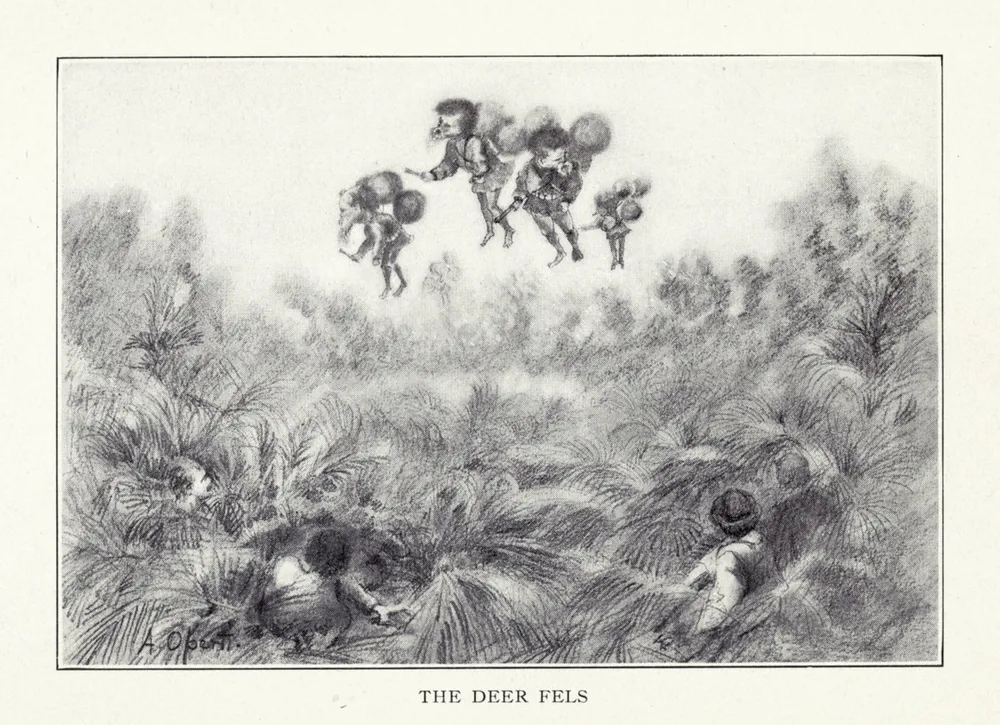
“The Deer Fels,” illustration by Albert Operti for L. P. Gratacap’s The New Northland (1915). Public domain. Source: The Public Domain Review.
Krocker Land and the first T. Rex in fiction
The New Northland sends Americo-Nordic adventurers from Alaska into a warm Arctic realm called Krocker Land — a barely disguised Crocker Land, the phantom mass Robert Peary claimed to have sighted in 1906. There they find prehistoric animals, lush valleys and a decaying “Radiumite” civilisation that turns base matter into gold with radium. The novel never lets you forget Gratacap’s reading list: Conan Doyle’s The Lost World, De Mille’s copper-cylinder manuscript, Doré’s Dante, Johnson’s Happy Valley and a comic catalogue of travellers from Sinbad to Gulliver.
A “yellow” journalist named Azaziel Link frames the tale as already serialised in the New York Truth Getter. Characters joke about copyright riches and movie rights — ten years before Doyle’s novel reached the screen. The knowingness sometimes breaks the documentary spell: an “Editorial Apology” admits Link rewrote Erickson’s words for literary effect.
Image generated by AI
What Gratacap could offer that Haggard and Doyle could not was museum science. The American Museum sponsored Donald MacMillan’s Crocker Land Expedition; neither that team nor Stefansson’s Canadian expedition had returned when the novel appeared in 1915. Gratacap fictionally “confirms” Peary’s land and even stages a news-desk panic when telegrams claim MacMillan and Stefansson have arrived. Reality was grimmer: Crocker Land was a mirage, and the expedition archive records violence against an Inuk guide that never faced legal action.
Inside the museum, Henry Fairfield Osborn — white-supremacist palaeontologist and AMNH president — had named Tyrannosaurus rex in 1905. Gratacap’s explorers meet a “tyrannosaurus or something like it” of the Cretaceous, dubbed the Crocodilo-Python. Operti’s drawings barely match the anatomy; the first mounted T. rex at the museum would not open until December 1915. Still, Fallon argues the novel is arguably the first fiction to feature the dinosaur, ahead of Burroughs’s The Land That Time Forgot (1918).
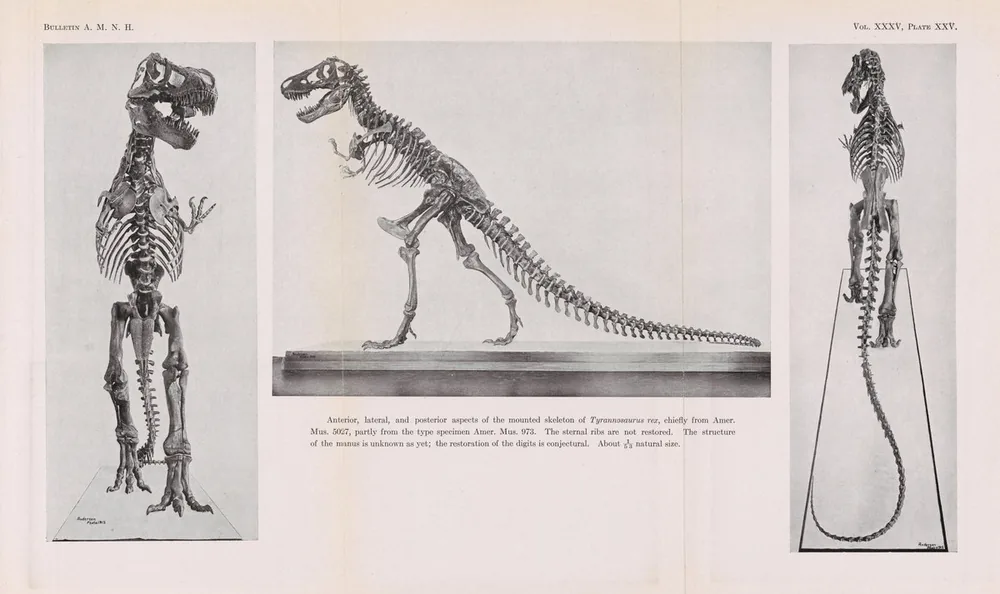
Mounted Tyrannosaurus rex skeleton views from the 1916 Bulletin of the American Museum of Natural History. Public domain. Source: The Public Domain Review.
Fallon also notes how Gratacap folds Genesis and geology together: the serpentine “Crocodilo-Python” echoes Eden’s snake and World-Tree dragons, as if sin and sauropsida could share one valley. That comparative-myth tangle is clumsy, but it shows a curator who refused to keep specialisms in separate drawers.
Why it matters
Gratacap’s book is long, didactic and tangled with period racism toward Inuit characters and “degenerate” civilisations — a reminder that natural-history museums were never neutral stages. Yet as literary history it shows how a working curator folded live polar science, comparative myth and pulp metafiction into one overstuffed romance. For readers of adventure fiction and museum culture, Fallon’s essay restores a missing link between the display case and the lost-world bookshelf.
Related reading
For another TeaLamp piece on buried texts and scientific recovery, see Herculaneum Scrolls: How Lead Ink Could Unlock Buried Texts.
Frequently asked questions
Was Crocker Land real?
No. Peary’s 1906 sighting was not confirmed; later expeditions found no such land mass north of Ellesmere Island.
Is The New Northland the first T. rex in fiction?
Fallon says it is arguably the first, appearing in 1915 — before Burroughs (1918) and before the AMNH’s first mounted skeleton went on public view later that same year.
Can I read the novel for free?
Yes. The 1915 text is in the public domain; The Public Domain Review links Internet Archive and Project Gutenberg copies.









0 Comments