

Key takeaways
- Physicist Kostya Trachenko showed that how runny a liquid can possibly be is set by a handful of fundamental physical constants.
- Living cells need viscosity and diffusion to sit inside a “bio-friendly window” so nutrients, waste and chemical signals can move in and between cells.
- This constraint is formally independent of the classic stellar fine-tuning: a universe could make stars, planets and oxygen, yet have liquids as thick as tar.
- The result is theoretical work published in 2023, extended to blood in 2025, that resurfaced in headlines this October — it is not a new October 2026 paper.
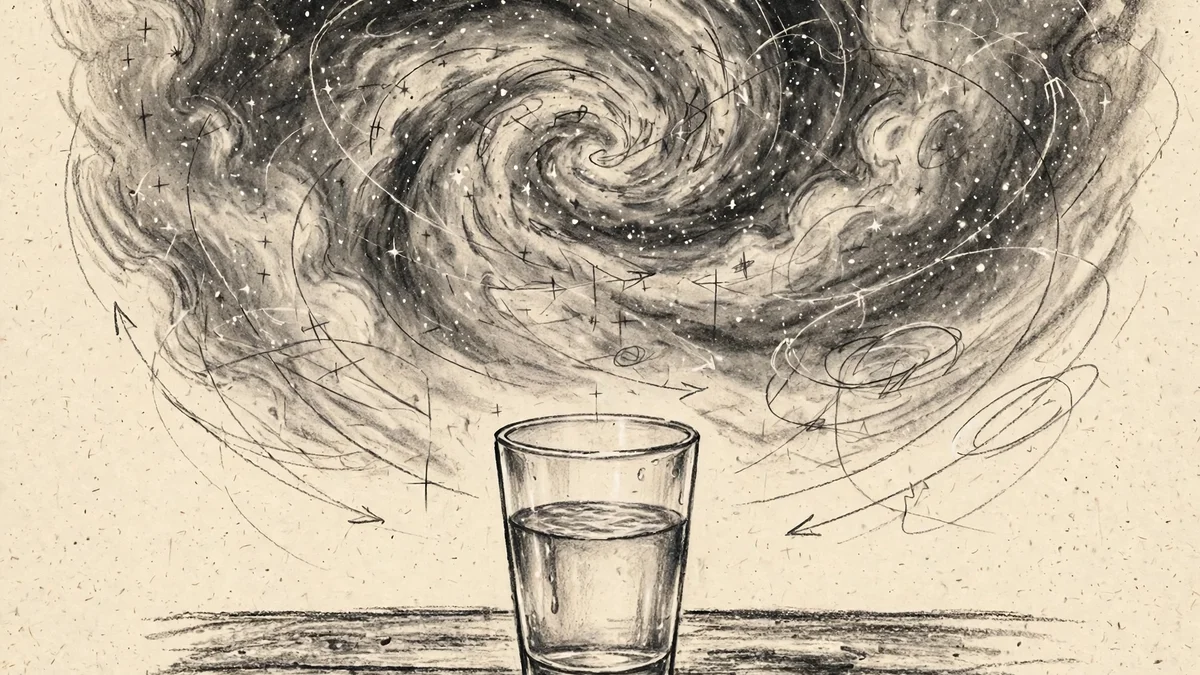
The fine-tuned universe is one of the most intriguing ideas in modern physics: the suggestion that a few fundamental numbers of nature seem oddly well suited to the existence of life. This month, headlines revived one of the most concrete pieces of this puzzle, and it fits in a drinking glass. The physics at the centre of the story is not new — it comes from a 2023 paper by Kostya Trachenko of Queen Mary University of London, and a 2025 follow-up — but it resurfaced in the press this October, which is why readers are seeing it now.
Why runny matters for life
Life, at the cellular level, is a logistics operation. Nutrients have to arrive, waste has to leave, and chemical signals have to travel from cell to cell. All of that movement depends on two properties of liquids: viscosity (how thick they are) and diffusion (how easily molecules spread through them). If water were as thick as tar, nothing inside a cell could get anywhere, and biology as we know it would stop.
Trachenko’s insight was to ask a question that sounds almost childlike: how thin can a liquid get? In 2020, working with Valentina Brazhkin, he showed that there is a universal lower limit to viscosity. Measured across wildly different fluids — water, liquid helium, mercury, molten metals — the minimum viscosity clusters in a narrow band, roughly 10-4 to 10-5 pascal-seconds, regardless of the liquid’s molecular details. The thinnest a liquid can be is not a matter of chemistry. It is a matter of fundamental physics.
The constants that set the limit
The formula for that universal minimum contains only three things: the Planck constant, the mass of the electron and the mass of the proton. The reasoning, stripped of mathematics, goes like this. To work out how freely particles in a liquid can move, you need a typical spacing between them and a typical energy holding them together. The Bohr radius sets the spacing and the Rydberg energy sets the bond strength — and both are fixed by fundamental constants, not by molecular details. So the allowed range of liquid thickness is, at bottom, quantum-mechanical.
The 2023 paper went further. Trachenko showed that the bounds on viscosity, and the related bounds on diffusion, are set by four constants: the Planck constant, the electron mass, the proton mass and the electron charge. For life to have a workable “bio-friendly window”, the analysis says the Planck constant must be large enough while the electron and proton masses and the electron charge must be small enough, with the other constants held fixed. Shift them the wrong way and the window closes.
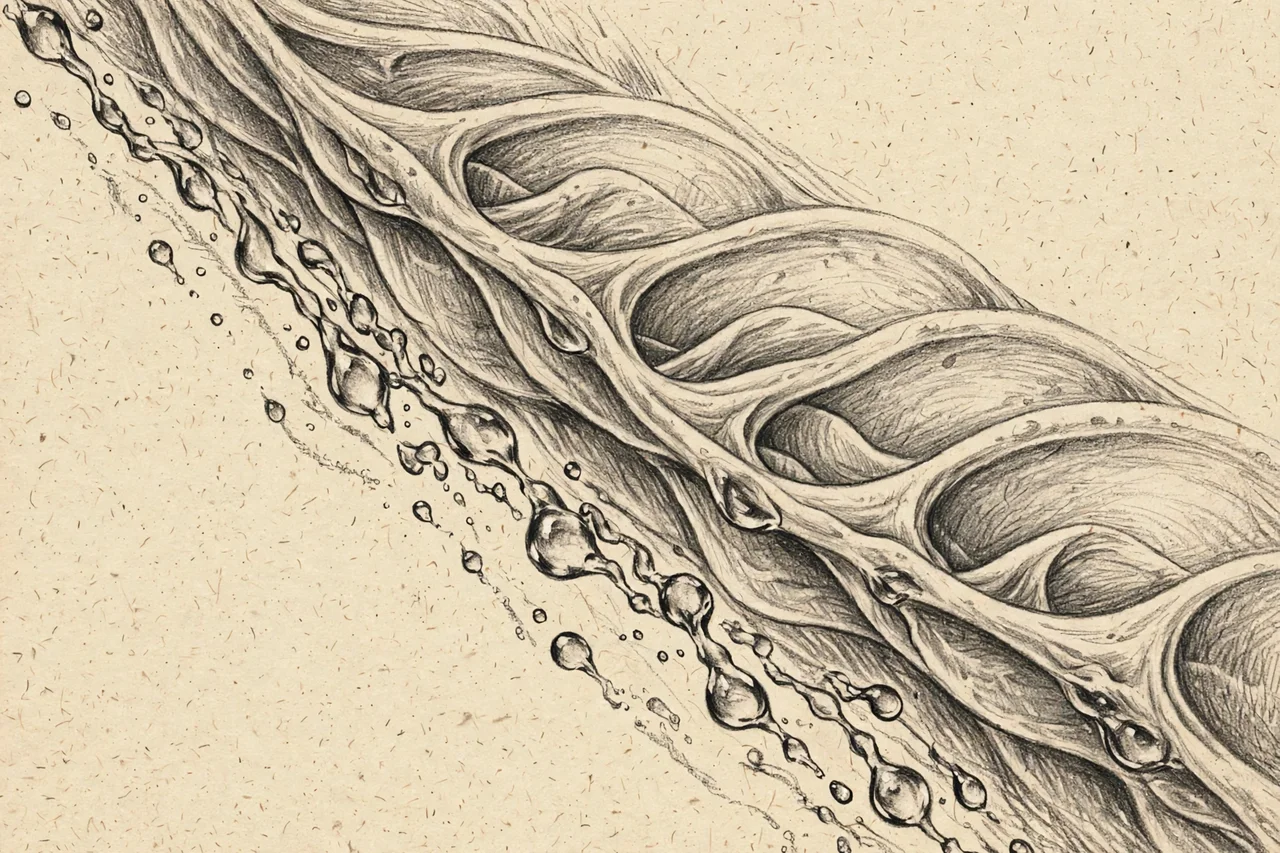
Water must stay thin enough for nutrients and signals to move through cells – a property fundamental physics may dictate. Image generated by AI.
Blood runs close to the quantum limit
The follow-up paper, published in January 2025 with Pietro Tello, Stuart Kauffman and Sauro Succi, tested whether this abstract result survives contact with something as messy as blood. Blood is a complicated fluid: red blood cells, clustering, collective flows. Yet its measured viscosity sits surprisingly close, on a fundamental scale, to the value derived from the physical constants alone. The authors’ proposed explanation is that the forces acting where cells touch work over molecular, quantum-scale distances.
Trachenko put the stakes in plain words in the press materials for the work: a change of only a few per cent in some fundamental constants, such as the Planck constant or the electron charge, would make blood viscosity too thick or too thin for the body to function. In his own framing, if water were as viscous as tar, “life would not exist in its current form or not exist at all.”
Tuned twice: the fine-tuned universe
This is where the fine-tuned universe angle enters. The classic fine-tuning argument is about stars. Constants like the fine-structure constant and the proton-to-electron mass ratio govern nuclear reactions in stellar cores, including the processes that forge carbon and oxygen. Shift those constants slightly, and the story goes, there would be no stars, no heavy elements, no planets and no life.
Trachenko’s striking finding is that the viscosity and diffusion bounds can be shifted while keeping the fine-structure constant and the proton-to-electron mass ratio intact. In plain terms: the constants that decide how runny liquids can be can be changed without disturbing the nuclear physics that lets stars make heavy elements. So a universe could pass the stellar test — stars, planets, carbon, oxygen — and still fail the biology test, with oceans of tar instead of water.
The constants appear tuned twice, he argued: once for matter and once for motion. He even conjectured, explicitly as speculation, that nature might show “multiple tuning” — independent useful constraints acquired separately, drawing a loose analogy with biological evolution, where separate traits accumulate because each is useful on its own. The paper itself draws no metaphysical conclusions. It does not say the universe was designed, and it does not claim life requires exactly our constants — only that the viscosity requirement narrows the life-permitting range in a way that is independent of the stellar one.
Related reading: Life on Mars, Explained: Ancient Molecules, New Clues — what chemistry on another world tells us about the narrow conditions life needs.
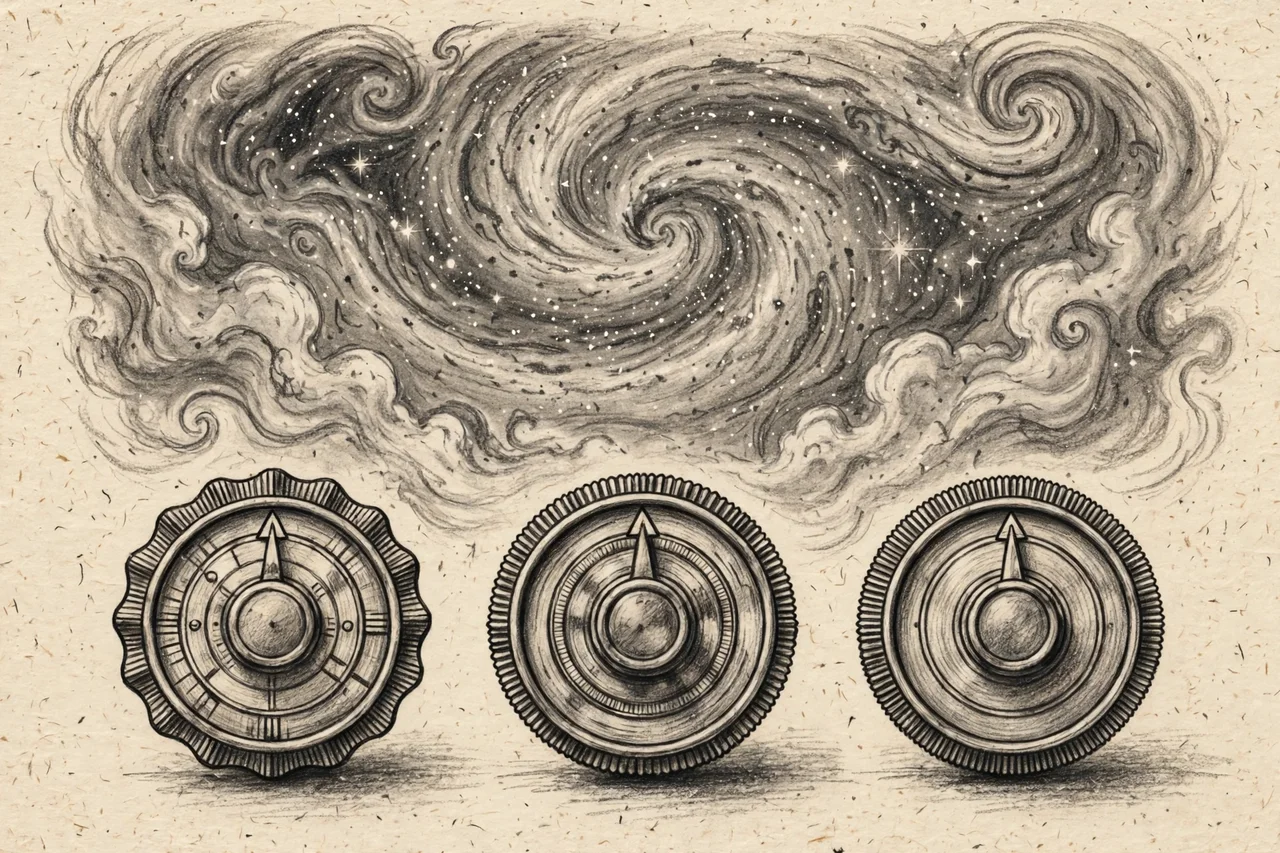
The universe’s fundamental constants work like tuning dials: nudge them and the bio-friendly window for liquids closes. Image generated by AI.
Why it matters
Fine-tuning debates often stay abstract, trading in universes we can never visit. What is unusual about this result is that it anchors the argument in a kitchen glass. Viscosity is a property anyone can feel, and the claim is precise enough to be checked against measurements: the minima across real fluids really do cluster in a narrow band, and blood really does sit close to the fundamental value. At the same time, the caveats are real. These predictions come from theoretical models, not from experiments in which anyone changed the constants, and the exact width of the bio-friendly window remains uncertain. No published scientific rebuttal of the 2023 paper has appeared, though how to interpret fine-tuning in general remains contested in the philosophy of science. The October 2026 headlines are renewed press attention, not a new experiment — but the physics underneath is worth a second look.
Frequently asked questions
Does this prove the universe was designed for life?
No. The 2023 paper draws no metaphysical conclusions. It identifies an additional physical constraint on the constants that permit life and shows it is independent of the stellar constraint. Whether that is explained by a multiverse, by observational selection, by some deeper principle, or by nothing at all is outside the paper’s scope.
Could scientists ever test this?
Not directly. Nobody can dial the fundamental constants up or down. The checkable parts are the theoretical predictions themselves: the universal viscosity minimum across real fluids, and the position of blood’s viscosity relative to the fundamental value. Both match the measurements available.
Why is this in the news now?
A Queen Mary press item released on October 9, 2026 re-announced the 2023 paper and the January 2025 follow-up, and explainers of the result have been circulating widely on social media since. The physics itself dates to 2023 and 2025.
Who was Kostya Trachenko?
Kostya Trachenko was a physicist at Queen Mary University of London who studied how fundamental physics shapes the properties of liquids; his work on viscosity was a Physics World Top 10 Breakthrough of 2020. He died in 2025, aged 54. The findings described here come from his published papers.
Sources
- K. Trachenko, “Constraints on fundamental physical constants from bio-friendly viscosity and diffusion”, Science Advances 9(34), eadh9024 (2023). Full text (CC BY) · arXiv abstract
- K. Trachenko, P. G. Tello, S. A. Kauffman and S. Succi, “Extrinsic and intrinsic effects setting viscosity in complex fluids and life processes: the role of fundamental physical constants”, European Physical Journal E 48:2 (2025). Full text (PDF)
- Queen Mary University of London press item, re-released October 9, 2026: “Scientists make stunning discovery that could help explain why life exists”
- Physics World (2020): “Fluids only get so runny, as physicists put a universal lower limit on viscosity”
- European Physical Society obituary for Kostya Trachenko: hal.science/hal-05337414v1










0 Comments