

Originally published by Lindsey Doermann for NASA Earth Observatory on October 5, 2026. Public-domain text; adapted for TeaLamp by the TeaLamp Editorial Team with the help of AI. Changes: rewritten and restructured for a general audience; the satellite and astronaut photographs replaced with AI-generated illustrations; “Key takeaways” and FAQ sections added; intro sentence lightly reworded (2026-10-11).
Key takeaways on Madagascar’s moon rocks
- An astronaut’s photograph shows a bright, round rock formation in southern Madagascar that looks like it belongs on the Moon.
- The pale rock is anorthosite, the same igneous rock that forms the bright highlands of the Moon’s surface.
- The Saririaky massif formed at least 600 million years ago, and its visible outcrop covers about 100 square kilometres.
- Its twisted surroundings record the collision of continents that built the supercontinent Gondwana.
From the window of the International Space Station, a patch of southern Madagascar looks out of place, like a field of moon rocks set down on Earth. It is a bright, almost circular lens of pale rock set among darker, banded terrain, the kind of landscape you would expect to see on the Moon, not on Earth. An astronaut photographed it on August 28, 2026, and the picture became NASA Earth Observatory’s image of the day. The pale rock has a name, anorthosite. It is moon rock, the same rock that makes the Moon’s bright highlands shine.
Moon rocks in Madagascar
The photograph, catalogued as ISS075-E-85249, was taken by a member of the Expedition 75 crew with a Nikon Z9 camera and a 400-millimetre lens. It shows the Saririaky anorthosite massif, a body of intrusive igneous rock in the arid south of Madagascar. “Intrusive” means it formed underground, from magma that cooled slowly beneath the surface, growing the large mineral crystals that give anorthosite its distinctive pale, reflective look.
The same brightness that makes the massif stand out in the photo is what makes anorthosite visible on the Moon with the naked eye. Look up at a full Moon and the light-coloured, highly reflective regions are the lunar highlands, and the lunar highlands are anorthosite.
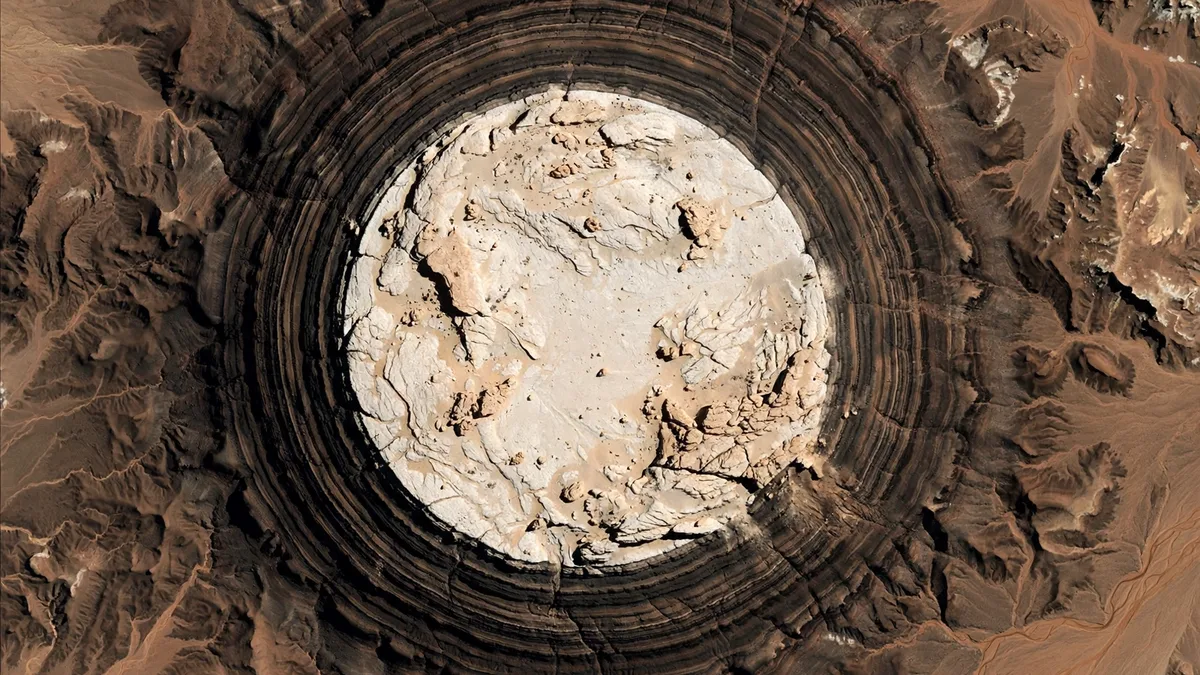
The Saririaky massif seen from above: a bright lens of pale rock amid darker terrain. Image generated by AI.
What exactly is anorthosite?
Anorthosite is a rock made almost entirely of a single mineral family, plagioclase feldspar, crystallised out of cooling magma in large interlocking grains. On the Moon, anorthosites are ancient, more than four billion years old. They crystallised from a global ocean of magma that covered the young Moon and floated to the top to form its outer crust, like slag rising on molten metal.
Apollo astronauts brought samples of that crust back to Earth, but the supply is limited and precious. So planetary scientists also study anorthosite where it crops up on our own planet. It appears in a handful of places: eastern Canada, Scandinavia, southern India, Madagascar, and the Beartooth Mountains of Montana. The Montana rocks, researchers have found, match the composition of the lunar version particularly well, making them one of the best stand-ins for Moon rock anywhere on Earth.
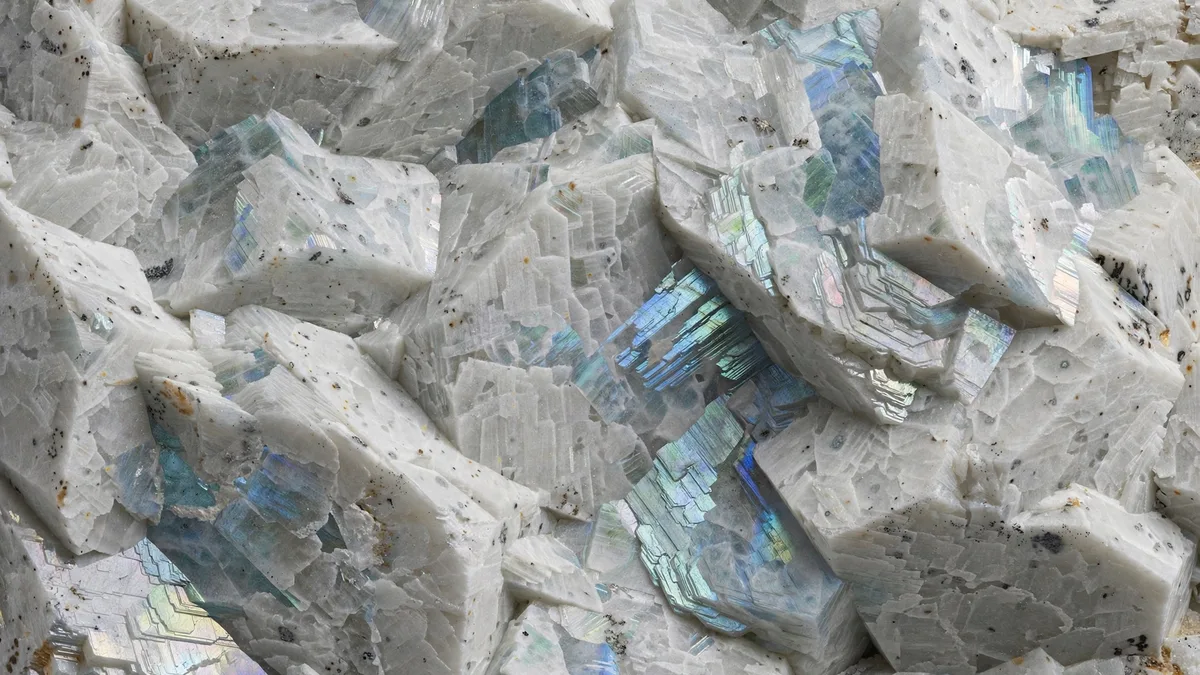
Anorthosite is built from large crystals of plagioclase feldspar. Image generated by AI.
Six hundred million years in the making
The Saririaky massif is old, but not Moon-old. Geologists think it formed in the late Precambrian, at least 600 million years ago, and its present-day outcrop covers roughly 100 square kilometres. What makes the astronaut’s photograph so striking is not just the bright rock but the contorted dark rock around it.
The massif sits inside a ductile shear zone, a region where immense pressure and heat bent and stretched the rock like toffee, imprinting the north-south streaks visible from orbit. That deformation happened when the pieces of what are now Africa, India, Madagascar, Australia and Antarctica were grinding together to assemble the supercontinent Gondwana. Some geologists think a second anorthosite massif, about 60 kilometres to the north, was once part of the same body and was pulled apart during that collision, a structure geologists call boudinage.
Why it matters
Pictures like this one do quiet double duty. They are beautiful, and they are useful. Every Apollo sample is irreplaceable, so each terrestrial anorthosite outcrop is a laboratory where scientists can test ideas about how the Moon’s crust formed, how magma oceans behave, and how the earliest chapters of planetary history were written. A photograph taken from 400 kilometres up, of a rock 600 million years old, is helping us read the story of a world 384,000 kilometres away.
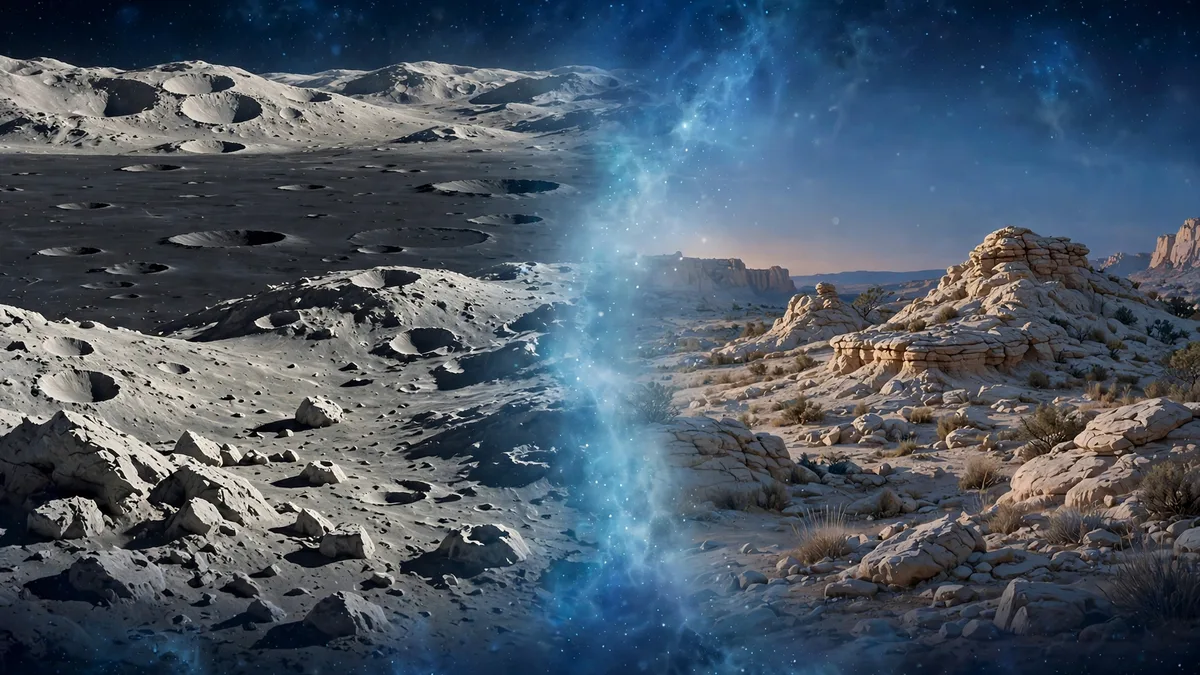
The Moon’s bright highlands and Madagascar’s massif are made of the same rock. Image generated by AI.
Related reading
Another Earth Observatory view of our planet from above: The Forested Floodplains of Congaree National Park.
Frequently asked questions
Is it really the same rock as on the Moon?
Yes, in the ways that count. Both are anorthosite, an igneous rock dominated by plagioclase feldspar. The Moon’s version is far older, over four billion years, while Madagascar’s formed at least 600 million years ago, but their composition is closely comparable.
Where else on Earth can you find anorthosite?
Eastern Canada, Scandinavia, southern India, Madagascar, and Montana’s Beartooth Mountains, whose rocks match the lunar composition especially well.
How was the photograph taken?
By an astronaut aboard the International Space Station on August 28, 2026, using a Nikon Z9 with a 400-millimetre lens. The image was cropped and contrast-enhanced by NASA’s Earth Science and Remote Sensing Unit.
Can I visit the Saririaky massif?
In principle, yes, though it sits in a remote, arid part of southern Madagascar. Most of us will have to settle for the view from orbit.










0 Comments