


Key takeaways on optogenetics
- Optogenetics uses light to switch individual brain cells on or off with millisecond precision.
- It began with a light-sensitive protein found in pond algae, channelrhodopsin, and grew into a tool that controls neurons in living brains.
- Karl Deisseroth, Peter Hegemann and Georg Nagel won the 2026 Nobel Prize in Physiology or Medicine for making it possible.
- The technique has already helped partially restore vision in a blind patient and is being explored for depression, Parkinson’s disease and better cochlear implants.
On October 5, 2026, the Nobel Prize in Physiology or Medicine went to three scientists who gave neuroscience something it had always dreamed of: a remote control for the brain. Optogenetics lets researchers turn individual nerve cells on and off with flashes of light. Here is what it is, how it works, and why it matters.
A light switch for the brain
Your brain contains about 86 billion nerve cells, or neurons. For over a century, scientists could listen to these cells with electrodes or watch them with brain scans, but they could not easily test what a specific group of cells actually does. Optogenetics changed that. Scientists first add a gene for a light-sensitive protein to a chosen set of neurons. Then they shine light of a specific color onto those cells, usually through a thin optical fiber. The light opens the protein like a gate, and the neuron either fires or falls silent. The result is cause and effect: flash the light, and you can see exactly what changes when those neurons are switched on or off.
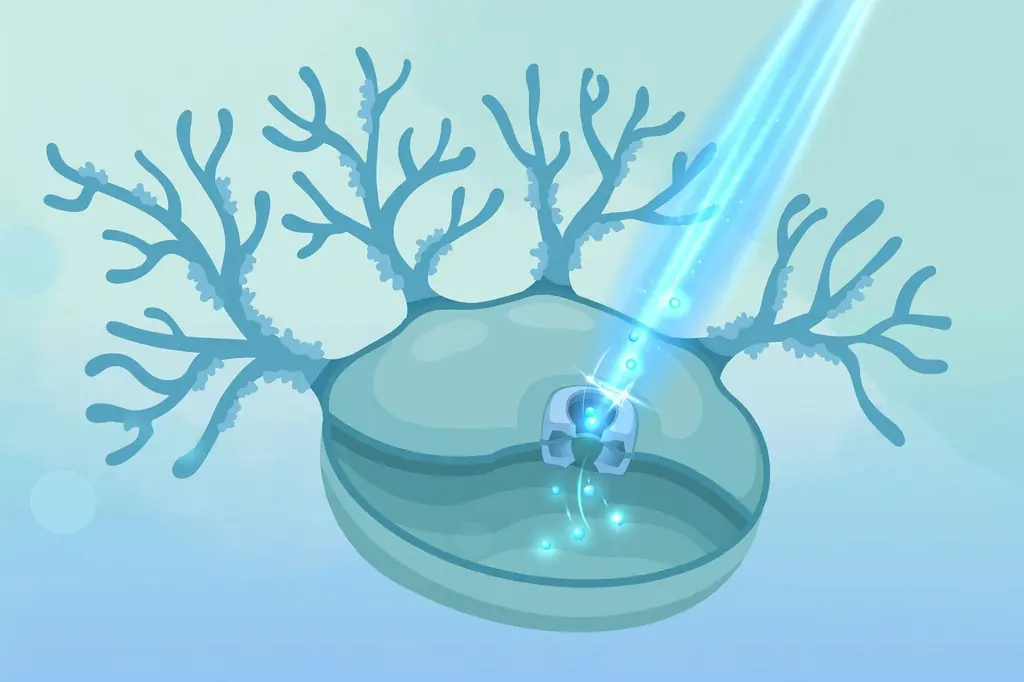
Blue light opens channelrhodopsin, a gate in the neuron’s outer wall. Image generated by AI.
The Nobel story: from pond algae to living brains
The protein that swims toward light
The story starts in the 1990s with Peter Hegemann, then at the Max Planck Institute for Biochemistry in Germany. He wanted to know how Chlamydomonas, a single-celled green alga, swims toward light. The answer turned out to be channelrhodopsin, a protein in the alga’s membrane that opens a channel for ions when struck by light. In the 2000s, Hegemann teamed up with Georg Nagel, then at the Max Planck Institute for Biophysics in Frankfurt. Together they showed that this light-sensitive gate works in almost any cell it is placed into: put the protein in, and the cell becomes light-sensitive.
From a dish of rat neurons to a living mouse brain
Karl Deisseroth at Stanford University saw the bigger picture. He put the gene for channelrhodopsin into nerve cells from rats. When he shone blue light on them, the neurons fired. That 2005 result was the proof of concept. Deisseroth then made the switch work inside the brains of living mice, delivering light through hair-thin optical fibers. The technique got a name: optogenetics, from “opto” (light) and “genetics” (the genes that make cells light-sensitive).
How it works, in plain terms
Switching neurons on
Think of channelrhodopsin as a gate in the neuron’s outer wall. Normally the gate is closed. A pulse of blue light flips it open, positively charged ions rush in, and the neuron fires an electrical signal. Turn the light off and the gate closes within milliseconds. Because the gene is delivered only to chosen cells, the light affects exactly the neurons the scientist wants, leaving the neighbors untouched.
Switching neurons off
An on-switch is only half the toolkit. A second protein, halorhodopsin, works as an off-switch: yellow light pumps negatively charged chloride ions into the cell, which quiets the neuron. With the two proteins in different cells, researchers can play the brain like an instrument, activating one circuit with blue light while silencing another with yellow.
What light has revealed about the brain
Before optogenetics, brain research was mostly observation. Scientists could see which regions were active during a behavior, but not prove those regions caused it. Light changed the question from “what is active?” to “what happens if I switch this off?” In one striking demonstration, researchers woke sleeping mice by activating the right neurons with light. The method has since been used to map the circuits behind memory, fear, reward, thirst, social behavior and sleep, and to study what goes wrong in depression, anxiety, schizophrenia, Parkinson’s and Alzheimer’s disease.
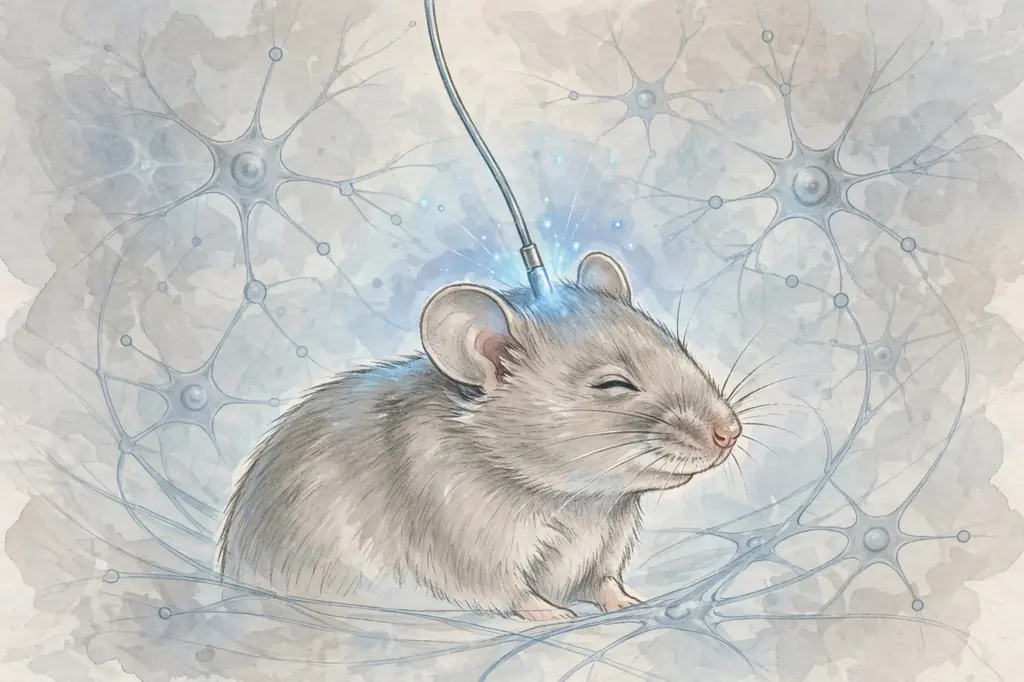
In living animals, light reaches the brain through a hair-thin optical fiber. Image generated by AI.
From the lab bench to the clinic
Restoring sight
The most dramatic human result so far involves vision. In 2021, an international team led by José-Alain Sahel and Botond Roska reported in Nature Medicine that a 58-year-old man, blind for decades from retinitis pigmentosa, had partially regained visual function. A harmless virus delivered the gene for a light-sensitive protein called ChrimsonR into his retinal cells, and special goggles projected amplified light pulses onto the retina. With the treated eye and the goggles, the patient could perceive, locate, count and touch objects. It was the first reported case of partial visual recovery in a neurodegenerative disease after optogenetic therapy.
What might come next
Researchers are exploring optical cochlear implants that would stimulate the auditory nerve with light far more precisely than today’s electrical implants, and clinical trials are underway. Farther out, scientists talk about light-based treatments for Parkinson’s disease and some forms of epilepsy. All of these require genetic modification of cells, which is why progress in people has been slower than in mice.
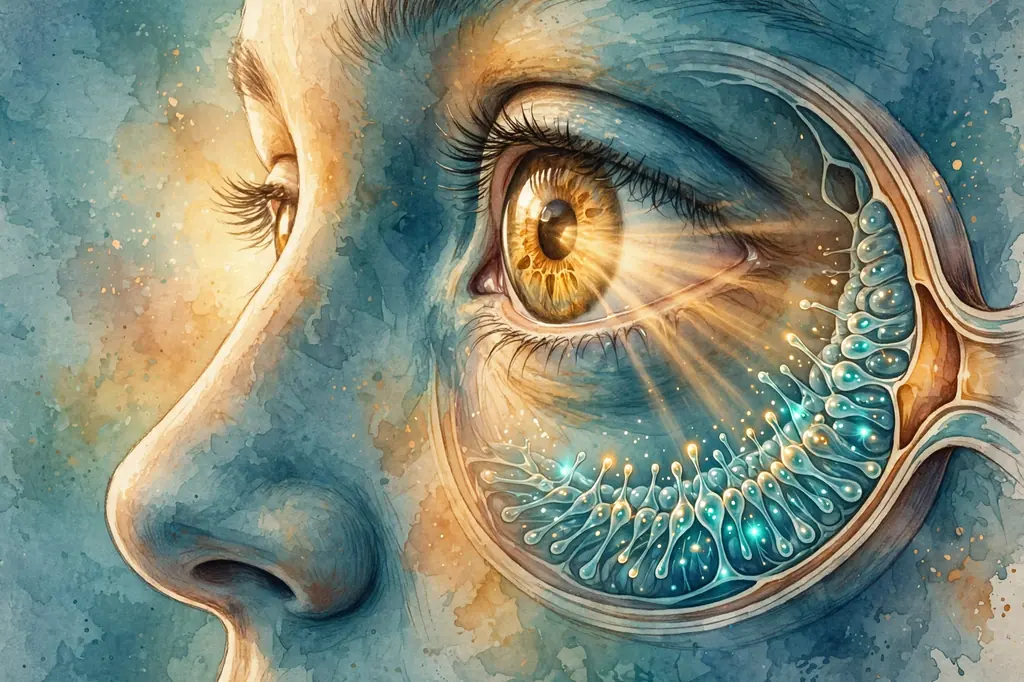
Light-amplifying goggles are part of optogenetic vision therapy. Image generated by AI.
Why it matters
Optogenetics earned the Nobel Prize because it gave neuroscience something rare: a way to test ideas directly. Instead of guessing what a brain region does, scientists can now flip its cells on and off and watch what changes. That precision is slowly turning a research tool into medicine, one flash of light at a time.
Related reading
For another tour of the neuroscience of the brain, see The Science of Making Good Decisions.
Frequently asked questions
What does “optogenetics” mean?
“Opto” refers to light and “genetics” to the genes that make specific cells sensitive to it. Together: controlling cells with light through introduced genes.
Can optogenetics be used to control people’s minds?
No. It requires genetically modifying the target cells and delivering light directly to them, usually through an implanted fiber. It is a laboratory research tool, not mind control.
Who won the 2026 Nobel Prize for optogenetics?
Karl Deisseroth of Stanford University (USA), Peter Hegemann of Humboldt University in Berlin (Germany) and Georg Nagel of the University of Würzburg (Germany), “for their discoveries concerning light-gated ion channels and optogenetics.”
Is optogenetics used in human medicine yet?
Only in limited trials. The furthest advance is the partial restoration of vision in a blind patient with retinitis pigmentosa, reported in 2021. Wider use still depends on making genetic delivery safe and reliable in people.
Sources
- Nobel Prize press release, October 5, 2026: nobelprize.org/prizes/medicine/2026/press-release
- Nature live coverage of the 2026 medicine Nobel: nature.com/articles/d41586-026-03091-2
- New Scientist on the optogenetics Nobel: newscientist.com
- MIT Technology Review, “Light Switches for Neurons” (channelrhodopsin/halorhodopsin mechanism): technologyreview.com
- Edward S. Boyden, “Optogenetics: Using Light to Control the Brain”: synthneuro.org
- Review of optogenetic opsins (PMC): pmc.ncbi.nlm.nih.gov
- GenSight vision trial reported in Nature Medicine (2021): fiercebiotech.com
- Institute of Molecular and Clinical Ophthalmology Basel press release (PDF): iob.ch










0 Comments