


Originally published by Camilo José Pecha Garzón in the IDB Blog on June 22, 2026, under a Creative Commons licence (CC BY 4.0) (the page states “Copyright © 2026 Inter-American Development Bank (IDB). This work is subject to the Creative Commons Attribution 4.0 International Public License CC BY 4.0”). Republished here under that licence. The IDB and its Board of Directors are not contributors to TeaLamp and do not endorse it or its use of this work; the opinions expressed are those of the author. This article asks whether Belize after the rebound can reach long-term growth. Changes: formatting, the closing copyright and report-link lines removed, the two IDB charts reused, an AI-generated illustration and a short “Key takeaways” section added by TeaLamp; the IDB photo was not used. Prepared for TeaLamp by the TeaLamp Editorial Team with the help of AI.
- Belize recorded one of the region’s strongest post-pandemic rebounds, growing by nearly 8% a year between 2021 and 2024 as tourism, agricultural exports, and outsourced business services expanded.
- But sustaining that rebound will require higher productivity, stronger firms, better access to finance and skills, and greater economic opportunities for women, according to an IDB study.
- Indeed, Belize has strong assets, from natural capital and a strategic location to an English-speaking workforce and entrepreneurial dynamism, that could underpin long-term development if matched by stronger infrastructure, human capital, and institutions.
Few countries in Latin America and the Caribbean emerged from the pandemic with such a strong recovery as Belize. Between 2021 and 2024, the economy expanded at an average annual rate close to 8%, supported by the rapid rebound of tourism, stronger agricultural exports, and the expansion of outsourced business services. Poverty and unemployment fell sharply, while public debt declined from the extraordinary levels reached during the pandemic.
The harder question is whether Belize can turn that recovery into sustained, resilient, and inclusive growth, according to our latest BIDeconomics report, Landscape of Opportunities: Belize. This question matters because much of the recent expansion reflects cyclical recovery rather than a deeper transformation of the economy. As the rebound effect fades, growth is expected to slow significantly in the coming years (Figure 1).
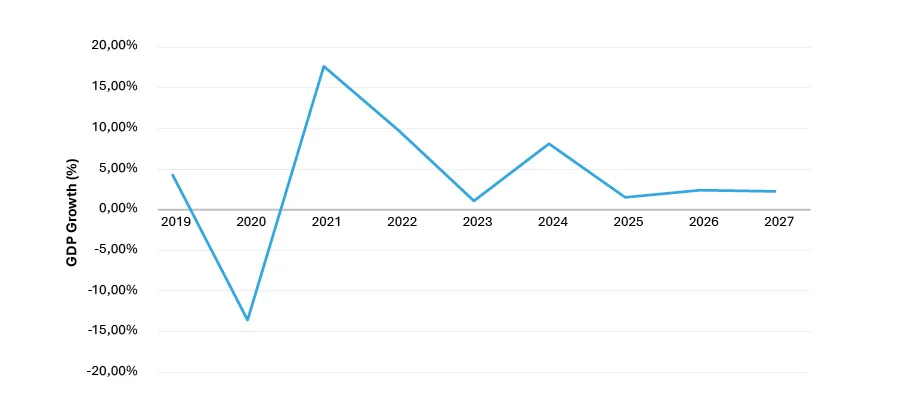
Figure 1. Belize GDP growth, 2019–2027. Source: Inter-American Development Bank (CC BY 4.0).
Productivity as the Next Frontier
In many ways, Belize has reached a turning point. At the center of this challenge lies productivity. Belize’s economy remains heavily dependent on tourism, agriculture, and small-scale services, while most firms are micro or small enterprises with limited access to finance, technology, and skilled labor. Against this backdrop, it is not surprising that innovation remains limited, digital adoption uneven, and infrastructure bottlenecks continue to raise costs across the economy.
The problem, however, is not a lack of entrepreneurial activity. Belize has a vibrant private sector and a growing services economy. Rather, many firms struggle to scale, modernize, or move into higher-value activities.
In this context, limited access to credit continues to constrain investment, particularly for micro and small businesses operating outside major urban centers. At the same time, firms increasingly report difficulties finding workers with the technical and digital skills needed to expand into more sophisticated sectors.
Women and Economic Growth
Women are central to Belize’s economic transformation. They already play a major role in entrepreneurship and small business activity: approximately 80% of microenterprises are led by women. Yet women-owned businesses continue to face greater obstacles in accessing finance, formalization, and business support systems.
This is not only a social challenge, but also an economic one. Women in Belize outperform men in educational attainment, yet they participate less in the labor market (Figure 2) and remain concentrated in lower-productivity and informal jobs, mainly in wholesale and retail trade.
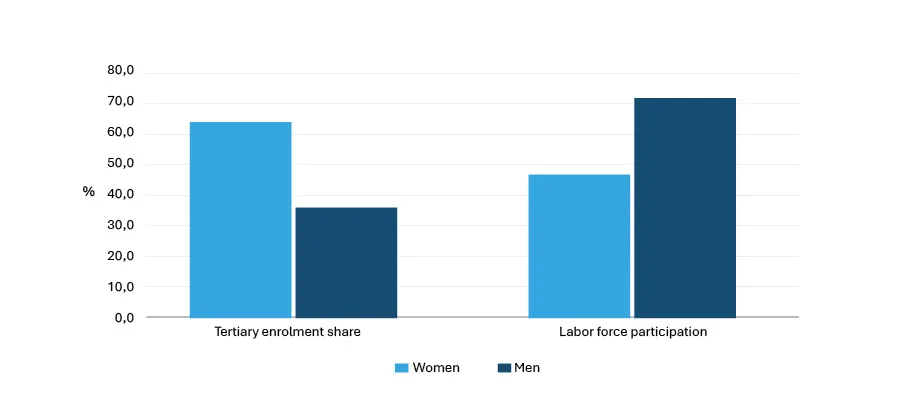
Figure 2. Women’s education advantage versus the labour-market gap in Belize. Source: Inter-American Development Bank (CC BY 4.0).
Limited access to childcare and care services, combined with persistent barriers to finance and asset ownership, restricts women’s ability to fully participate in the economy. Expanding women’s economic opportunities could therefore become one of the country’s most important sources of productivity growth in the coming years.
Infrastructure, Resilience, and Natural Capital
Infrastructure gaps further complicate Belize’s growth prospects. Road networks remain highly vulnerable to flooding and natural disasters, energy systems continue to depend heavily on imported electricity, and digital connectivity remains uneven across territories. These constraints disproportionately affect rural communities and smaller firms, limiting both competitiveness and economic inclusion.
Environmental vulnerability adds another layer of complexity. In Belize, this is not simply an environmental issue; it also shapes the country’s entire economic model. Tourism, agriculture, fisheries, and coastal infrastructure all depend heavily on environmental stability. Hurricanes, floods, droughts, and coastal erosion already generate significant economic losses and recurrent fiscal pressures.
Natural Capital as a Strategic Asset
At the same time, Belize’s natural capital remains one of its greatest strategic assets. The country’s marine ecosystems, forests, and biodiversity sustain tourism, fisheries, and the emerging blue economy. Belize’s innovative Blue Bond demonstrated how environmental conservation and fiscal management can reinforce one another, while also positioning the country as a regional reference in debt-for-nature financing.
Belize’s coast and marine ecosystems are a strategic asset. Image generated by AI.
Yet resilience will require more than conservation initiatives alone. Belize still faces important deficits in water and sanitation systems, waste management, climate-resilient infrastructure, and disaster risk management. Without stronger adaptation measures, climate shocks could increasingly undermine growth, investment, and social progress.
Human Capital and the Next Phase of Growth
Human capital remains another critical constraint. Educational attainment continues to lag behind regional averages, particularly at the secondary and tertiary levels, while many young people remain outside both education and formal employment. These gaps limit Belize’s ability to diversify into more knowledge-intensive sectors and sustain productivity growth over time.
Still, Belize enters this new phase from a stronger position than many expected just a few years ago. Fiscal indicators have improved substantially, debt pressures have eased, and the country has demonstrated an ability to innovate in areas ranging from environmental finance to services exports.
The challenge now is to advance reforms that raise productivity, expand economic inclusion, and build resilience before external conditions become less favorable.
Belize has already shown that recovery is possible. Yet the harder task lies ahead: turning that recovery into a more productive, resilient, and inclusive growth model.
Whether it succeeds will depend on its ability to leverage its strategic advantages, including natural capital, geographic position, an English-speaking workforce, and entrepreneurial dynamism, while investing in the infrastructure, human capital, and institutions needed to sustain long-term development.
Key takeaways on Belize after the rebound
- Belize’s economy grew at an average of nearly 8% a year between 2021 and 2024, driven by tourism, agricultural exports and outsourced business services.
- Much of the recent growth reflects cyclical recovery, so the next step is higher productivity, stronger firms and better access to finance and skills.
- About 80% of microenterprises are led by women, and women outperform men in education, but they participate less in the labour market.
- Belize’s natural capital, including marine ecosystems and its Blue Bond, is a strategic asset, while infrastructure and climate resilience still need investment.










0 Comments