


Originally published by Nuriye Melisa Bilgin and Gianmarco Ottaviano in LSE Business Review on September 18, 2026, under a Creative Commons licence (CC BY 4.0) (LSE’s republishing policy states that LSE Blogs content is licensed under CC BY 4.0). Republished here under that licence. LSE, LSE Business Review and the authors are not contributors to TeaLamp and do not endorse it or its use of their work. The article gives the views of the authors. The article explains why some firms adopt AI before others, based on two CEP discussion papers. Changes: formatting, retitled in title case, the two charts from the post reused, an AI-generated illustration and a short “Key takeaways” section added by TeaLamp; the stock photo and comment links were not used. Prepared for TeaLamp by the TeaLamp Editorial Team with the help of AI.
Which companies become early adopters of artificial intelligence, giving them a head start in the productivity race? By studying firms in Turkey, Nuriye Melisa Bilgin and Gianmarco Ottaviano find that firm size tells only part of the story. Employee skills and better broadband are key to understanding which firms adopt AI. And both can be influenced by policymakers.
After its launch in November 2022 ChatGPT reached 100 million users within two months, illustrating the extraordinary speed with which generative AI entered everyday use. Inside firms, however, adoption has been much slower and far more uneven. In most economies only a minority of businesses use AI. And large firms adopt at substantially higher rates than smaller ones. This familiar size advantage is usually attributed to their greater ability to absorb the fixed costs of new technology, including investments in data, IT systems and specialist staff.
Our research shows that this conventional picture changes once we distinguish between different types of AI and look beneath firm size to the capabilities that enable adoption. In two recent papers, Skills, Not Scale: GenAI and Technology Adoption and AI Unbound: Digital Infrastructure, AI Adoption, and Firm Performance, we use administrative and survey data on Turkish firms between 2021 and 2024. For traditional AI, the familiar size advantage remains. For generative AI, however, firm size has essentially no effect on adoption once workforce skills are held constant. Lower fixed costs do not make adoption frictionless: instead, other capabilities come to the fore. Workforce skills, digital connectivity and organisational readiness increasingly determine which firms are able to adopt AI and put it to productive use.
Not all AI is the same
Our data allow us to distinguish between two technologies that are often grouped together under the label of AI. “Traditional” AI systems, such as image recognition, process automation and machine learning applications, often require dedicated hardware, specialist IT staff and substantial changes to business processes. “Generative” AI, by contrast, can often be adopted with little more than an internet connection and employees who know how to use it effectively. This fundamental difference changes who adopts AI and why.
Between 2021 and 2024 overall AI adoption among Turkish firms more than doubled, increasing from 4.6 to 12.1 per cent, while generative AI adoption tripled from 2.6 to 8.1 per cent (Figure 1). Behind these averages lies an important difference. Traditional AI follows the familiar pattern seen in previous waves of technological change: both firm size and workforce skills predict adoption.
Generative AI tells a different story. Once workforce skills are taken into account, firm size has essentially no effect on adoption. Instead, the strongest predictor is workforce skills, proxied by average wages. Small firms adopt generative AI at roughly twice the rate of large firms, while firms with highly skilled employees are more than four times as likely to adopt as firms with lower skilled workforces. Service sector firms are also much more likely to become early adopters.
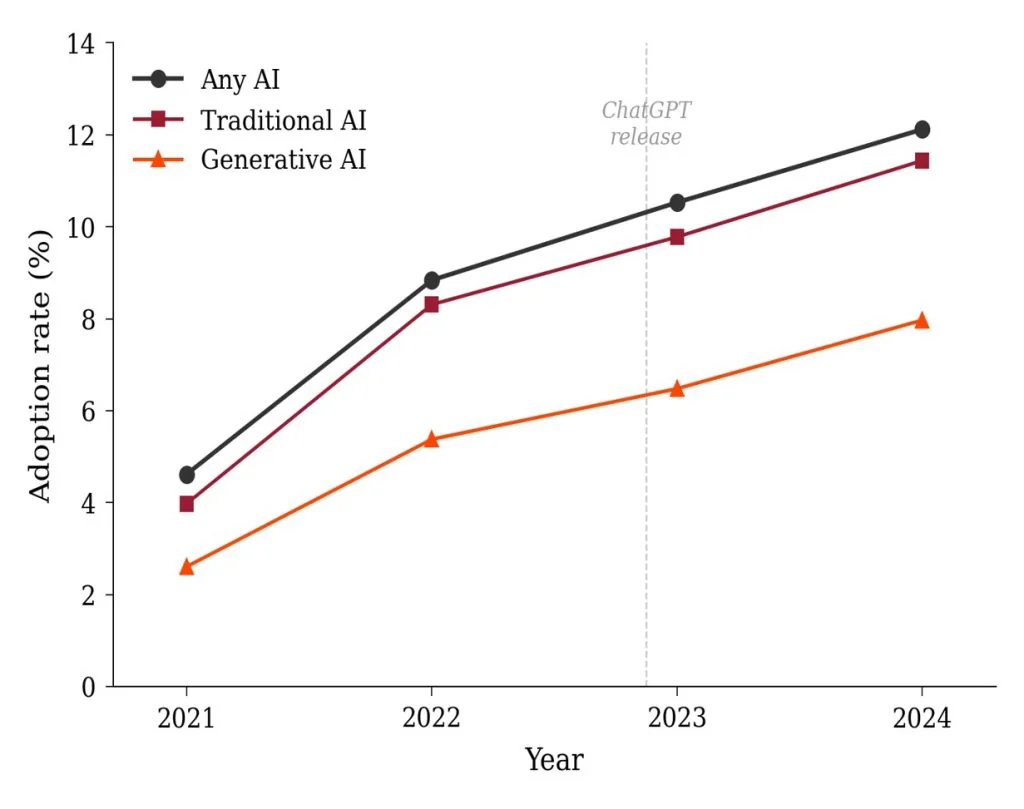
Share of firms using each AI type, 2021–2024; the dashed line marks the release of ChatGPT in November 2022. Source: the authors’ CEP discussion papers, as published in LSE Business Review (CC BY 4.0).
A particularly revealing group consists of firms combining traditional and generative AI. These “hybrid” adopters appear to represent the next stage of the adoption process rather than a separate category altogether (Figure 2). Nearly three quarters remain hybrid from one year to the next, while around one quarter of firms using only generative AI move into hybrid adoption each year. In other words, generative AI often serves as an accessible entry point before firms combine it with other AI systems.
Reaching this final stage depends heavily on workforce skills. Hybrid adoption is far more sensitive to workforce skills than generative AI alone, and this relationship has become much stronger over time. Between 2021 and 2024 the wage gradient associated with hybrid adoption increased sixfold, suggesting that differences in workforce capabilities are becoming increasingly important.
Unbinding AI: the infrastructure channel
Skills are only part of the story. Many modern AI applications run in the cloud, relying on fast and reliable internet connections to access foundation models, process large datasets and deliver services in real time. If digital connectivity is a genuine constraint, then improving broadband should do more than increase download speeds. It should enable firms that previously could not use AI to adopt it.
Showing this is challenging because broadband infrastructure is rarely deployed at random. Internet providers typically expand first where demand is already high. We overcome this problem by exploiting a quirk of how infrastructure is built in Turkey. Fibre optic cables are laid alongside the natural-gas pipeline network because sharing the same trench is much cheaper than digging two separate ones. Since pipeline expansion is determined by energy policy rather than local demand for AI, this staggered rollout provides a natural experiment for studying the impact of connectivity.
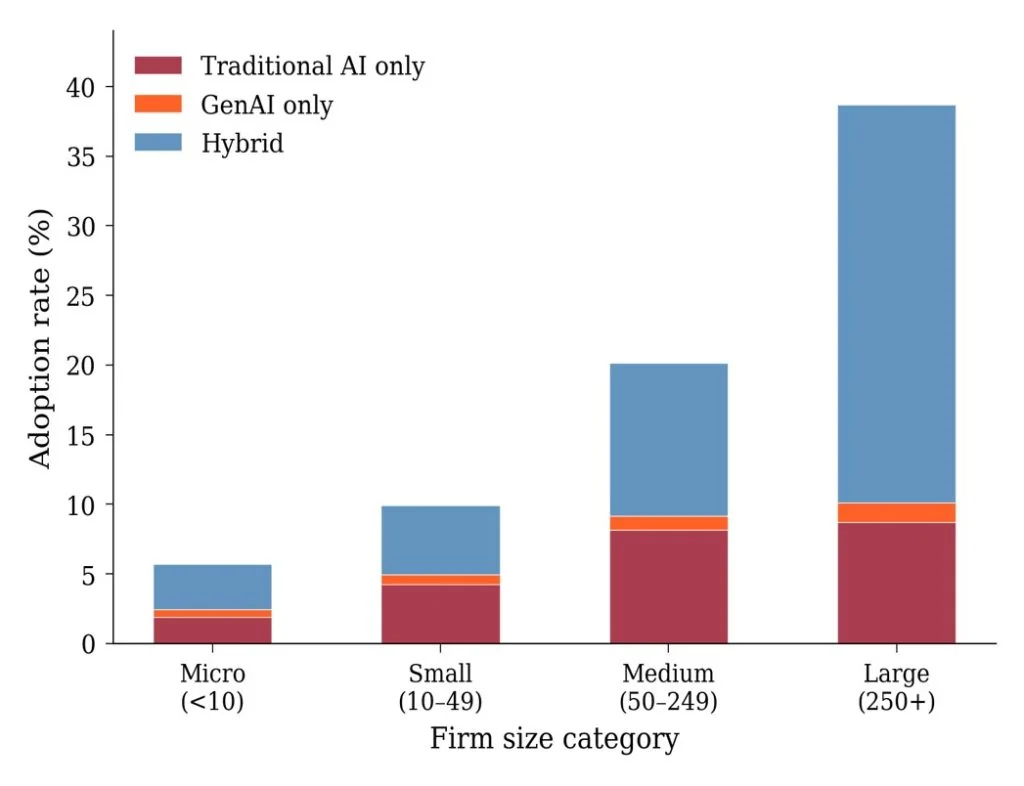
Share of firms in each adoption category by size class, 2021–2024. Source: the authors’ CEP discussion papers, as published in LSE Business Review (CC BY 4.0).
The effects are substantial. Two years after broadband reaches a district, AI adoption increases by around 9.5 percentage points among small and medium sized enterprises, compared with around 7 percentage points among large firms. The gains are concentrated in cloud based, software intensive AI applications, while hardware intensive technologies such as autonomous systems show little response.
The stronger effect among smaller firms suggests that they face tighter connectivity constraints. Better broadband removes an important barrier to adoption, allowing many firms that were already capable of using AI to begin doing so.
Adoption, however, is only the first step. Firms reorganise internally after adopting AI. They hire more technology specialists and, particularly among smaller firms, strengthen their management teams by becoming more likely to employ managers and increasing the share of managers in their workforce. Productivity and export performance also improve gradually, alongside these organisational changes. The pattern is consistent with firms complementing AI adoption with investments in people and organisational capabilities.
Rethinking the policy levers
Taken together, these findings challenge a common approach to AI policy. Governments often encourage technology adoption through subsidies targeted at small firms, assuming that financial constraints are the main obstacle. Our evidence suggests a more nuanced picture.

Skills and connectivity help firms put AI to work. Image generated by AI.
Such policies may still encourage investment in traditional AI systems, where fixed costs remain important. Generative AI is different. Here, the main constraint is workforce capability rather than firm size or financial resources. Likewise, for many cloud-based AI applications, improving broadband infrastructure may be more effective than subsidising adoption itself.
The evidence also points to a growing risk. The most advanced, hybrid forms of AI are becoming increasingly concentrated among firms employing highly skilled workers. Since these firms rarely abandon AI once they adopt it, early differences in workforce skills could translate into persistent productivity gaps unless workers in lower adoption firms have opportunities to upgrade their digital capabilities.
How policymakers can encourage firms to adopt AI
Our findings suggest that the spread of AI depends on two essential complements: skilled workers and high quality digital infrastructure. Firm size matters far less than commonly assumed because larger firms are simply more likely to possess these underlying advantages.
The encouraging implication is that both constraints can be influenced by policy. Better broadband enables firms to adopt AI, while workforce skills and organisational capabilities shape their ability to adopt and integrate it effectively. As governments develop national AI strategies, attention should extend beyond frontier models and computing capacity. The future benefits of AI will depend just as much on classrooms and fibre optic cables as on the technology itself.
Key takeaways on firms adopt AI
- Adoption of traditional AI still favours larger firms, but for generative AI firm size has essentially no effect once workforce skills are held constant.
- AI adoption among Turkish firms more than doubled between 2021 and 2024, from 4.6 to 12.1 per cent, while generative AI adoption tripled from 2.6 to 8.1 per cent.
- Two years after broadband reaches a district, AI adoption rises by around 9.5 percentage points among small and medium-sized enterprises.
- The authors conclude that skilled workers and high-quality digital infrastructure are the two key ingredients, and that policy can influence both.










0 Comments