


Originally published by Rodolfo Gomes Benevenuto, Arturo Galindo Andrade and Laura Giles Álvarez on the Inter-American Development Bank (IDB) blog on June 12, 2026, under a Creative Commons Attribution 4.0 licence (CC BY 4.0): “Copyright © 2026 Inter-American Development Bank. This work is subject to the Creative Commons Attribution 4.0 International Public License.” Republished here under that licence. The IDB and the authors are not contributors to TeaLamp and do not endorse it or its use of their work. Prepared for TeaLamp by the TeaLamp Editorial Team with the help of AI. Changes: formatting, a chart and an AI-generated illustration added by TeaLamp, and a short “Key takeaways” section. The post explains the gaps in finance for Amazonia’s small businesses and what is already working.
With the right financial tools, small businesses and rural producers can turn Amazonia’s local potential into jobs, sustainable growth, and broader economic opportunity.
Highlights
- Amazonia’s local businesses often operate far from formal financial systems, with limited banking access, weak digital infrastructure, and credit products that do not match their specific needs.
- These gaps also shape what gets financed: while soy and cattle production receive more than $30 billion per year, biodiversity-based products such as açaí, Brazil nuts, and cocoa receive just $0.3 billion.
- Financial inclusion, innovation, and local solutions must advance together: inclusion expands access to formal financial services, innovation can reduce digital and bureaucratic barriers, and local design ensures that financial tools fit the realities of Amazonia’s businesses and communities.
Small businesses in the heart of the Amazon rainforest are eager to expand their operations and invest in sustainable practices, generating economic activity and employment for the communities around them. But too often, credit is expensive, difficult to access, or simply unavailable. As a result, promising businesses struggle to grow, productive investments are delayed, and opportunities for local development remain limited.
Gaps in access to finance: A regional reality
Access to finance is scarce across Amazonia, particularly for micro, small, and medium enterprises (MSMEs), which are the backbone of many local economies. The numbers make this clear. In the Brazilian Amazonia, for example, the region is home to 13% of the country’s rural producers, but over the past two decades it has received only 6.3% of total rural credit, most of which has gone to individuals rather than firms. The imbalance is also evident across sectors: while soy and cattle production receive more than $30 billion per year in financing, biodiversity products such as açaí, Brazil nuts, and cocoa receive just $0.3 billion, 100 times less.
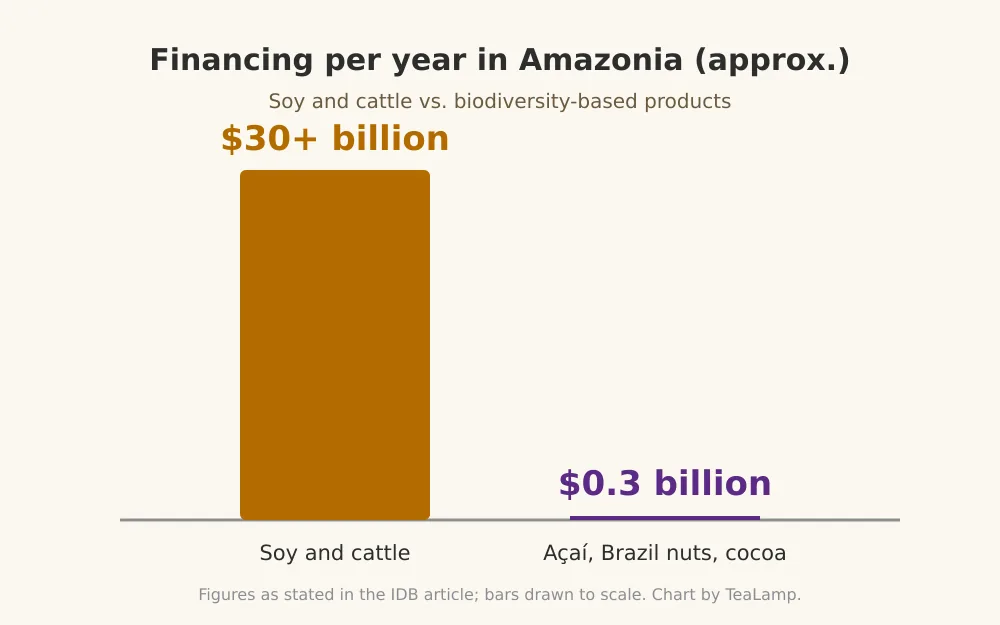
Chart prepared by TeaLamp from the figures quoted above (bars drawn to scale); the figures are the IDB authors’, and the chart design is TeaLamp’s own.
As highlighted in our most recent publication, Amazonia: A Journey Toward Prosperity and Resilience, the barriers to finance in Amazonia are not just about money. Many firms and entrepreneurs lack access to banking services, digital tools, and even basic documentation, making it hard to join the formal financial system. To be sure, digital financial services are expanding: in Brazil, fintechs granted $3.8 billion in credit in 2023, up 52% from the previous year. But that growth has not yet reached all firms and communities equally, as persistent gaps in digital infrastructure and financial literacy continue to limit access, especially in rural and remote areas.
Even where public financing tools exist, bureaucratic hurdles, high transaction costs, and a lack of local technical assistance can keep them out of reach. In addition, MSMEs face another challenge: traditional financial institutions rarely offer products compatible with the region’s unique business models and requirements, which often involve collective ownership of land and assets, informal governance, and alternative forms of value creation.
The consequences are profound. Evidence shows that well-designed credit lines can lead to reductions of up to 60% in deforestation in remote, rural regions of Amazonia. Without adequate financial resources, however, communities struggle to invest in resilience practices, promote growth, adapt to environmental changes, and escape poverty.
Access to finance is also a key tool for closing gender gaps. For instance, in Bolivia, 63% of women have a bank account, compared to 74% of men; in Peru, the figures are 53% and 62%. In Brazil, only 33% of women borrowed from a financial institution in the past year, compared to 48% of men.
What can be done about it?
Despite these challenges, promising solutions are emerging across the region. Targeted financing programs are already making a difference by combining credit, technical support, and incentives designed for local businesses and communities.
In Peru, for example, the Program to Promote Sustainable Financing in the Amazonia Region blends concessional finance with a trust fund to support MSMEs engaged in biobusinesses. In Brazil, meanwhile, the IDB-BNDES ProAmazonia Program mobilizes $900 million to expand financing for MSMEs, with 30% earmarked for women-led enterprises and 20% for low-carbon agriculture. Ecuador’s Bioeconomy for a Sustainable Amazon (BASE) Program, in turn, combines long-term credit lines for small-scale biobusinesses with a pioneering loan-loss reserve that covers up to 80% of individual losses on loans to Indigenous Peoples and women.
These experiences point to a clear lesson: financial inclusion is not just about credit. It also means giving households, firms, and communities access to a wider range of formal financial services, including savings, insurance, and digital payments, at affordable costs, especially for low-income populations.
Tailoring financial services to local needs
Microcredit has proven effective for enhancing financial inclusion in Amazonia, but success depends on tailoring services to local realities. Unlike mainstream credit products, which often require formal collateral or extensive documentation, microcredit initiatives can accommodate informal entrepreneurs and community enterprises. When paired with technical assistance, financial literacy, and consumer protection, even small loans can meaningfully enhance the financial resilience and autonomy of rural populations. However, without adequate safeguards, microcredit can lead to over-indebtedness and ultimately fail to reduce poverty.
Mobile banking and savings groups are also helping bridge financial gaps. In Peru, participation in savings groups has increased female labor force participation, improved access to credit, and strengthened households’ capacity to cope with financial shocks. Digital solutions in local languages are also being developed to reduce barriers and increase Indigenous participation in formal financial services.

Mobile payments and local products. Image generated by AI
Why finance matters so much for inclusion and development
Targeted financing programs that support MSMEs, cooperatives, and women-led businesses can create local employment opportunities, improve livelihoods, and empower historically marginalized populations. But for these programs to work at scale, access to finance must be designed around the realities of the people and enterprises it aims to serve. As highlighted in the publication, four priorities stand out:
- Policies should prioritize culturally sensitive financial services, financial education, and capacity-building initiatives, so underserved groups can participate more fully in the formal economy.
- Digital finance infrastructure must be strengthened. Promoting fintech solutions and simplifying bureaucratic procedures can also expand outreach and reduce barriers for small and informal enterprises.
- Scaling inclusive financial services will also help meet environmental goals. Inclusive financial mechanisms are pivotal for advancing environmental sustainability in Amazonia by redirecting capital flows toward forest-compatible and biodiversity-based enterprises.
- De-risking instruments and public-private investment vehicles, such as blended finance and green credit lines, can help incentivize bioeconomy projects, discourage extractive and high-emission activities, and mobilize long-term financing for biodiversity protection.
In the end, financial inclusion is the cornerstone for Amazonia’s sustainable future. It is the key to unlocking the region’s economic potential, empowering its people, and preserving its forests. Only by advancing inclusion, innovation, and local solutions together can Amazonia achieve shared prosperity and resilience.
This post benefited from a valuable contribution by Nadia Rocha.
Key takeaways on finance for Amazonia
- Small businesses in Amazonia are held back by scarce credit, weak digital infrastructure and financial products that do not fit local business models.
- Financing is heavily skewed: soy and cattle receive more than $30 billion a year, while biodiversity-based products such as açaí, Brazil nuts and cocoa receive about $0.3 billion.
- Programmes in Peru, Brazil and Ecuador show that targeted credit, technical support and risk-sharing can reach micro and small enterprises, including women-led and Indigenous businesses.
- The authors argue that financial inclusion, innovation and locally designed services need to advance together.










0 Comments