

An original TeaLamp explainer based on the sources listed below. Prepared by the TeaLamp Editorial Team with the help of AI.
For close to a century, comets have enjoyed a romantic reputation in the story of how life began. They are icy wanderers from the outer solar system, and they carry the very molecules that living things are made from. It was easy to imagine them as delivery vans, dropping off life’s ingredients on a young Earth. A new study of comets origins of life, published in Scientific Reports on October 28, 2026, says that picture is probably wrong. The delivery, the researchers argue, would have been at best a one-off fluke, not a steady rain of useful molecules.
Key takeaways on comets origins of life
- Comets carry hydrogen cyanide, a key starting molecule for prebiotic chemistry, but most of it would be destroyed by the heat of impact.
- In 100,000 computer simulations of Earth’s early bombardment, the median number of impacts delivering a useful concentration of hydrogen cyanide to land was zero, and 54 percent of simulations recorded none at all.
- Even a successful delivery would fade fast, as crater water and rain dilute the molecules within days to weeks, so later chemistry would have had to work very quickly.
- Mars looks like a better target than Earth for comet delivery, yet the study stresses this is still only a possibility, not evidence that it happened there.
- If comets did not do the job, the ingredients may have come from asteroids, which struck more often, or from chemistry on Earth itself.
A century-old idea
The idea that space delivered life’s ingredients is more than a century old, and it is easy to see why it lasted. Comets are rich in volatile molecules, including hydrogen cyanide, or HCN, at about 0.1 percent relative to water. HCN matters because its strong triple bond can drive the chemistry that builds lipids, sugars, nucleobases and nucleotides, the parts from which living things are assembled. Laboratory experiments show that concentrations around 10 millimolar, written 10 mM, can make many of those building blocks. In theory, a comet could deliver as much as about 30 mM of HCN to a local spot, a concentration that would be immediately useful.
That theory got a fresh twist in 2023, when lead author Richard Anslow and colleagues suggested that in systems where planets orbit close together, comets might slow down by bouncing from one planet to the next. The new study asks whether that could have worked here. The answer, after combining recent models of comet formation, atmospheric entry and impact heating, is that it almost certainly could not, at least not often enough to matter.
The three filters a comet must survive
Think of a comet’s journey as three filters, each one removing most of the candidates. The first filter is size. Comets are porous and fragile, and small ones break apart high in the atmosphere. The study finds that comets smaller than about 100 metres would fragment in explosive airbursts, spreading their molecules over a wide area instead of delivering them in one concentrated place. That matters because only a concentrated delivery is useful for chemistry.
The second filter is speed and angle. To keep its HCN intact through the violence of impact, a comet needs to arrive slowly and at a shallow, glancing angle. But the atmosphere itself works against that combination: it preferentially destroys small and oblique comets, while the comets that survive tend to hit fast and steeply. The study focused on short-period comets, the slower kind, because they give molecules the best chance. Even then, successful delivery was confined to a very narrow region of size, speed and angle.
The third filter is timing and dilution. Comet impacts fell sharply during Earth’s first 500 million years, leaving at most a handful of chances for a useful HCN delivery. And even if a comet did deliver its cargo intact, groundwater filling the new crater, plus rain and runoff, would dilute the HCN within days to weeks, and hydrolysis would finish the job. Any chemistry that followed would have had to start almost immediately, which the researchers call highly unlikely.
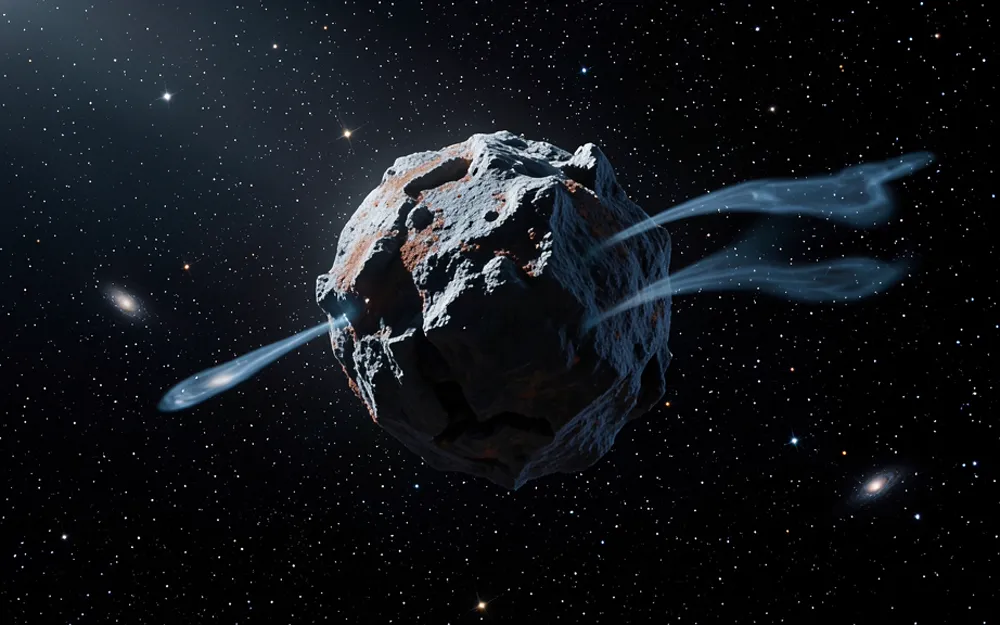
A comet nucleus, rugged ice and dust in deep space. Image generated by AI.
What the numbers say
The headline numbers come from 100,000 Monte Carlo realisations, or simulated histories, of Earth’s early bombardment, built on a model following one million primordial cometesimals from beyond Neptune. Across those histories, Earth accreted more than 100,000 comets larger than 100 metres. Yet counting only impacts that delivered more than 10 mM of HCN onto exposed land, the median was zero, and in 54 percent of simulations no such impact happened at all.
On a global scale the picture is just as stark. All the HCN that survived intact totalled only about 2.65 times ten to the power of thirteen kilograms. Spread through one ocean, that gives at most about 0.75 micromolar, orders of magnitude below the 10 mM used in experiments. Comets could not have stocked the whole early ocean, and usually could not stock even a single local pond.
There is also a timing problem. Among the simulations that did record at least one successful impact, the most probable time of the last success was about 4.41 billion years ago, more than 100 million years before the estimated emergence of the last universal common ancestor, the shared ancestor of all living things today, at about 4.2 billion years ago. Fewer than 5 percent of simulations recorded a success later than 4.03 billion years ago. A delivery that early would have had to survive, concentrated, for an implausibly long time before life appeared.
It is important to state what the study does not claim. It does not say comets carry no organic molecules, and it does not rule out a single lucky delivery. As Anslow puts it, “We can’t rule out for certain that it happened that way. But it seems to be a really rare occurrence, at best, a one-off fluke.” The authors also stress that their setup was deliberately generous: where early Earth conditions were uncertain, they chose values that maximised delivery. The result is a best-case scenario, and it still fails.
Why Mars fares better, and why that is not proof
The same modelling was run for Mars and Venus, and Mars came out well ahead. Ignoring how much dry land each planet had, Mars received 744 successful HCN deliveries on average, compared with 87 for Earth and 24 for Venus. Mars is smaller, so comets arrive more slowly, and its thinner atmosphere lets almost all comets larger than 100 metres survive entry. Even if early Mars had an atmosphere as thick as Earth’s, at about 1 bar, its successes still numbered 448, more than five times Earth’s figure.
That does not mean life began on Mars. The comparison leaves out land availability, and a warm, wet early Mars covered in water would dilute its deliveries just as Earth’s oceans would. Anslow is careful: the result does not prove delivery happened on Mars, only that it would be unlikely to have happened on Earth and not on Mars, and the more likely alternative is that it happened on neither planet. The Mars result is a guide for future searches, not a claim about Martian life.

A rust-red desert plain on Mars at dusk. Image generated by AI.
If not comets, then what
If comets are out, two routes remain open: asteroids, which struck Earth far more often than comets and could have made molecules in their impacts, and chemistry made on Earth itself, in its early atmosphere or in geological settings. The study does not choose between them. Its contribution is narrower and still important: it removes one long-standing candidate from the centre of the story and forces the alternatives to carry more weight.
The result also matters beyond our solar system. Systems where comets can bounce gently between close-orbiting planets could be better places to look for comet-delivered chemistry than a system like ours. Knowing where a mechanism fails is, in its own way, as useful as knowing where it works.
Frequently asked questions
Did comets bring life itself to Earth?
No, that is not what the theory claimed. The idea was that comets delivered the chemical ingredients, such as hydrogen cyanide, from which life’s building blocks could form. The new study questions even that gentler claim, finding that useful deliveries would have been exceedingly rare.
Why is hydrogen cyanide so important?
Hydrogen cyanide is a simple molecule with a high-energy triple bond, regularly found in solar system comets. At concentrations around 10 mM it can help make lipids, sugars, nucleobases and nucleotides, and it is the only feedstock molecule found in comets at such concentrations, which is why the study uses it as a test case.
Does this study prove life did not come from space at all?
No. It studies one molecule and one kind of delivery, comets hitting Earth, and it models rather than observes the early solar system. Asteroid delivery and chemistry made on Earth remain open possibilities, and the authors say a single lucky comet delivery cannot be ruled out completely.
Why it matters
Comets origins of life was a beautiful idea: icy messengers crossing the dark, carrying the seeds of everything alive. The new study does not make it impossible, but it makes it improbable in a precise, quantitative way, with numbers other researchers can test and refine. Science advances as much by closing doors as by opening them. If comets did not bring life’s ingredients, the story of how Earth became alive must be found closer to home, in asteroids, in Earth’s own chemistry, or in a combination we have not yet untangled.
Related reading
For another story about the search for life’s beginnings, read Life on Mars, Explained: Ancient Molecules, New Clues.
Sources
- University of Cambridge, “Comets didn’t seed life on Earth after all, new study suggests,” October 28, 2026
- Anslow, McDonald, Bonsor, Rimmer and Rae, “Cometary impacts an unlikely pathway towards the origins of life on Earth,” Scientific Reports, October 28, 2026
- EarthSky, “Did comets seed life on Earth? A new study says, probably not,” November 1, 2026
- SciTechDaily, “Comets Probably Didn’t Bring Life’s Ingredients to Earth After All, New Study Reveals,” November 2026










0 Comments