

Key takeaways on life on Mars
- NASA’s Curiosity rover found the largest organic molecules ever detected on Mars: decane, undecane and dodecane, chains of 10 to 12 carbon atoms, in a 3.7-billion-year-old lakebed.
- The molecules may be fragments of fatty acids, the kind that build cell membranes on Earth. But fatty acids can also form without life, so this is not proof of ancient life.
- A February 2026 study found that non-biological sources, such as meteorites, cannot fully explain the amount of organic material present. Its authors say it is reasonable to hypothesize that living things formed them.
- Curiosity’s onboard laboratory cannot detect anything bigger than these molecules. Settling the question will probably require bringing Mars rocks home to Earth.
Is there life on Mars? It is the oldest cold case in science. About 3.7 billion years ago, Mars was warmer and wetter, with lakes in which microbes could, in principle, have lived. In 2013, NASA’s Curiosity rover drilled into one such ancient lakebed in Gale Crater and tucked the powdered rock away for analysis. The result took years of laboratory work, but when it was published in March 2025, it was the richest haul of organic molecules ever found on Mars. And this year, a follow-up study made those molecules much harder to explain away.
The largest molecules ever found on Mars
The rock has a name: Cumberland, a mudstone from a spot called Yellowknife Bay, once the floor of a Martian lake. Curiosity drilled it in 2013, and the powdered sample sat in the rover’s chemistry lab, Sample Analysis at Mars (SAM), waiting for its turn. SAM works by heating rock powder in a small oven and studying the gases that come off, which reveal the molecules trapped inside.
The science team, led by astrochemist Caroline Freissinet of France’s CNRS, was actually hunting for amino acids, the building blocks of proteins. What they found instead was arguably more interesting: three long-chain hydrocarbons called decane, undecane and dodecane. These are chains of 10, 11 and 12 carbon atoms with hydrogen atoms attached, the longest carbon chains ever detected on Mars. The finding was published in the Proceedings of the National Academy of Sciences on March 24, 2025.
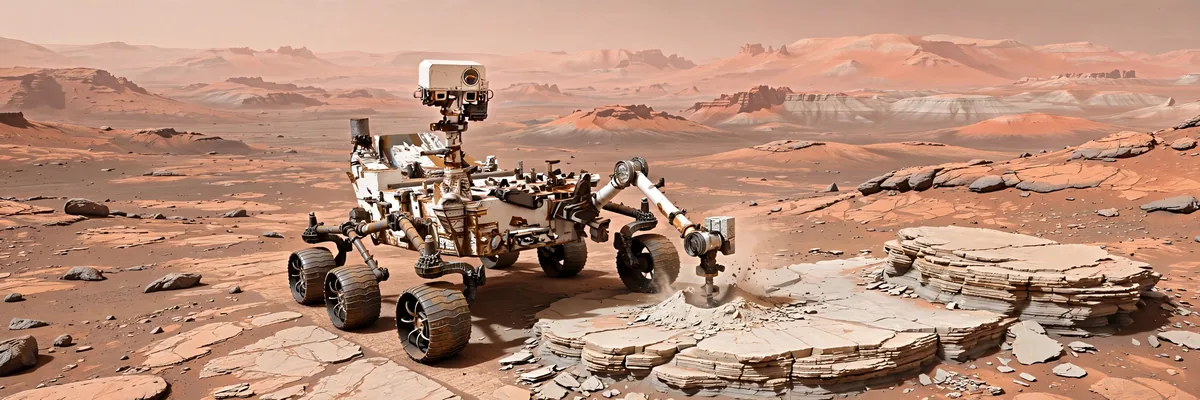
Curiosity drilled the Cumberland rock in Gale Crater, at the site of a 3.7-billion-year-old lakebed. Image generated by AI.
What exactly is an organic molecule?
“Organic” here does not mean “made by life.” It means a molecule built around carbon, usually with hydrogen attached. The simplest is methane, one carbon atom with four hydrogens. On Earth, carbon chemistry is the foundation of life, but plenty of organic molecules form through non-living chemical reactions too.
What makes this discovery special is the length of the chains. Long-chain molecules are fragile. They are far more delicate than the ring-shaped carbon molecules Curiosity had found before, and fragile things are not supposed to survive 3.7 billion years of radiation and oxidation on the Martian surface. Their survival suggests that complex chemistry could persist on Mars far longer than scientists had dared to hope.
Why fatty acids matter
The three alkanes look like fragments of something bigger: fatty acids. On Earth, fatty acids are essential components of cell membranes, and living things produce them to build cells and regulate their chemistry. But they can also be made without life, through geological processes such as water reacting with minerals in hydrothermal vents.
So the molecules are tantalizing, not conclusive. Freissinet points to one more intriguing detail: on Earth, long-chain fatty acids can spontaneously assemble into tiny capsules called vesicles, and some scientists think that is how the first cells formed. If similar chemistry ran on early Mars, it may have been following the same script, at the same time. Life is thought to have emerged on Earth about 3.7 billion years ago too.
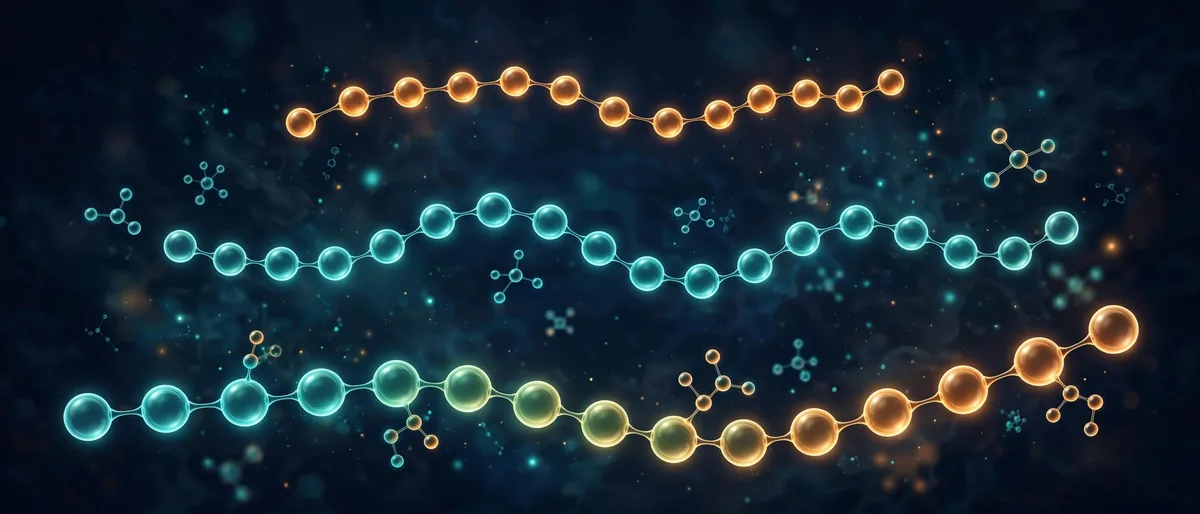
Decane, undecane and dodecane: chains of 10, 11 and 12 carbon atoms, the longest found on Mars. Image generated by AI.
Meteorites can’t explain it all
For years, the cautious explanation was that these organics arrived from space. Meteorites rain carbon-rich material onto planets all the time, and Mars has no shortage of impacts. A study published on February 4, 2026, in the journal Astrobiology tested that idea and found it wanting.
The researchers combined laboratory radiation experiments, mathematical modelling and Curiosity’s data to “rewind the clock” about 80 million years, the length of time the rock had been exposed at the Martian surface. That let them estimate how much organic material must have been present before cosmic radiation destroyed most of it. The answer: far more than typical non-biological processes, including meteorite delivery, could plausibly produce. As NASA’s summary of the study put it, it is therefore reasonable to hypothesize that living things could have formed them. It is not proof. But the easy non-biological excuse just got weaker.

The SAM instrument heats rock powder and analyses the gases released to identify trapped molecules. Image generated by AI.
New molecules, still unexplained
The story kept growing. In May 2026, NASA reported that Curiosity had found organic molecules never before seen on the Martian surface: nitrogen-bearing ring compounds called nitrogen heterocycles, and a carbon-and-sulfur molecule called benzothiophene. They came from a different rock, a sample called Mary Anning 3, analysed with SAM’s “wet chemistry” cups, which dissolve samples in a powerful solvent to reveal molecules that heat alone cannot free. NASA’s mission scientist Ashwin Vasavada said the collection of organic molecules once again increases the prospect that Mars offered a home for life in the ancient past.
Why it matters
Even if none of these molecules came from life, the discovery changes the odds. One of the biggest worries in the search for life on Mars was that any chemical traces of biology would be destroyed by radiation within tens of millions of years, long gone before we could find them. The survival of fragile chains for 3.7 billion years allays that fear: large organic molecules, including ones that could only be made by life, may still be sitting in Martian rocks, waiting to be found.
There is a catch. SAM cannot detect molecules bigger than dodecane, so the rover has reached the limit of what it can see. The decisive tests need instruments too large for any rover. That is why NASA and its partners want to bring Mars samples home, where Earth’s best laboratories could settle the debate. The sample-return mission has hit funding and design troubles, but the molecules are patient. They have waited 3.7 billion years. They can wait a little longer.
Related reading
Mars is not the only place where Earth rocks tell space stories: Moon Rocks on Earth: Madagascar’s Anorthosite, Seen From Space.
Frequently asked questions
Is this proof of life on Mars?
No. The molecules could have formed through geological chemistry with no life involved. What the new studies show is that non-biological explanations are struggling to account for all of them, which keeps the life hypothesis firmly on the table.
What is a biosignature?
A molecule, or a pattern of molecules, that can only be made by life. Finding one on Mars would be the smoking gun. None has been found yet.
Why can’t the rover just test for life directly?
Its instruments are limited in size and power. Definitive tests, such as dating the molecules or reading their fine structure, need laboratory equipment that cannot fit on a rover.
What happens next?
Curiosity keeps analysing rocks with its SAM lab. The big hope is Mars Sample Return: bringing Martian rocks to Earth labs. Its future is uncertain, but the molecules are not going anywhere.
Sources
- NASA Jet Propulsion Laboratory: “NASA’s Curiosity Rover Detects Largest Organic Molecules Found on Mars” (March 24, 2025) — decane, undecane, dodecane; Cumberland mudstone; SAM analysis.
- Freissinet, Glavin et al. (2025), Proceedings of the National Academy of Sciences 122(13), e2420580122 — doi:10.1073/pnas.2420580122. Primary research paper.
- NASA Science: “NASA Study: Non-biologic Processes Don’t Fully Explain Mars Organics” (February 6, 2026) — Astrobiology follow-up study; meteorites cannot account for the abundance.
- NASA: “NASA’s Curiosity Finds Organic Molecules Never Seen Before on Mars” (May 2026) — nitrogen heterocycles and benzothiophene in the Mary Anning 3 sample.
- BBC Sky at Night Magazine: “Search for life on Mars takes major leap forward” (October 2026) — interview with Caroline Freissinet on the fragile alkanes and the fatty-acid hypothesis.
- EarthSky: “Surprisingly big organic molecules on Mars: A hint of life?” (March 2025) — explainer on the discovery and its limits.










0 Comments