

An original TeaLamp explainer based on the sources listed below. Prepared by the TeaLamp Editorial Team with the help of AI.
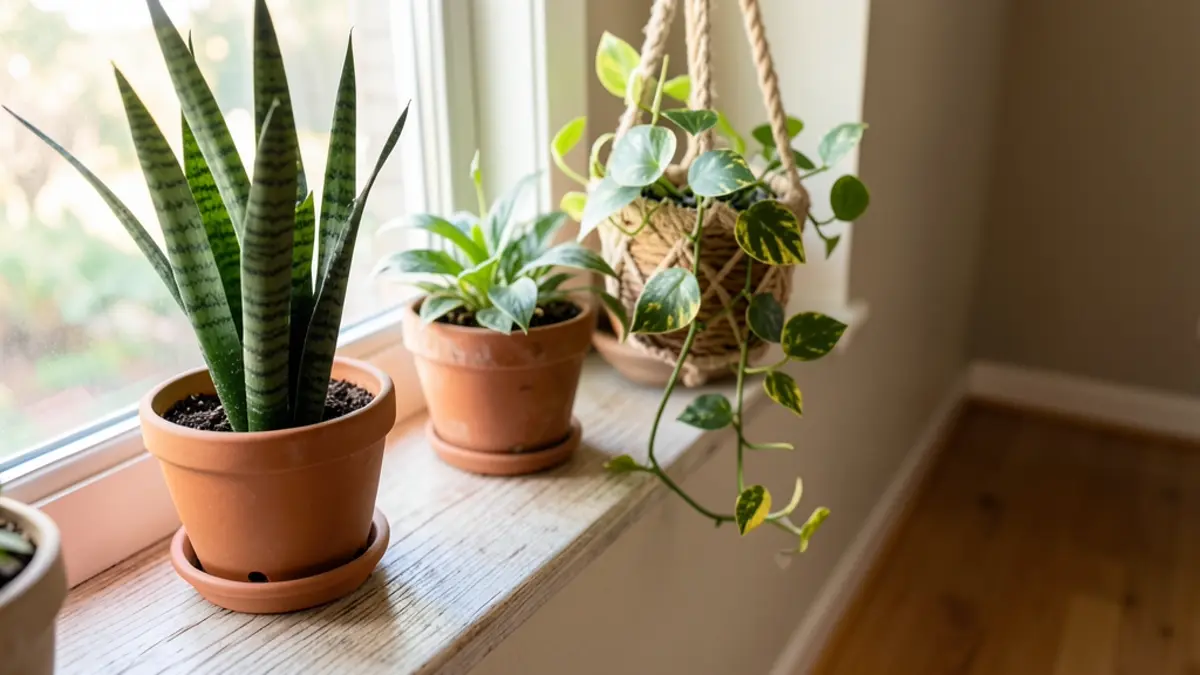
There is a snake plant on my windowsill that has survived three winters, two moves and a month of near-total neglect. It is not beautiful in any dramatic way. It is just there, green and upright, and somehow the room feels less bare because of it. Millions of people keep houseplants at home for exactly this reason, and the plant sellers have a ready story to go with it: your pothos is quietly cleaning your air while you sleep. That part, it turns out, is mostly a myth. The real story is better, and it has very little to do with air.
Key takeaways on houseplants at home
- Houseplants do not clean the air in a normal room in any measurable way. You would need hundreds of them to match what an open window does.
- What they do, reliably, is calm us down. Handling a plant for fifteen minutes lowered blood pressure in a small study, and people reported feeling soothed and comfortable.
- Offices enriched with plants saw productivity rise by 15 percent in a field study across two countries.
- Even a forty-second look at greenery can restore attention, according to research with 150 students.
- The benefit seems to come from tending the plant, not just owning it. The care is the point.
The air-cleaning myth, tested
The claim that houseplants purify indoor air traces back to a single study from 1989. Researchers working for NASA, led by B. C. Wolverton, placed individual houseplants in sealed chambers about the size of a bathroom cabinet, pumped in chemicals such as benzene and formaldehyde, and watched the levels fall. In those sealed boxes, the plants worked well. Some species cut the chemicals by half or more within a day.
But the study was designed for space stations, not living rooms. The chambers were sealed shut, with no fresh air coming in and chemical levels far higher than anything in a normal home. When two engineers at Drexel University, Bryan Cummings and Michael Waring, gathered twelve of these chamber studies and translated all 196 experiments into the standard measure used for air purifiers, the picture changed completely. The typical plant cleaned about 0.023 cubic metres of air per hour. A normal room swaps its air with the outside roughly once an hour. To match that with plants alone, you would need somewhere between 10 and 1,000 plants for every square metre of floor. A living room would need hundreds; a house would need thousands.
None of this makes the NASA study wrong. Inside a sealed box, plants really do absorb those chemicals, with the help of the microbes living around their roots. It just does not scale. Wolverton himself later said the work was about closed environments, and that homes need to understand its limits. So if you bought a peace lily to replace your air purifier, keep the purifier. The lily earns its place for other reasons.
What plants actually do for your mood
The honest benefits of houseplants are quieter, and they show up in the body rather than in the air. In a 2015 study, 24 young men spent fifteen minutes repotting an indoor plant, and on another day spent fifteen minutes on a computer task. After the plant task, their diastolic blood pressure — the lower number in a blood pressure reading — was significantly lower, and they described feeling more comfortable, soothed and natural. During the computer task, the markers of stress in their nervous systems climbed instead.
It was a small study, and all the participants were young men, so it proves less than a headline would like. But it fits a wider pattern. A systematic review published in 2022 looked at studies of small-scale greenery — a few plants on a desk, a green view from a window — and found that longer exposure eased psychological stress. The same review was careful to add that every study it included carried a high risk of bias, which is science’s way of saying: promising, not proven. Treat the claim the way you would treat a good cup of tea. It helps many people relax. It is not medicine.
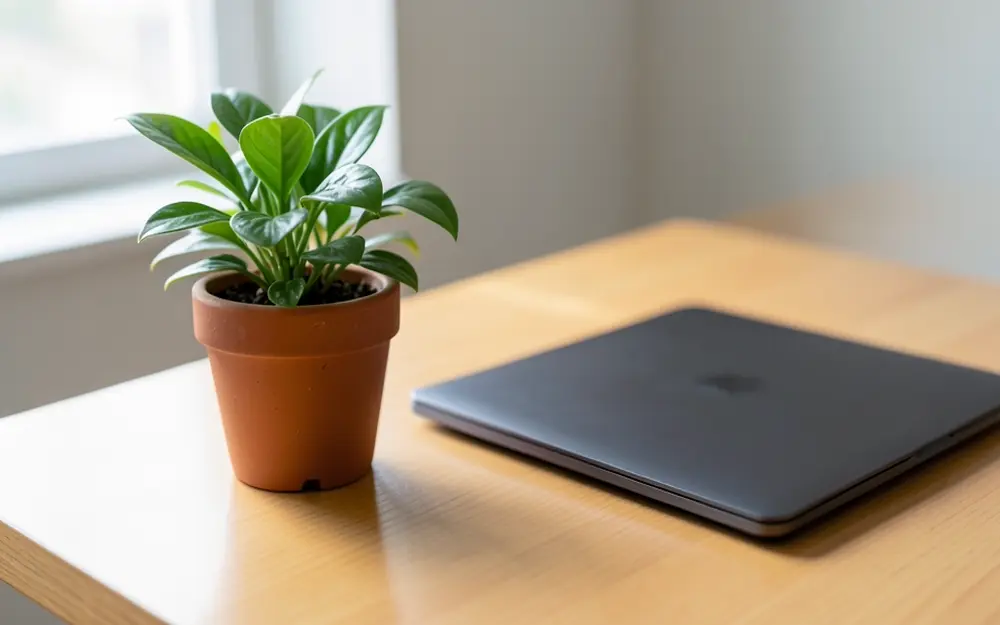
One plant on the desk is enough to start. Image generated by AI.
A greener desk works better
The strongest evidence for plants at work comes from real offices rather than laboratories. In 2014, researchers from Cardiff University, the University of Exeter, the University of Groningen and the University of Queensland ran three field experiments in two large commercial offices, one in Britain and one in the Netherlands. They enriched half of each office with leafy plants and left the other half bare and minimalist, then watched what happened over several months.
The staff in the green half reported better concentration, higher satisfaction with their workplace, and even a sense that the air was better. More strikingly, their measured productivity rose by 15 percent. The lead researcher, Marlon Nieuwenhuis, put it plainly: simply enriching a previously bare space with plants served to increase productivity by 15 percent, a figure that matched earlier laboratory work. The bare office, the researchers noted, was described by some as the most toxic space you can put a human into — not because the air was bad, but because there was nothing in it to look at, nothing alive.
Forty seconds of green
You do not even need to own a plant to get some of the benefit. In another 2015 study, 150 students were given a short, tiring attention task, then shown either a green roof or a bare concrete roof for just forty seconds. The students who saw the green roof recovered their attention faster and performed better afterwards. Forty seconds. Less time than it takes to boil a kettle.
It is a small effect from a brief glimpse, and it probably fades quickly. But it hints at why a plant on a desk or a view of a tree matters on a long afternoon. Our attention is not a machine that runs at one speed all day. It dips, and it recovers when something in the room gives it a gentle place to rest. A leaf does that job. A blank wall does not.
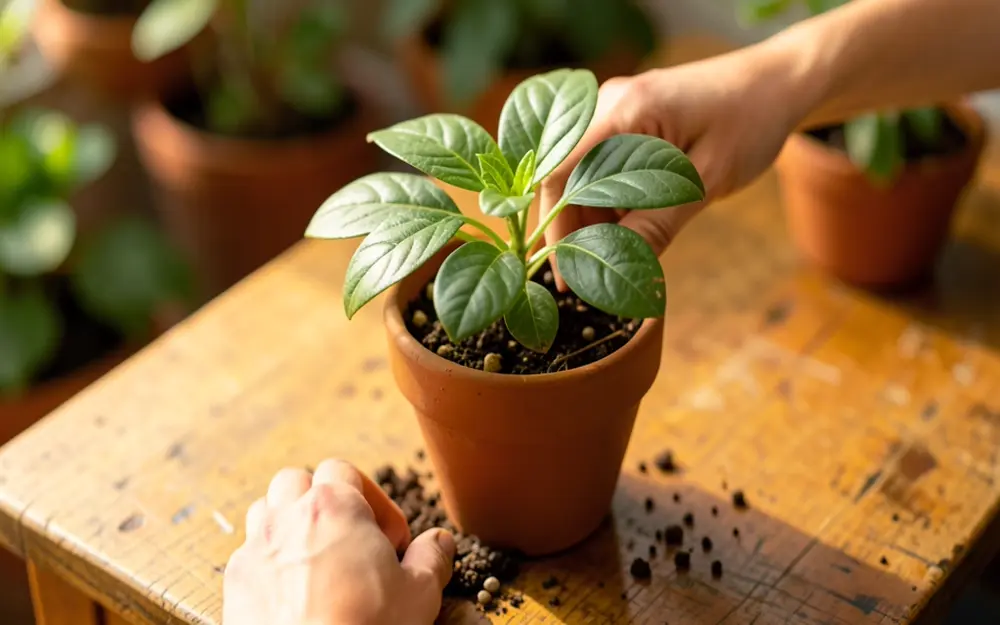
Repotting time: hands in the soil. Image generated by AI.
Why tending matters more than owning
Here is the part the plant shops never put on the tag. In the Korean study, the benefit came from repotting the plant — hands in the soil, fifteen minutes of slow, careful work — not from sitting near one. The researchers compared it with a computer task, and the difference was the doing. Watering, pruning, turning a pot towards the light: these are small rituals, and rituals are calming in a way that objects are not.
That also explains why a neglected plant can have the opposite effect. A drooping, yellowing pothos on a shelf is a small daily reminder of something you meant to do and did not. The plant does not judge you, but the sight of it can still nag. If your plants are struggling, the kindest move is to pick one that forgives you. A snake plant tolerates low light and forgotten watering. A pothos tells you clearly when it is thirsty and recovers fast. A peace lily droops dramatically when dry and perks up within hours of a drink, which makes it oddly satisfying to keep.
Start with one plant in the room where you spend the most time. Put it where you will actually see it — beside the kettle, on the desk, at the end of the kitchen table — rather than on a high shelf you never look at. Water it when the top of the soil feels dry, not on a fixed schedule. And accept that a plant or two will die. Every gardener kills plants. The ones who keep going are the ones who buy another and learn from the last one.
Why it matters
Houseplants at home are not air purifiers, and it is better to know that than to buy ten of them and wonder why nothing changed. What they are is cheaper and more interesting: a small, living presence that lowers the temperature of a room, gives your eyes somewhere soft to land, and hands you a tiny daily ritual that asks for nothing but a little water and attention. The science says the air claim is a myth and the mood claim is real, if modest. The plant on my windowsill does not clean anything. It just stands there, green and upright, and the room is better for it.
Related reading
If you like the idea of small habits that clear the head, read Why a Walk Helps You Think More Clearly.
Frequently asked questions
Do houseplants clean the air?
Not in any way you would notice. In sealed laboratory chambers, plants absorb chemicals like formaldehyde. In a normal room with windows and doors, fresh air does the job far faster. A review of twelve studies found you would need 10 to 1,000 plants per square metre to match ordinary ventilation.
How many plants do I need to feel the benefit?
For mood and focus, one or two in the room where you spend the most time is a good start. The studies that found benefits used a handful of plants in an office or a single plant task, not a jungle. More plants are lovely, but they are a hobby, not a dose.
Which houseplant is hardest to kill?
A snake plant is the classic beginner’s choice: it tolerates low light, little water and a lot of neglect. Pothos is nearly as forgiving and tells you when it needs a drink. Both are cheap, widely available and happy in an ordinary room.
Sources
- Do Houseplants Clean the Air? The NASA Study Explained — The Plant Index, on Wolverton et al. (1989)
- Cummings, B. E. and Waring, M. S. (2020). Potted plants do not improve indoor air quality. Journal of Exposure Science & Environmental Epidemiology
- A “Green” Office May Beat a “Lean” Office — Association for Psychological Science, on Nieuwenhuis et al. (2014)
- Lee, M. S. et al. (2015). Interaction with indoor plants may reduce psychological and physiological stress. Journal of Physiological Anthropology
- Can Even a Small Amount of Greenery Be Helpful in Reducing Stress? A Systematic Review — International Journal of Environmental Research and Public Health (2022)








0 Comments