

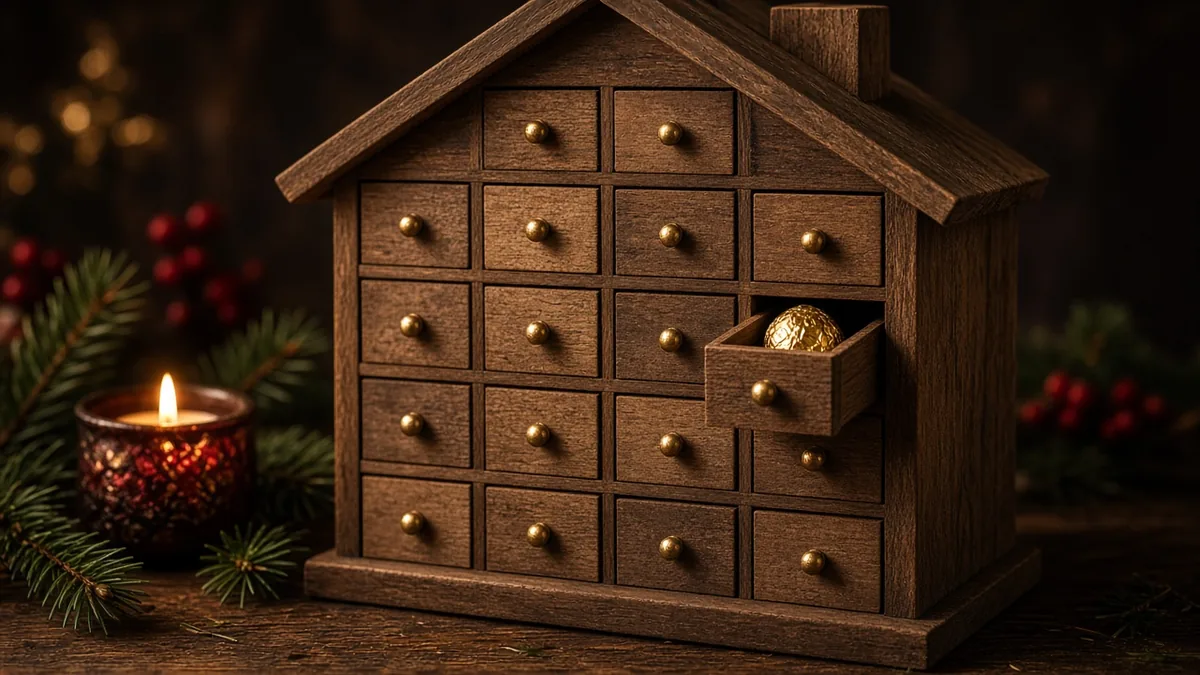
An original TeaLamp explainer based on the sources listed below. Prepared by the TeaLamp Editorial Team with the help of AI.
The history of the Advent calendar is a small, charming story about how people learned to make waiting feel like a gift. Long before chocolate windows and luxury beauty boxes, German families counted down to Christmas with chalk marks on a door, a picture a day or a candle burned down notch by notch. A Munich printer turned the idea into a product in 1908, a Stuttgart publisher carried it across the Atlantic after the Second World War, and today it comes in almost every flavour imaginable. Here is how a homemade family custom became a worldwide tradition, and why opening one little door a day feels so good.
Key takeaways on the history of the Advent calendar
- The Advent calendar grew out of 19th-century German Protestant home customs for counting the days before Christmas.
- The first printed calendars appeared in the early 1900s, and Gerhard Lang’s 1908 Munich calendar is usually named as the first commercial one.
- Calendars with little doors spread around 1920, and the first chocolate-filled versions arrived in 1958.
- After 1945, the Stuttgart publisher Richard Sellmer helped take the calendar to the United States and far beyond.
- Research on anticipation helps explain the appeal: looking forward to something can be a real source of happiness in itself.
What Advent is, and why the dates wobble
Advent, from the Latin word for “coming”, is the season of preparation before Christmas in many Christian churches. It begins on the fourth Sunday before Christmas Day, so its first day moves around between November 27 and December 3. In 2026, the First Sunday of Advent falls on November 29.
That wobble explains a small puzzle you may have noticed in the shops. Most modern calendars simply start on December 1 and run to December 24, so they can be printed once and sold every year. Some traditional and church calendars still begin on the first Sunday of Advent instead, and a few even carry on to Epiphany on January 6.
Before print: chalk marks, straw and candles
The calendar’s roots lie in Germany in the 1800s, especially among Lutheran families. Martin Luther’s reforms had encouraged a shift in gift-giving from St Nicholas’ Day on December 6 to Christmas itself, which made the wait for presents longer, and families found playful ways to help children through it.
According to the Knauf Museum in Iphofen, which held a major exhibition on Advent calendars, the methods were wonderfully simple. Some families hung up a picture a day. Others drew 24 chalk lines on a door, and children were allowed to wipe one away each morning. Some placed a single piece of straw in a little manger each day, so the crib was soft by Christmas Eve, while others burned an Advent candle down to the next mark every evening. The museum dates the earliest known homemade calendar to 1851.
The custom even found its way into literature. In Thomas Mann’s 1901 novel Buddenbrooks, young Hanno follows the approach of Christmas on a tear-off calendar made for him by his nursemaid, a detail the museum highlights as an early glimpse of the idea.
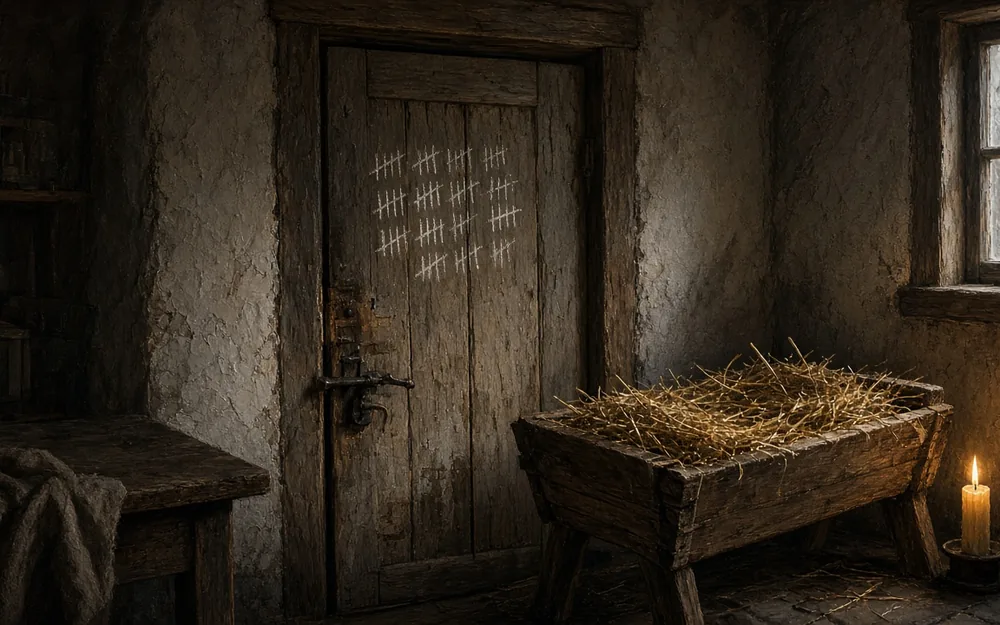
Before printed calendars, families counted the days with chalk, straw and candles. Image generated by AI.
The printers step in
At the start of the 20th century, the custom met the printing press. Deutsche Welle, Germany’s international broadcaster, reports that a Protestant bookshop in Hamburg printed a calendar shaped like a clock in 1902, and that the Stuttgart newspaper Neues Tagblatt included a “Christmas calendar” in one of its editions two years later.
The name most often linked with the first commercial Advent calendar, though, is Gerhard Lang. Most histories date his first calendar to 1908 (some German sources say a few years earlier). The printing firm Reichhold & Lang in Munich produced a calendar made of two sheets: one with 24 small pictures to cut out, and one with 24 numbered spaces to paste them into, one each day. National Geographic notes that Lang was inspired by his own childhood, when his mother made him a homemade countdown with a small treat for each day.
Lang’s company became known for some of the most artistic calendars of its time. The design that would define the tradition, with little doors that open to reveal a picture, appeared around 1920. Behind the windows, children found Bible verses, scenes from the Christmas story, or simply snowy villages and toys.
The following decades were harder. Lang’s firm did not survive the years between the wars, and during the Nazi period the calendars’ Christian imagery was partly replaced with fairy-tale figures and Germanic symbols before paper shortages in wartime halted production almost entirely.
Crossing the Atlantic: Sellmer and “The Little Town”
The modern Advent calendar owes a great deal to a Stuttgart publisher called Richard Sellmer. In December 1945, he received a licence from the American occupation authorities to print calendars, and his first design, a stand-up scene called Die kleine Stadt (“The Little Town”), was drawn by the artist Elisabeth Lörcher. It is still sold today.
Sellmer looked abroad from the start, and returning American soldiers helped spread the idea. The big moment came in 1953, when US President Dwight D. Eisenhower’s grandchildren were photographed with Advent calendars as part of a fundraising appeal by the National Epilepsy League. American families took notice, and the calendar became a familiar sight in the United States.
Sellmer also learned to adapt. Between 1946 and 1998, the company produced more than 230 designs, adjusted to local tastes. Calendars for Switzerland left out St Nicholas, angels for the American market had no wings, and British buyers tended to prefer religious themes.
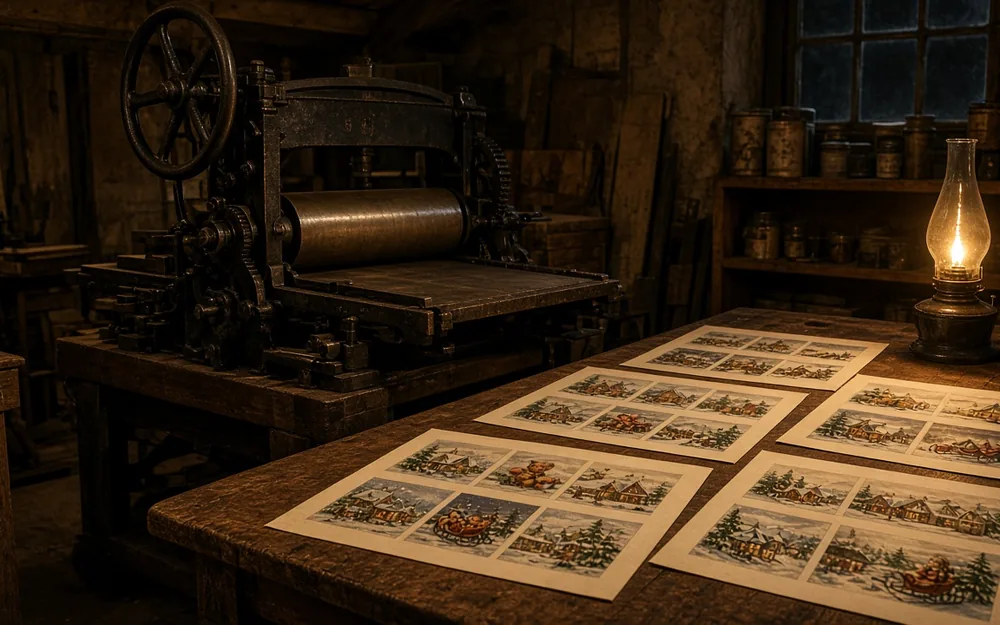
Printers turned the homemade custom into a product in the early 1900s. Image generated by AI.
Chocolate, television and calendars on buildings
From the 1950s onward, the Advent calendar became an affordable mass-produced item, most often showing romantic snow-covered towns with a larger window for December 24 that usually hid a nativity scene. Then, in 1958, came the first calendars filled with chocolate. It was the addition that would eventually make the calendar a fixture of supermarket shelves.
In the Nordic countries, the idea took a different form. In 1957, Swedish radio began broadcasting Barnens adventskalender, a children’s programme with one episode a day through December, and Swedish television followed in 1960. Denmark’s first televised Christmas calendar aired in 1962, and the “julekalender” or “julkalender” is now a beloved December habit across the region.
Some towns have gone even bigger. In parts of Europe, whole buildings become Advent calendars, with a different window decorated or lit each evening. At Hellbrunn Palace in Salzburg, Austria, the 24 front windows serve as a giant calendar during the Christmas market.
Why opening a little door feels so good
Why has such a simple object lasted for more than a century? Part of the answer may lie in what psychologists have learned about anticipation.
In a 2010 study of 1,530 Dutch adults, researchers led by Jeroen Nawijn found that people about to go on holiday were happier than those with no trip planned, an effect the authors linked to looking forward to the break. After the holiday, most travellers were no happier than before. In other words, a good part of the joy came before the trip even began.
A 2014 study by Amit Kumar, Matthew Killingsworth and Thomas Gilovich in Psychological Science found something similar about spending. Waiting for an experience, such as a trip or a concert, tended to feel more pleasant and exciting than waiting for a material purchase.
An Advent calendar seems to borrow from both ideas. It turns a long wait into a daily experience, breaking it into 24 small, predictable moments of surprise. For young children, who find it hard to picture time, it also makes the countdown visible: the closed doors shrink, and Christmas visibly comes closer. None of the studies tested calendars directly, so this is our reading rather than a proven result, but it fits neatly with what families have known since the chalk-mark days.
Modern twists on an old custom
Today the format is used for almost anything, from toy bricks and puzzles to cheese, socks and skincare. Many come from brands, and most leave out the religious imagery of the early calendars. Alongside them, the homemade calendar is thriving again, in forms our 19th-century predecessors would recognise:
- A tea calendar. Twenty-four different teas, one for each evening, turn the countdown into a small daily ritual.
- A kindness calendar. Each day reveals a small good deed to do for someone else.
- A story calendar. One short chapter, poem or carol a day, read aloud together.
- A memory calendar. Old family photos tucked into envelopes, with a story to share behind each one.
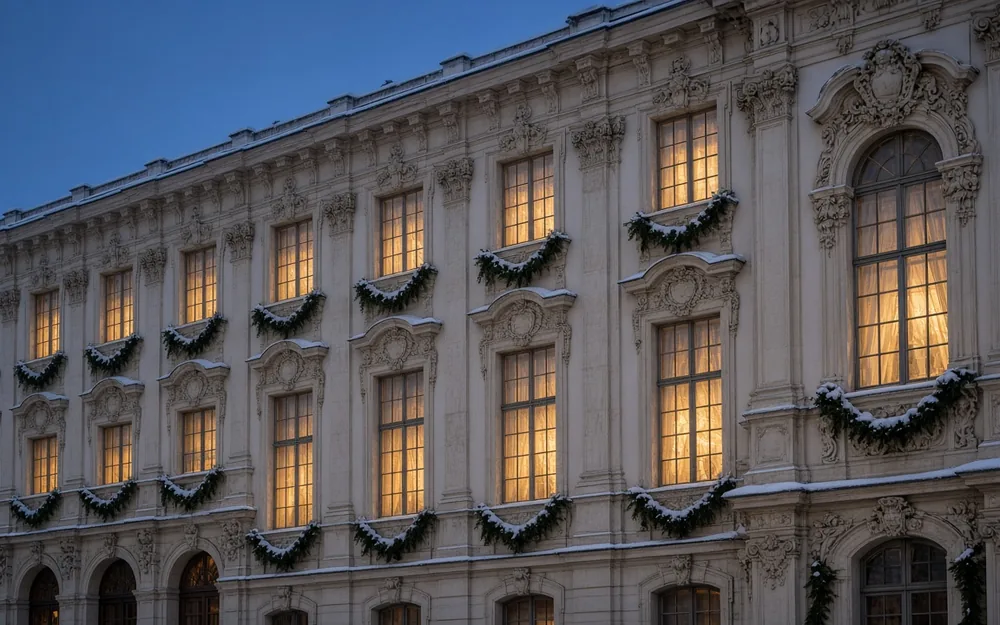
Some buildings become giant Advent calendars each December. Image generated by AI.
Related reading
For another tradition that turns small things into something beautiful, read about kintsugi, the Japanese art of mending pottery with gold, and for cozy December evenings, browse our five snowy stories to read with tea.
Why it matters
The Advent calendar shows how a tradition can be both very old and constantly new. It began as a way for parents to help children through a long wait, became a printed product, survived war and paper shortages, and then travelled the world, changing shape for each place it reached. Behind every little door is the same simple idea: waiting together, one day at a time, can be a pleasure rather than a chore.
Sources
- Adventskalender im Wandel der Zeit (Advent calendars through time), exhibition notes (Knauf-Museum Iphofen, in German)
- The Advent calendar’s sweet history (Deutsche Welle)
- What is Advent and why do we celebrate with calendars? (National Geographic)
- A brief history of Advent calendars (RTÉ)
- Advent calendar (Wikipedia)
- Nawijn et al. (2010): Vacationers happier, but most not happier after a holiday (Applied Research in Quality of Life, via PubMed Central)
- Kumar, Killingsworth and Gilovich (2014): Waiting for Merlot, anticipatory consumption of experiential and material purchases (Psychological Science)










0 Comments