

An original TeaLamp explainer based on the sources listed below. Prepared by the TeaLamp Editorial Team with the help of AI.
When was the last time a letter arrived for you that was not a bill? For most of us, the answer is a long time ago. Email, messaging and social media took over the everyday work of keeping in touch, and the handwritten letter quietly moved to the edges of life: birthday cards, thank-you notes, the occasional postcard from a holiday. Yet something small and stubborn is happening. People are picking up pens again, swapping postcards with strangers around the world, and discovering that a letter does something a message cannot quite do.
Key takeaways on handwritten letters
- Writing by hand produces far more elaborate brain connectivity than typing, according to a 2024 Norwegian EEG study of 36 students.
- Longhand note-takers remembered concepts better than laptop users in a well-known 2014 study, though later replications found a smaller effect.
- Postcrossing, a postcard exchange started in 2005, now has more than 800,000 members in over 200 countries and has passed 85 million postcards.
- A letter works because it is slow, personal and physical: it carries the writer’s time, hand and choices in a way a typed message does not.
The brain on pen and paper
The most interesting evidence for handwriting comes from a laboratory in Trondheim, Norway. Researchers at the Norwegian University of Science and Technology fitted 36 university students with caps holding 256 sensors each and recorded their brain activity while they wrote words by hand with a digital pen and typed the same words on a keyboard. When the students wrote by hand, the patterns of connection between brain regions were far more elaborate than when they typed, especially in the parietal and central regions, areas involved in memory formation and learning. The study was published in Frontiers in Psychology in January 2024.
It is worth stating plainly what the study did and did not show. The students copied words they were shown; nobody tested whether they remembered those words afterwards. The finding is about brain connectivity while writing, not proof that every handwritten note will be remembered better than every typed one. A published commentary also noted that the typing condition was unnatural, since students typed with a single finger. Still, the result fits a broader pattern: forming letters by hand asks the brain to coordinate vision, movement and touch in a way that pressing keys does not.
An earlier classroom study points in the same direction. In 2014, psychologists Pam Mueller and Daniel Oppenheimer asked students to take notes on lectures either by hand or on laptops. The laptop users wrote far more words, but they tended to copy the lecture almost word for word. The longhand writers, forced to choose what mattered, put ideas into their own words. On tests of conceptual understanding, the longhand group did better, and the advantage was still there a week later when students could review their notes before the test.
That study, too, needs a careful reading. Later attempts to repeat it, including work by Morehead and colleagues in 2019, found the handwriting advantage weaker and less consistent than the original result. The honest summary is modest: handwriting may help in some situations, especially when it forces you to think about what you are writing, but it is not magic. The pen helps because it slows you down enough to choose.
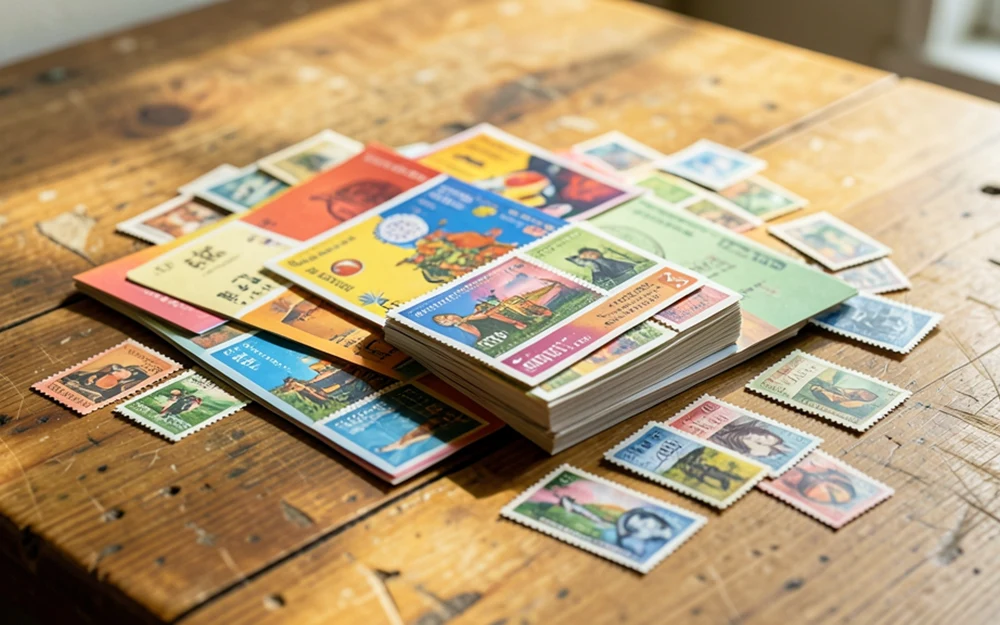
Postcards waiting to travel. Image generated by AI.
A postcard network that never stopped
If handwriting were only a laboratory curiosity, the letter’s comeback would be a thin story. But there is a living, worldwide example of slow mail thriving in the age of instant messaging. Postcrossing began in July 2005, when a Portuguese student, Paulo Magalhães, built a small website for exchanging postcards with strangers. The idea is simple: you send a postcard to a randomly chosen member somewhere in the world, and in return you receive cards from other random members.
Twenty-one years later, the numbers are remarkable. According to the United States Postal Service, which issued Postcrossing stamps in May 2026, the project has inspired more than 800,000 people in more than 200 countries and territories to send more than 85 million postcards, with more than 300,000 cards on their way at any given moment. Germany sends the most cards, and the United States comes second. In 2025 alone, members received almost 4.9 million postcards, each travelling an average of about 5,500 kilometres, roughly the distance from London to New York.
Why would hundreds of thousands of people wait weeks for a card from a stranger when a message arrives in a second? The wait is part of the point. A postcard cannot be edited after it is sent, it cannot be unsent, and it arrives bearing the marks of its journey: stamps, postmarks, a stranger’s handwriting and a view of a place you may never visit. It is a small, physical proof that someone, somewhere, thought of you for a few minutes and meant it.
Why a letter lands differently
Think about the letters you have kept. Most people keep a few: a note from a grandparent, a card from a friend, a letter from a time when someone’s words mattered. We rarely print out emails to keep in a drawer. A letter is kept because it is an object as well as a message. It carries choices a typed message hides: the paper, the pen, the handwriting itself, the crossing-out, the little drawing in the margin. You can see the person in it, not just their words.
A letter also gives both people something rare: unhurried attention. Writing one takes time, and that time is visible to the reader. There is no read receipt, no typing indicator, no pressure to reply within the hour. The writer chose what to say, and the reader can take as long as they like to take it in. In a world of instant replies, that slowness feels less like inefficiency and more like respect.
None of this means giving up the keyboard. Long emails, work documents and quick messages are exactly what typing is good at. The letter’s comeback is not a rejection of technology. It is a rediscovery of a tool we set aside too quickly, for the occasions when the message deserves more than speed.
How to start again
Starting is easier than it sounds, and it does not require beautiful handwriting or fancy paper. Pick one person you would like to hear from, and write them a short letter: what you have been doing, something you noticed lately, a question you would like them to answer. Three or four paragraphs are plenty. A letter that arrives is worth far more than a perfect letter that never gets written.
If you want a little structure, try a weekly habit. Sunday evening works well for many people: one letter, one cup of tea, no phone nearby. Write to a friend, a parent, a grandchild, or a stranger through Postcrossing. Keep a small stock of cards and stamps so there is nothing stopping you when the mood strikes. And keep the letters you receive. In a few years, you will be glad you did.
For anyone nervous about their handwriting, here is a reassuring fact from the Norwegian study: the researchers expected both print and cursive writing to have similar effects, because what matters is the careful forming of letters, not the style. Your handwriting does not need to be beautiful. It only needs to be yours.
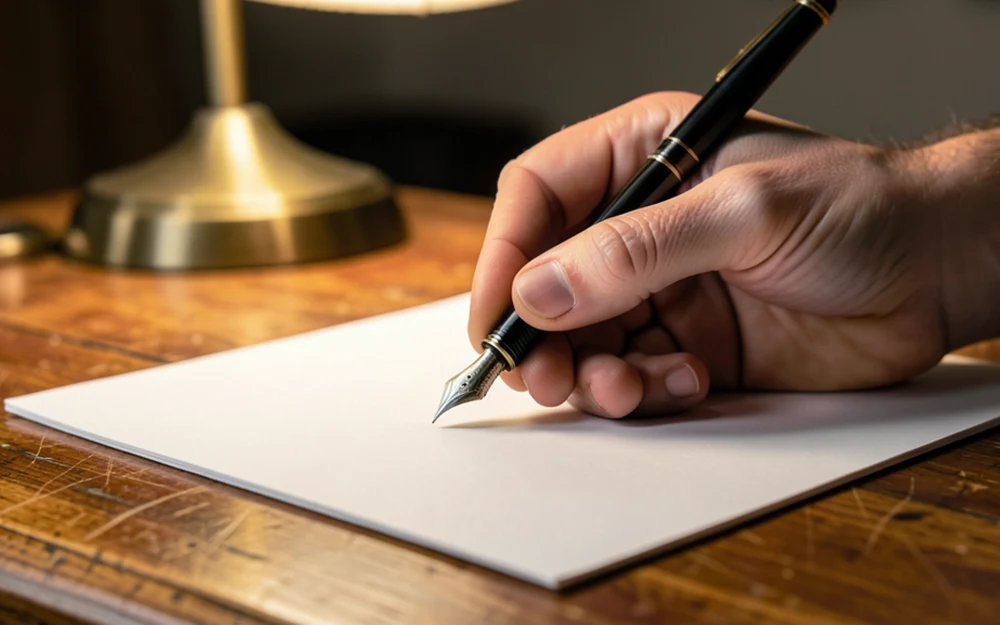
A hand, a pen and a blank page. Image generated by AI.
Frequently asked questions
Does handwriting really improve memory?
The evidence is promising but not settled. Brain imaging shows richer connectivity when writing by hand, and one well-known study found longhand note-takers understood concepts better, but later replications found a smaller effect. Treat handwriting as a helpful habit, not a guaranteed memory trick.
What is Postcrossing?
It is a free website, started in 2005, where members send postcards to randomly chosen people around the world and receive cards in return. More than 800,000 members in over 200 countries have exchanged more than 85 million postcards.
Do I need good handwriting to write letters?
No. Research suggests the benefit comes from forming letters carefully, whether in print or cursive. Readers treasure a letter for its personal touch, not its calligraphy.
Why it matters
Handwritten letters are making a quiet comeback for a simple reason: they give us something instant messaging cannot. They slow us down, they show our thinking, and they arrive as objects we can keep. The science is still being argued over, and that is fine. You do not need a brain scan to know why a letter from someone you love feels different from a notification. Pick up a pen, write to one person, and find out for yourself.
Related reading
For another story about slowing down and listening properly, read How to Interview Your Grandparents: A Holiday Oral History Guide.
Sources
- Van der Weel and Van der Meer, “Handwriting but not typewriting leads to widespread brain connectivity,” Frontiers in Psychology, 2024
- PubMed record for the Van der Weel and Van der Meer handwriting study
- Mueller and Oppenheimer, “The pen is mightier than the keyboard,” Psychological Science, 2014, summarised by Journalist’s Resource
- United States Postal Service, “U.S. Postal Service Issues Postcrossing Stamps,” May 2026
- Postcrossing in numbers: 2025 statistics




0 Comments