

A TeaLamp reading list, written in our own words. Prepared by the TeaLamp Editorial Team with the help of AI.
These five books about tea are for anyone who has ever wondered how a few dried leaves came to shape empires, art and everyday comfort around the world. Some are short and poetic, some read like adventure stories, and one is a practical guide you can keep beside the kettle. Together they tell the story of tea from ancient Chinese mountains to the modern teapot on your table.
Key takeaways on these books about tea
- The Book of Tea by Okakura Kakuzō (1906) is a short, poetic classic about tea, beauty and simplicity, and it is free to read in the public domain.
- For All the Tea in China by Sarah Rose tells the true story of plant hunter Robert Fortune and his journey into China’s tea country in the 1840s.
- The True History of Tea by Victor H. Mair and Erling Hoh is a lively world history that follows tea across Asia, Europe, Africa and beyond.
- A Thirst for Empire by Erika Rappaport explores how tea and the British Empire shaped each other, from advertising to plantations.
- Tea: History, Terroirs, Varieties by the team at Montreal’s Camellia Sinensis Tea House is a practical guide to tea regions, types and brewing.
The Book of Tea by Okakura Kakuzō
Our list begins with the most famous short book ever written on the subject. Okakura Kakuzō, a Japanese scholar of art, wrote The Book of Tea in English, and it was published in New York by Fox, Duffield and Company in 1906. It runs to well under two hundred pages, so you can read it in an evening, ideally with a cup of something green.
Okakura uses the Japanese tea ceremony as a doorway into a whole way of seeing the world. He introduces the word “Teaism” for an outlook that finds beauty in small, imperfect and passing things. Chapters move through the history of tea in China, the links between tea and Taoist and Zen thought, the design of the simple tea room, flower arranging and the tea masters, ending with the great sixteenth-century master Sen no Rikyū. The book also gently invites Western readers to look at Asian cultures with more curiosity and respect.
Its influence went far beyond tea lovers. Architects, designers and writers have returned to it for more than a century. Because it is now in the public domain, you can find free editions online through projects like Project Gutenberg.

Tea bushes on terraced slopes, where every book on this list begins. Image generated by AI.
For All the Tea in China by Sarah Rose
If you like history that reads like a thriller, this is the book for you. Sarah Rose, an American journalist, tells the true story of Robert Fortune, a Scottish botanist sent by the East India Company in 1848 to gather tea plants, seeds and know-how from China and bring them to the company’s new gardens in India. At the time, China was the world’s main source of tea, and its growers guarded their methods closely.
Rose follows Fortune as he travels inland in Chinese dress, visits famous tea districts such as the Wuyi mountains, and learns how green and black teas are made from the same plant. She also explains the clever glass cases that helped living plants survive the long sea voyage. The book was first published in Britain in 2009 and in the United States by Viking in 2010.
It is a lively, accessible read that helps explain why so much of the world’s tea now comes from India and Sri Lanka. It also raises fair questions about trade, secrecy and who benefits when knowledge crosses borders.
The True History of Tea by Victor H. Mair and Erling Hoh
For a broad, global view, this book is hard to beat. Victor H. Mair, a sinologist at the University of Pennsylvania, and Erling Hoh, a writer and journalist, trace tea’s journey from its early use in southern China to almost every corner of the world. Thames and Hudson published it in 2009, and it runs to about 280 pages with illustrations.
The authors draw on Chinese, Japanese, Tibetan and Mongolian records, along with European travel accounts, to show how tea moved along trade routes. Readers meet the old tea-horse trade between China and Tibet, the Russian samovar, sweet mint tea in Morocco and the tea gardens of colonial Asia. Each culture adds its own rituals, cups and tastes.
The tone is curious and friendly rather than academic, with plenty of stories and surprising details. It is a good choice if you want one book that connects the many tea traditions you may already know from cafés and travels.
A Thirst for Empire by Erika Rappaport
Erika Rappaport, a historian at the University of California, Santa Barbara, takes a closer look at one powerful chapter of tea’s story: how tea and the British Empire shaped each other from the seventeenth century to the twentieth. Princeton University Press published the book in 2017 under the full title A Thirst for Empire: How Tea Shaped the Modern World.
Rappaport looks at how tea became an everyday British habit, and at the merchants, planters, advertisers and shop owners who helped make that happen. She explores how marketing campaigns created a picture of the “cup of tea” as part of national identity, and how plantations in South Asia and Africa, often built on hard and poorly paid labour, supplied that demand. She also follows the story well into the twentieth century, as the industry worked hard to win new drinkers around the world.
This is the most scholarly book on our list, but it is clearly written. It suits readers who enjoy social and economic history and who want to understand the bigger forces behind something as ordinary as a morning cup.
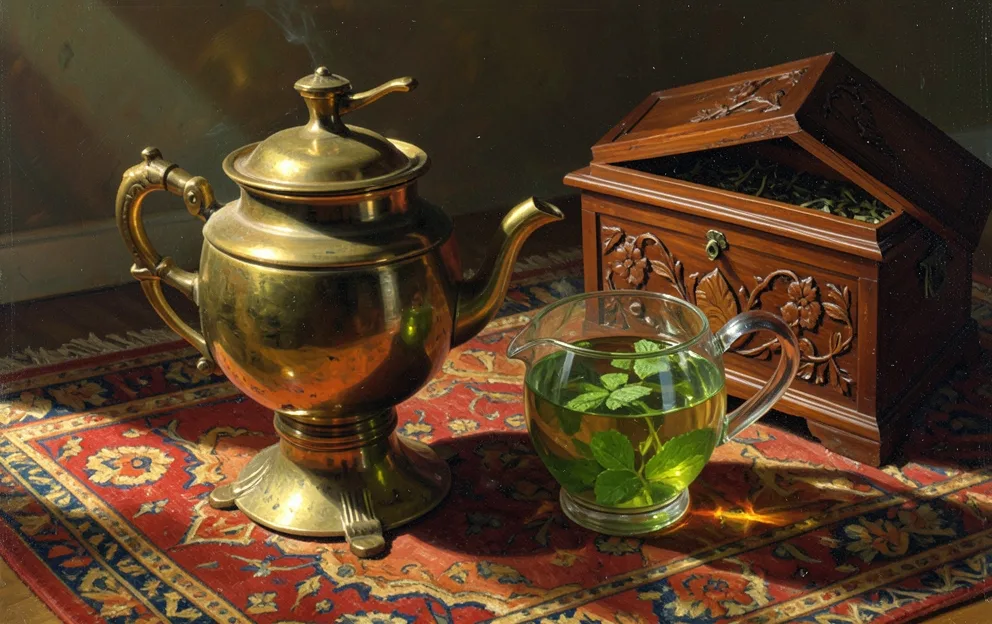
Brass, mint and a carved tea chest: tea traditions travel far. Image generated by AI.
Tea: History, Terroirs, Varieties by Camellia Sinensis Tea House
Our last pick is the one most likely to end up stained with tea. It was written by Kevin Gascoyne, François Marchand, Jasmin Desharnais and Hugo Américi, the tea buyers and founders behind Camellia Sinensis, a well-known tea house in Montreal. The book first appeared in French and was later published in English by Firefly Books. Its third edition came out in 2018 and runs to about 288 pages.
The authors travel every year to tea-growing regions, and the book shares what they have learned. It explains how tea is grown and processed, and then takes readers region by region through China, Japan, Taiwan, India, Sri Lanka, Nepal, Vietnam and East Africa. There are guides to the main tea families, tips on brewing and tasting, and recipes that use tea in the kitchen.
It is a warm, practical companion for anyone who wants to move from tea bags to loose leaves, or who simply wants to know where their favourite oolong comes from.
How to choose your first tea book
If you want something short and thoughtful, start with The Book of Tea. If you love a good true adventure, pick For All the Tea in China. For the widest view of tea around the world, choose The True History of Tea. Readers interested in trade and empire will get the most from A Thirst for Empire. And if your goal is simply to brew and taste better tea at home, reach for Tea: History, Terroirs, Varieties.
Why it matters
Tea is one of the most widely enjoyed drinks on Earth, yet most of us know little about where it comes from. These books show that every cup carries a long story of farmers, travellers, artists and traders, including some difficult chapters of history. Reading about tea can make an everyday habit feel richer, more mindful and more connected to people far away. It is also simply a pleasure: few subjects pair so naturally with a good book and a warm cup.
Related reading
Ready to put these books into practice? Try our guide on how to brew loose-leaf tea, or browse our list of Japanese novels to read over tea.
Sources
- Project Gutenberg: The Book of Tea by Kakuzo Okakura
- Wikipedia: The Book of Tea
- Penguin Random House: For All the Tea in China by Sarah Rose
- Wikipedia: Robert Fortune
- Thames and Hudson: The True History of Tea
- Princeton University Press: A Thirst for Empire
- Camellia Sinensis: Tea, History, Terroirs, Varieties (Third Edition)








0 Comments