

Key takeaways
- Horseshoe crabs are not crabs at all. They are ancient marine chelicerates, closer to spiders and scorpions, with fossils going back nearly half a billion years.
- Their blood runs blue because it uses copper-based hemocyanin to carry oxygen, unlike the iron-based haemoglobin in our red blood.
- Blood cells from these animals clot on contact with bacterial toxins, which is why the medical world has relied on them for decades to keep vaccines, implants and injectable drugs safe.
- About 15% of bled crabs die soon after release, with sublethal effects on the rest, and a lab-made alternative called recombinant Factor C is now officially accepted, with the US Pharmacopeia clearing it in 2025.
- The bigger pressure on the animals is not medicine at all. Roughly a million crabs a year are taken as fishing bait, a toll that dwarfs the biomedical harvest.
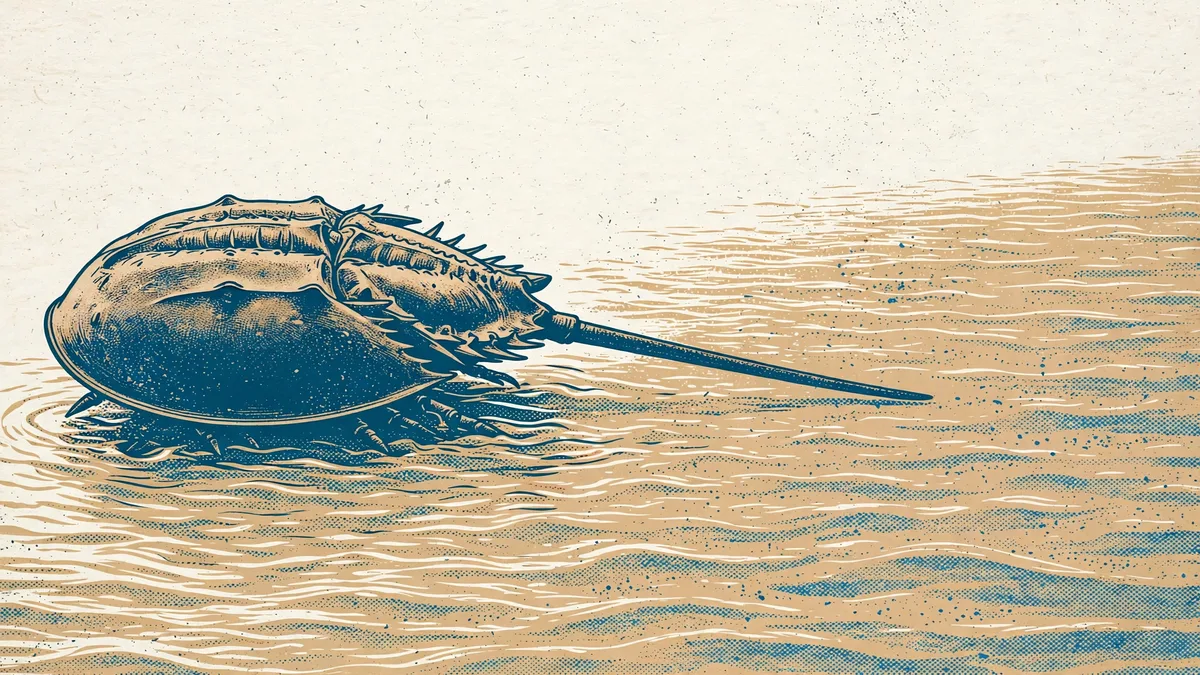
Somewhere in the shallow waters of the Atlantic coast, a creature older than the dinosaurs is crawling across the sand, dragging a sword-shaped tail behind it. It bleeds blue. It sees with ten eyes. And every year, a sample of its blood helps certify that the medicine in your cabinet is safe to use. The horseshoe crab is one of the strangest success stories in nature, and it is also the quiet guardian of modern pharmaceutical safety.
Horseshoe crab blood, explained
The blue comes down to chemistry. Our blood carries oxygen on haemoglobin, a molecule built around iron, and iron gives it the familiar red colour. Horseshoe crab blood carries oxygen on hemocyanin, a molecule built around copper. When hemocyanin binds oxygen, it turns a vivid blue, the same reason copper compounds so often look blue or turquoise. The blood is not a curiosity of appearance only. Suspended in it are special cells called amebocytes, and these cells do something remarkable: they clot instantly on contact with bacterial endotoxins, the debris shed by certain bacteria.
That clotting reaction was noticed in the 1950s, and it became the basis of the LAL test, short for Limulus amebocyte lysate, named after the Atlantic species Limulus polyphemus. A drop of LAL mixed with a sample of vaccine, saline drip or implant material will gel if even trace amounts of bacterial toxin are present. Before this test, the industry used rabbits. The LAL test is faster, more sensitive and far cheaper, and it is still the standard safety screen for anything injected into the human body.
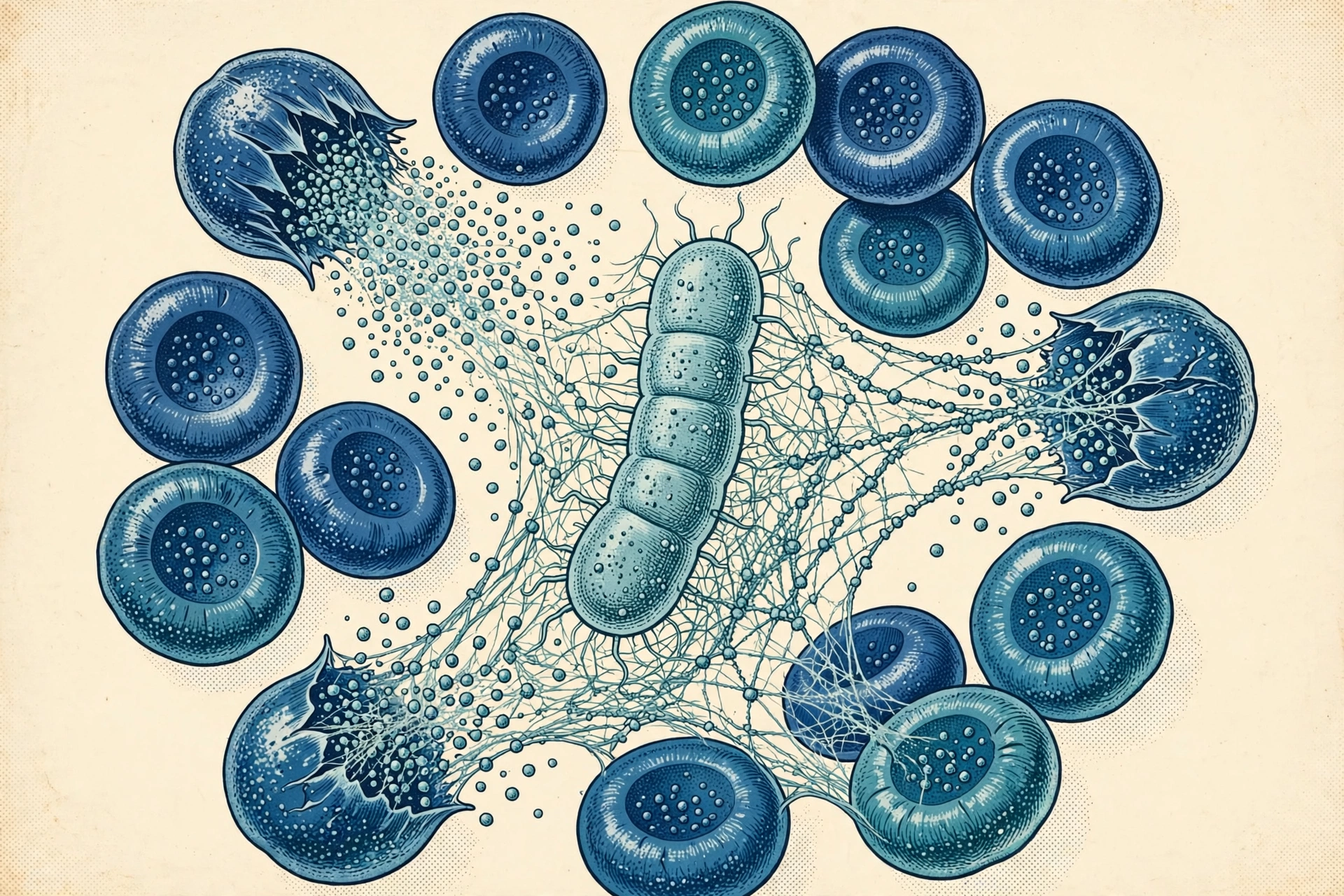
Horseshoe crab amebocytes burst on contact with bacterial endotoxins, releasing a clot that traps the invader. Image generated by AI.
Not a crab, and not young
Despite the name, the horseshoe crab is no crab. True crabs are crustaceans. Horseshoe crabs belong to the chelicerates, the group that includes spiders, scorpions and ticks, and they have been following their own evolutionary path for an astonishingly long time. Fossils recognisably like modern horseshoe crabs turn up in rocks about 450 million years old, and some of the oldest specimens known were found in Late Ordovician rocks in Manitoba, Canada.
Their vision is almost as odd as their age. The commonly cited total is ten eyes: two large compound eyes on the sides of the shell, two simple eyes on top, and six small rudimentary eyes scattered around the body, including on the tail. Those big lateral eyes made the animal a classic model in vision research. Work on horseshoe crab photoreceptors in the 1960s helped reveal how neurons encode light, research that contributed to the 1967 Nobel Prize in Physiology or Medicine.
The bleeding industry
Each spring, tens of thousands of Atlantic horseshoe crabs are collected from the US east coast, taken to laboratories, and bled. The standard draw removes up to about 30% of the animal’s blood volume, after which the crabs are returned to the water. Estimates from a large review of the data put the number of crabs bled each year at roughly 525,000, based on 2013 to 2017 figures.
What happens to them next is the difficult part. The same analysis estimates that about 15% of bled crabs die in the weeks after release, with the true figure somewhere in a range from 4 to 30%. Survivors do not get off lightly either. Studies tracking released animals found they move and feed less and spawn less successfully than crabs that were never bled. The animals matter ecologically, too: their eggs are a vital spring food source for migrating shorebirds such as the red knot, which times its Arctic migration to the crab spawning season.
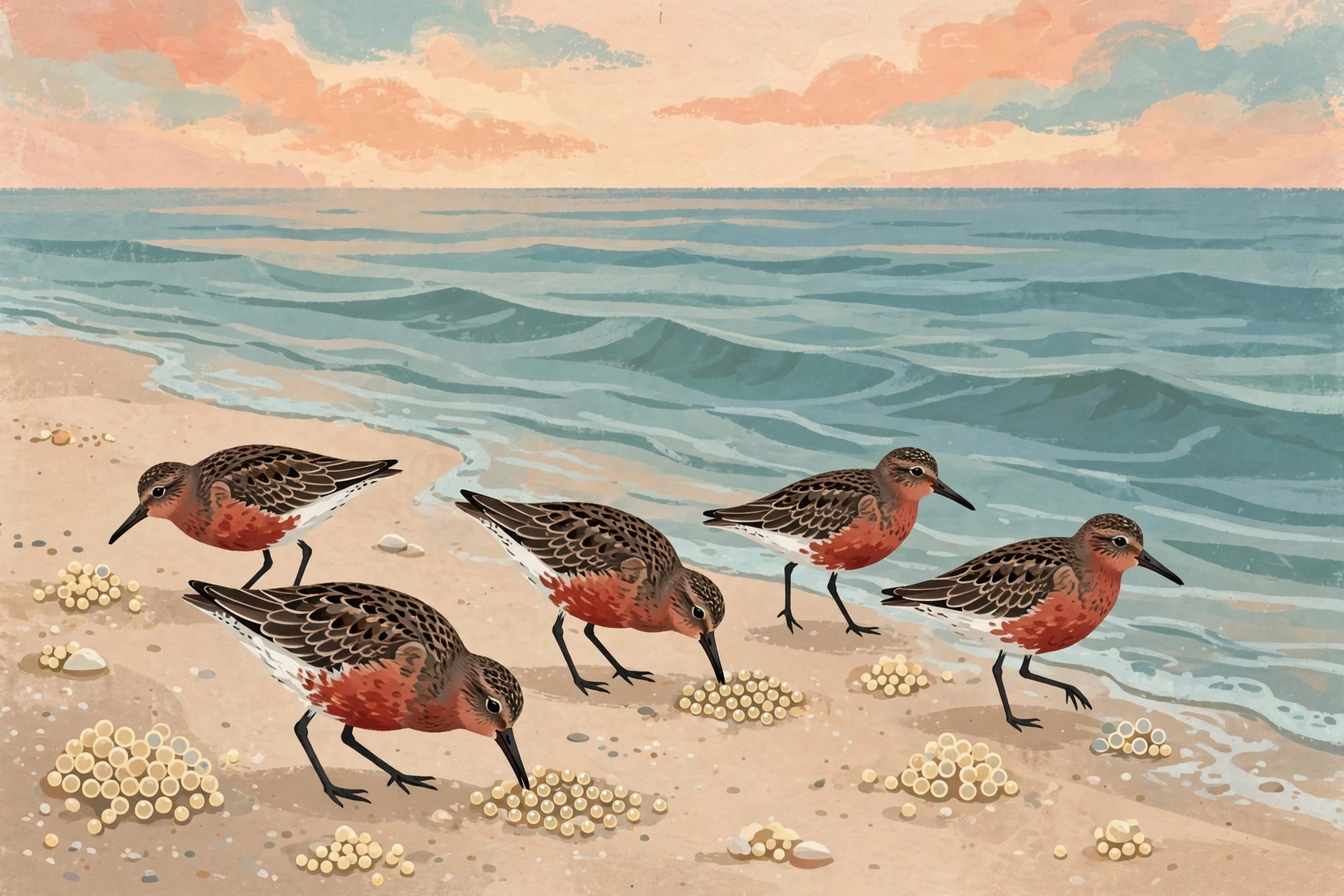
Red knots time their migration to the horseshoe crab spawning season, fattening up on the eggs. Image generated by AI.
A lab-made replacement arrives
The good news is that the bleeding may not be needed much longer. Scientists have long known that the clotting reaction depends on a single protein, Factor C. Since the 1990s they have been building a synthetic version, recombinant Factor C (rFC), produced by engineered cells instead of crabs. Companies now sell rFC-based test kits, and regulators have steadily moved toward acceptance.
The turning point came recently. The European Pharmacopoeia accepted rFC-based testing in 2016, and the US Pharmacopeia approved chapter <86>, covering endotoxin tests with recombinant reagents, with official status from May 2025. The US Food and Drug Administration has also clarified that recombinant reagents are acceptable alternatives to crab-blood lysate. In other words, the science that could end the bleeding is no longer experimental; it is in the rulebooks.
Why it matters
The horseshoe crab is a rare case where a wild animal sits directly inside the safety chain of modern medicine, and that position has made it both protected and exploited. The biomedical harvest gets the headlines, but the numbers tell a different story: around a million horseshoe crabs a year are caught to be used as bait for eel and whelk fisheries, and those animals do not return to the water. Against that, the biomedical toll is a fraction of the total. Several US states have restricted or banned the bait harvest, and the Atlantic species is listed as vulnerable by the IUCN while its Asian relatives are worse off. The rFC alternative offers the cleanest way forward for the medical side. For the rest, the animal’s fate depends on whether fishing rules can keep up with what the science has been saying for years.
Related reading
Curious about other ancient marine arthropods? Read The 32-Centimetre ‘Roly Poly’ Hiding in a Museum Drawer, the story of a giant isopod identified from a museum specimen.
Frequently asked questions
Why is horseshoe crab blood blue?
It carries oxygen on hemocyanin, a copper-containing molecule. Oxygenated hemocyanin looks blue, just as our iron-containing haemoglobin looks red.
Is the blood really worth tens of thousands of dollars a gallon?
The refined lysate is expensive because harvesting and processing are costly, but the viral figure you may have seen is not a standard market price. It is better to think of it as one of the most valuable fluids harvested from a wild animal, rather than a fixed price tag.
Does the synthetic test really work as well?
Yes. Recombinant Factor C detects the same bacterial toxins through the same core reaction, and it is now accepted by the European and US pharmacopeias and acknowledged by the FDA as an alternative to crab-blood lysate.
Can I see horseshoe crabs myself?
On the US Atlantic coast they come ashore to spawn on spring high tides, usually in May and June around the full and new moons. They are harmless, and wildlife agencies ask beachgoers to flip stranded crabs right-side up.
Adapted from “Horseshoe Crabs: The Good, the Bad, and the Amazing” by Winsor H. Watson III, Frontiers for Young Minds (2026), under CC BY 4.0. Original: kids.frontiersin.org/articles/10.3389/frym.2026.1695228. Minor TeaLamp wording edits (2026-10-11).










0 Comments