

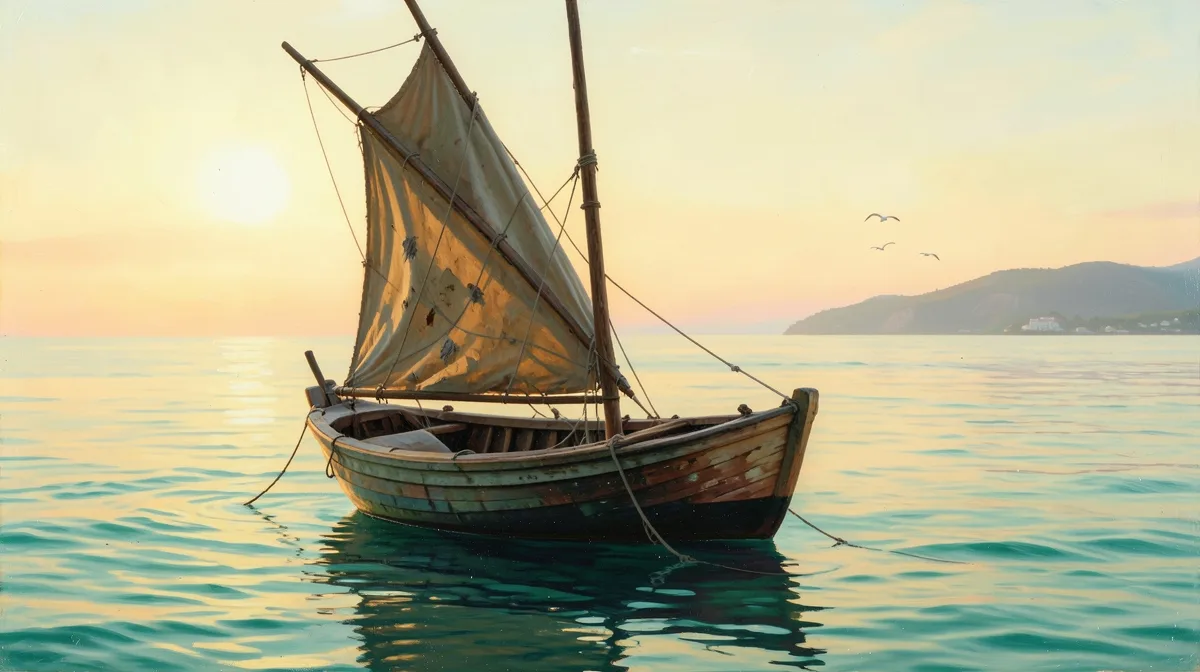
A TeaLamp book review of The Old Man and the Sea by Ernest Hemingway (1952), written in our own words. Prepared by the TeaLamp Editorial Team with the help of AI.
This Old Man and the Sea review looks at one of the shortest great books of the twentieth century: a story about an old fisherman, a giant fish and three long days on the open water. Ernest Hemingway’s novella can be read in a single quiet afternoon, yet readers have argued about its meaning for more than seventy years. Here is what the book does, why it caught the world’s attention so quickly, and who is most likely to love it.
Key takeaways from our Old Man and the Sea review
- A short novella, first published in full in Life magazine on September 1, 1952, and as a book by Charles Scribner’s Sons a week later.
- Santiago, an old Cuban fisherman who has gone 84 days without a catch, hooks a marlin longer than his boat and fights it far out in the Gulf Stream.
- The heart of the book is not victory but endurance, dignity and respect, including Santiago’s respect for the fish he is fighting.
- It won the Pulitzer Prize for Fiction in 1953 and was singled out when Hemingway received the Nobel Prize in Literature in 1954.
- Best for readers who enjoy spare, simple prose, sea stories and books that reward a second, slower reading.
What the story is about
Santiago is old, poor and, in the eyes of his village, unlucky. He has fished for 84 days without bringing anything home. Manolin, the boy he taught to fish, has been sent by his parents to work on a luckier boat, but he still comes every evening to help the old man carry his gear and to make sure he eats. The two talk about baseball and the great Joe DiMaggio, and the boy’s quiet loyalty gives the opening pages their warmth.
On the 85th day, Santiago rows out alone, farther than the other fishermen go. Deep in the Gulf Stream, a huge marlin takes his bait. The fish is too strong to pull in, so it pulls him instead, towing the small skiff out to sea through a day, a night and another day. Santiago holds the line across his back, talks to himself, talks to the fish and keeps going. When he finally brings the marlin alongside and ties it to the boat, the hardest part of the journey is only beginning. Sharks follow the trail, and the long sail home becomes a second test, of a very different kind.
We will not spell out every turn of the ending, but it is worth knowing that the story closes quietly, back on land, with the boy beside the old man. That final image is one of the gentlest in all of Hemingway’s work.
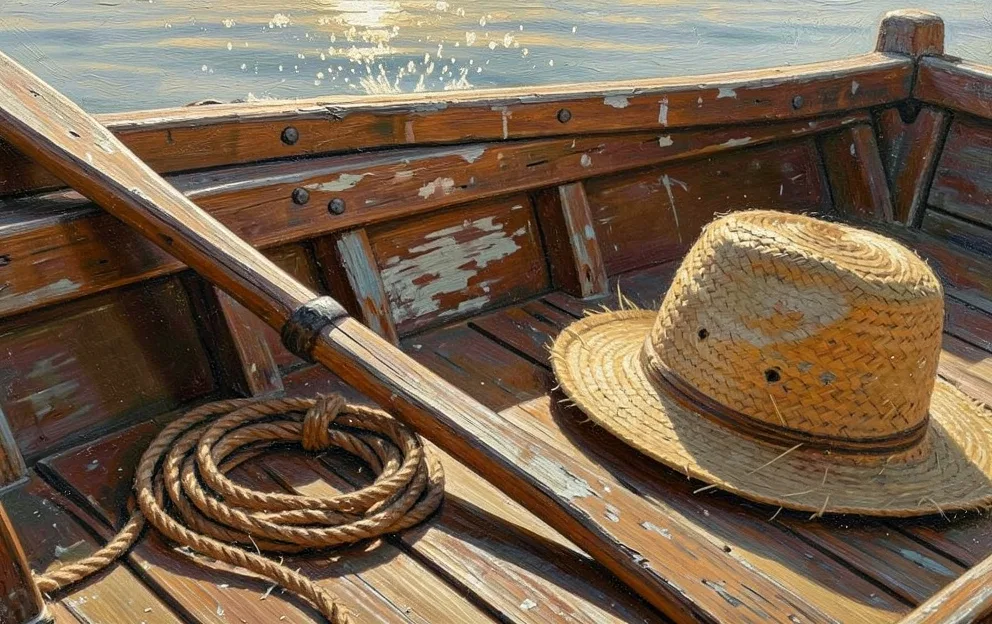
Line, oar and hat: the simple tools of Santiago’s long fight at sea. Image generated by AI.
Hemingway’s plain, rolling style
Hemingway was famous for short sentences and plain words, and this book shows that style at its most relaxed. Many passages are simple descriptions of work: baiting hooks, coiling line, watching the light change on the water. The language repeats itself, the way an old man’s thoughts might circle around the same few worries. On first reading, some people find it slow. On a second reading, that rhythm starts to feel like the sea itself, steady and patient, with sudden bursts of danger.
The novella also mixes two kinds of voice. Much of it sits close to Santiago’s mind, so we hear his half-spoken prayers, his memories of youth and his running conversation with the marlin. At other moments the narrator steps back and simply shows us the boat, the birds and the sky. That balance keeps the book from feeling either too private or too distant. It is a good choice for readers who want to see how much a writer can do with very little.
Santiago, the boy and the fish
Santiago is one of the most memorable characters in American fiction because he is both ordinary and grand. He is a working man with sore hands and an empty stomach, yet he faces his struggle with a calm sense of honour. He calls the marlin his brother, admires its strength and beauty, and feels sorrow even as he tries to catch it. This mix of rivalry and respect is what gives the book its moral depth.
His most quoted line sums up the spirit of the story. As he puts it in Hemingway’s novella, “a man can be destroyed but not defeated” (Ernest Hemingway, The Old Man and the Sea). Readers can take that idea in many directions: as a statement about old age, about work, about art, or simply about getting through a hard week. The book does not insist on one answer.
Manolin matters just as much, even though he is absent for most of the voyage. Santiago keeps wishing the boy were with him, and that longing tells us how much their friendship means. The relationship between a young person and an elder, each caring for the other, is one of the book’s quiet joys and one reason it is so often taught in schools.
Why the book caused such a stir in 1952
Part of the book’s legend comes from the way it arrived. Hemingway wrote the manuscript in Cuba over the winter of 1950 to 1951, at a time when his previous novel had received poor reviews. When Life magazine printed the whole novella in a single issue, it reportedly sold more than five million copies in two days. The Scribner’s edition followed, and the book stayed on the New York Times bestseller list for months.
Awards followed too. The novella won the Pulitzer Prize for Fiction in 1953, and when the Swedish Academy awarded Hemingway the Nobel Prize in Literature in 1954, The Old Man and the Sea was the one work it named in its announcement. For many readers, the book became a symbol of a great writer finding his voice again.
Critics have also debated the book over the decades. Some read it as a religious parable, pointing to Santiago’s name (Spanish for Saint James, a fisherman in the New Testament) and to imagery of suffering and the cross. Others see it as a story about the artist, who works alone for a long time and then watches others fail to understand the result. Some later critics felt the early praise had been too strong. That long conversation is a sign of a book that keeps people thinking.

Back on shore, the fishing village waits as the light fades. Image generated by AI.
Who will enjoy it most
This is an excellent first Hemingway for readers who have never tried him, because it is short, clear and complete in itself. It suits anyone who loves the sea, fishing or nature writing, and readers who enjoy stories about older characters who still have something to prove, mostly to themselves. It also works well for book clubs and classrooms, since it is easy to finish and hard to stop discussing.
Readers who prefer busy plots, many characters or lots of dialogue may find it best approached in the right mood: on a slow evening, perhaps with a pot of tea, ready to let the rhythm carry them. Animal lovers should know that the book describes fishing and shark attacks plainly, though never cruelly or for shock. If you enjoy big sea stories, it also pairs beautifully with longer classics like Moby-Dick, which takes the same ocean struggle and stretches it across a whole ship and crew.
Why it matters
The Old Man and the Sea matters because it shows how much a very small story can hold. One man, one boat and one fish become a way to think about age, pride, friendship, luck and the dignity of honest work. It reminds us that losing is not the same as being beaten, and that the people who wait for us on shore are part of every journey. More than seventy years after it first appeared, it still feels like a book you can carry in a pocket and keep for a lifetime.
Related reading
If this review leaves you longing for more great sea stories, read our Moby Dick summary, which follows Captain Ahab’s very different struggle with the deep.
Frequently asked questions
How long is The Old Man and the Sea?
It is a novella of about 27,000 words. The first hardcover edition ran to roughly 140 pages, so most readers finish it in two to three hours.
Is The Old Man and the Sea based on a true story?
Not exactly. Hemingway had heard a tale about an old fisherman and a huge marlin from a Cuban fishing guide in the 1930s and had written about it in an essay for Esquire. The novel’s characters and events are fiction, shaped by his own years of fishing in the Gulf Stream.
Where is the story set?
It takes place in a small fishing village near Havana, Cuba, and out on the Gulf Stream, where Hemingway himself spent thousands of hours on his boat.









0 Comments