


An original TeaLamp explainer based on the sources listed below. Prepared by the TeaLamp Editorial Team with the help of AI.
The Pomodoro technique is one of the simplest productivity methods ever invented: set a timer for 25 minutes, work on one thing until it rings, take a short break, and repeat. Millions of students, writers and programmers swear by it, and countless apps now put a little tomato on your screen. But does working in short, timed bursts actually help, or does it just feel tidy? Here is where the method came from, what the research really shows about breaks and focus, and how to make the timer work for you rather than against you.
Key takeaways on the Pomodoro technique
- The method was developed by Francesco Cirillo in the late 1980s and named after the tomato-shaped kitchen timer he used as a university student.
- A classic cycle is 25 minutes of focused work, a 5-minute break, and a longer break of 20 to 30 minutes after four rounds.
- Research on short breaks shows reliable, if modest, gains in energy and lower fatigue; the effect on performance is smaller and less certain.
- Studies comparing fixed Pomodoro breaks with breaks people choose themselves have found similar amounts of work done, with mixed results on mood.
- The best version is the one you adjust: the timer is a tool for starting and stopping, not a rule to obey.
A kitchen timer and a student’s problem
The story behind the method is refreshingly ordinary. Francesco Cirillo, then a university student in Italy, was struggling to concentrate on his studies. He picked up a kitchen timer shaped like a tomato, a pomodoro in Italian, and challenged himself to study without distraction for just a short, fixed stretch. That small experiment grew into a full system, which he later wrote up and taught. Each interval of work is itself called a pomodoro, and the plural, fittingly, is pomodori.
The original rules are a little stricter than most apps suggest. You choose a task, start the timer, and work only on that task until it rings. Then you take a short break, usually five to ten minutes. After four pomodori you take a longer rest. A pomodoro is meant to be indivisible: if something interrupts you, you either note it down and deal with it later, or you abandon that pomodoro and start a fresh one. Cirillo also built in planning and tracking, with a simple “To Do Today” list and a tally of completed rounds, so that over time you learn how long your tasks really take.
He was also fond of the physical timer. Winding it, he argued, is a small act of commitment; the ticking keeps the goal in mind; and the ring gives permission to stop. It is a charming idea, and one many people still enjoy, even if a phone does the job today.

A small kitchen timer, the humble start of a famous method. Image generated by AI.
Why short bursts might work
The method rests on a few sensible ideas. The first is that starting is often the hardest part. Twenty-five minutes feels small enough to begin even a dreaded task, and once you are under way, momentum tends to carry you. The second is that attention is limited. Most of us drift after a while, and long unbroken sessions can leave us tired, distracted and less careful. Regular breaks promise to top up our energy before it runs dry.
The third idea is about interruptions. By treating each pomodoro as protected time, the method nudges you to batch emails, messages and stray thoughts rather than reacting to each one. Anyone who has lost an afternoon to a stream of small notifications will recognise the appeal. Finally, counting pomodori turns vague effort into something visible. Seeing “six rounds done” on a piece of paper can be quietly motivating, especially on days when the work itself shows little progress.
What the research on breaks shows
Surprisingly little research has tested the Pomodoro technique by name, but there is a growing body of work on the thing at its heart: short breaks. The most useful summary is a 2022 systematic review and meta-analysis in the journal PLOS ONE, led by Patricia Albulescu, which pooled 22 study samples with more than 2,300 participants. It looked at “micro-breaks”, short pauses of up to about ten minutes taken during work.
The results were encouraging but modest. Micro-breaks gave a statistically significant, small boost to vigour, the feeling of being energetic, and a similar small reduction in fatigue. Their effect on overall performance, however, was smaller and not statistically significant. When the researchers looked more closely, breaks helped performance mainly on less mentally demanding tasks, and longer breaks tended to give bigger benefits. Their conclusion was that short breaks clearly support well-being, while recovering from really draining work may need more than ten minutes.
That is a useful reality check. A five-minute pause is good for how you feel, and feeling less worn out matters for its own sake. But it is not a magic switch that makes hard thinking easier. If your task is demanding, such as writing, coding or studying something new, you may need longer or more restful breaks than the classic formula suggests.

A short, restful break can lift energy and ease fatigue. Image generated by AI.
Fixed breaks or breaks you choose?
A more direct question is whether timed breaks beat simply stopping when you feel like it. In a 2023 study in the British Journal of Educational Psychology, Felicitas Biwer and colleagues followed 87 university students in the Netherlands during a real day of self-study. Some took breaks whenever they wished, some used a Pomodoro-style schedule of 24 minutes of work and 6 minutes of rest, and others took even shorter, more frequent breaks.
Students who chose their own breaks studied for longer stretches and took longer breaks. They also reported more fatigue and distraction, and less concentration and motivation, than those on a fixed schedule. Yet all groups finished a similar amount of work and reported similar mental effort. In other words, the Pomodoro group got the same work done with a better mood along the way, and seemingly in less time.
The story does not end there. A larger 2026 study in Behavioral Sciences, with 176 students reading about climate change, found no difference in comprehension test scores between fixed short breaks and self-chosen ones. This time, though, the students who chose their own breaks reported more positive moods, with higher energy, concentration and motivation. The authors suggested that flexibility may matter, and that the benefits of a fixed schedule may depend on getting its timing right for the task.
Put together, the evidence points in a gentle direction. Structured breaks do not seem to make people do more work, but they rarely make them do less. Whether a strict timer lifts or dampens your mood may depend on the kind of work, and on you.
Common mistakes with the timer
Like any simple tool, the Pomodoro technique can be used badly. The most common mistake is treating the ring as a command when you are deep in good work. If you have finally found your flow, stopping mid-sentence because a timer said so can cost more than it gains. Many people simply let the timer run on and take a break at the next natural pause.
Another mistake is spending the break on the very things that drain attention. Scrolling a busy feed for five minutes can leave you more scattered than when you started. The research on micro-breaks hints that the kind of break matters: standing up, stretching, looking out of a window, refilling a cup of tea or taking a short walk are restful in a way that a screen often is not.
A third trap is using pomodori as a scorecard. Counting rounds is useful for planning, but if the number becomes the goal, it is easy to fill a day with busy, shallow tasks that are satisfying to tick off. The point is to give the important work protected time, not to collect tomatoes.
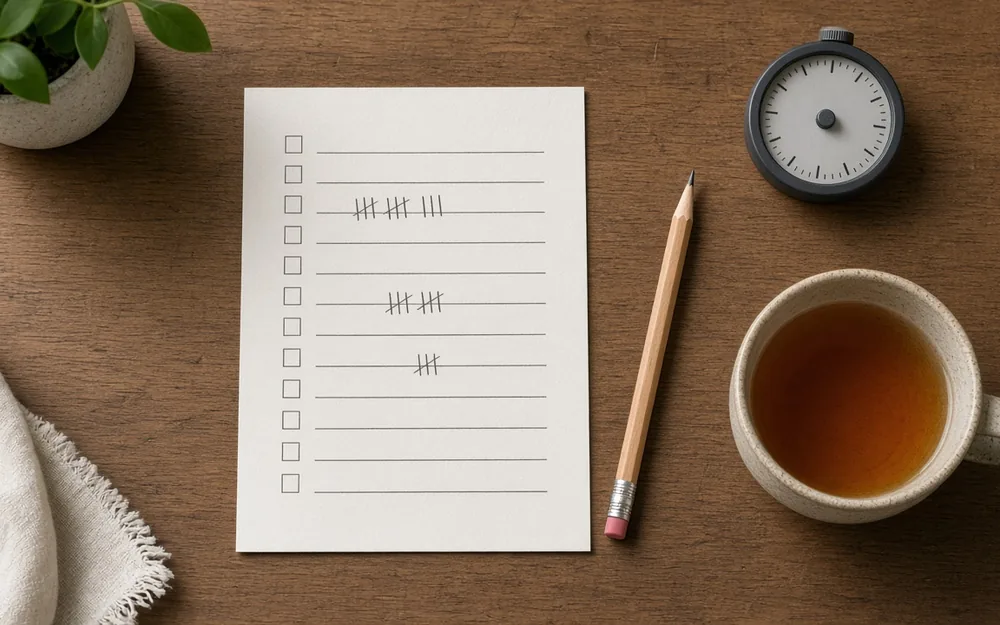
Tracking finished rounds helps make plans more realistic. Image generated by AI.
How to make it work for you
If you want to try the method, start with the classic version for a few days, then adjust. Some people find 25 minutes too short for deep work and move to 45 or 50 minutes with a longer break. Others, especially when tired or facing a dreaded task, prefer shorter rounds. The studies above suggest there is no single perfect interval, so treat the numbers as a starting point.
Before each round, decide on one clear task and write it down. Keep a notepad beside you for stray thoughts, so you can let them go without losing them. Make breaks properly restful and, every few rounds, take a longer one away from your desk. At the end of the day, glance at how many rounds each task really took. That simple record is one of the method’s most underrated gifts, because it slowly makes your plans more realistic.
Why it matters
The Pomodoro technique has lasted for decades not because it is scientifically perfect, but because it tackles very human problems: getting started, staying with one thing, and remembering to rest. The research suggests its biggest benefit may be how it makes work feel, with more energy and less fatigue, rather than how much it produces. That is no small thing. A method that helps you begin, keeps you kinder to yourself and builds in a moment for a cup of tea is worth a try, as long as you remain the one in charge of the timer.
If you are interested in how we learn and think, read our piece on why little and often beats cramming, or explore why a walk helps you think more clearly.
Frequently asked questions
Do I have to work for exactly 25 minutes?
No. Twenty-five minutes is the classic length, but many people adjust it to suit the task and their energy. The core idea is a fixed, focused interval followed by a real break.
What should I do during a Pomodoro break?
Something restful and different from your work: stand up, stretch, look out of a window, drink some water or tea, or take a short walk. Busy screens tend to make breaks less refreshing.
Is the Pomodoro technique good for studying?
It can help students start, stay focused and avoid long, tiring sessions. Studies suggest it does not raise test scores on its own, so pair it with proven study habits such as spacing out sessions and testing yourself.
Sources
- Francesco Cirillo, creator of the Pomodoro Technique (official site)
- Pomodoro Technique (Wikipedia, background on the method’s history and rules)
- “Give me a break!” A systematic review and meta-analysis on the efficacy of micro-breaks for increasing well-being and performance (PLOS ONE, 2022)
- Understanding effort regulation: comparing ‘Pomodoro’ breaks and self-regulated breaks (British Journal of Educational Psychology, 2023)
- When to take a break: comparing effects of systematic short (Pomodoro) and self-regulated breaks on subjective experience and actual learning (Behavioral Sciences, 2026)










0 Comments