

An original TeaLamp explainer based on the sources listed below. Prepared by the TeaLamp Editorial Team with the help of AI.
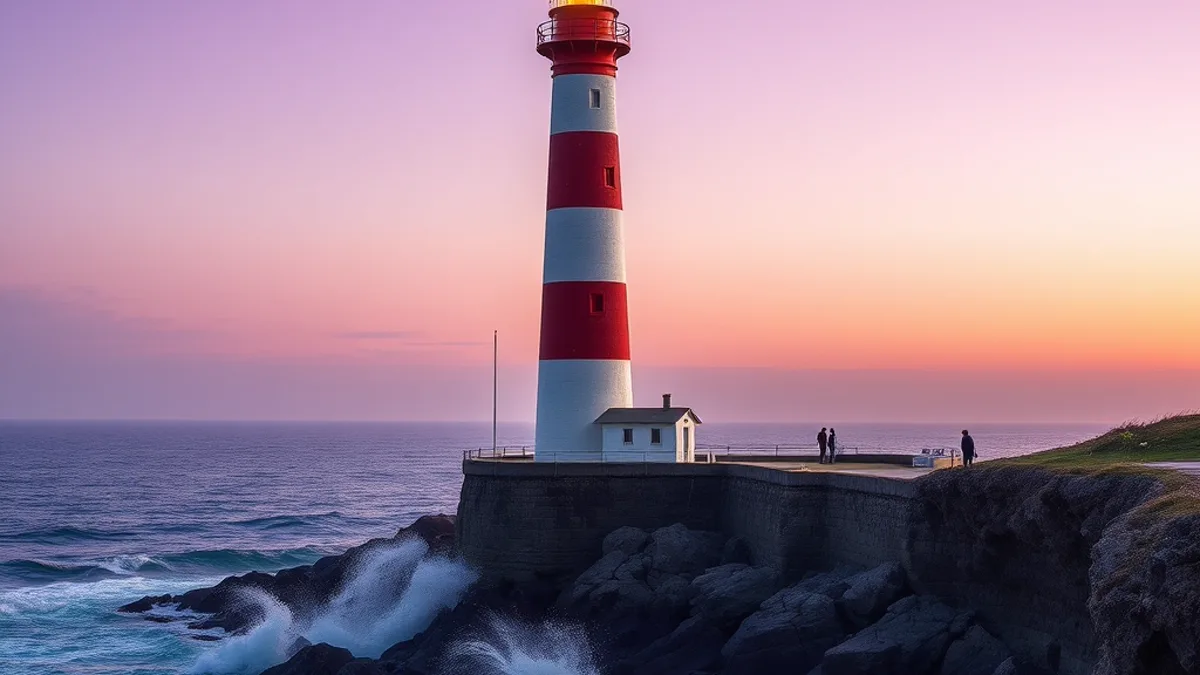
Long after ships learned to find their way by satellite, lighthouses still stop people in their tracks. A striped tower on a rocky point, a lamp turning slowly against the dark, a beam that sweeps the water and is gone: the image is so familiar that it feels older than any single building. Lighthouses began as simple fires on hilltops, grew into feats of engineering, and survived the age that was supposed to replace them. They endure because they were never only machines. They were promises, kept in light, that the shore was there and that someone was watching.
Key takeaways on lighthouses
- Lighthouses began with open fires and the great Pharos of Alexandria, built around 280 BC, one of the wonders of the ancient world.
- The Fresnel lens, first put to work in France in the early 1820s, turned a lamp into a beam visible more than twenty miles away.
- Keepers lived lonely, exacting lives tending lamps, fog signals and clockwork, and the last staffed American light lost its keeper only in 2023.
- Satellites did not kill the lighthouse: its light still marks danger in a way no screen can, and its towers now draw visitors, artists and preservationists.
The oldest lights
Before there were towers, there were fires. Fishermen and traders lit beacons on headlands so that boats could find a harbour mouth after dark, and the habit slowly grew into architecture. The most famous early lighthouse stood on the island of Pharos outside Alexandria in Egypt, built around 280 BC. It rose in tiers to a great height, carried a fire at its top, and guided ships into one of the busiest ports of the ancient world. It stood for more than a thousand years, damaged by earthquakes, and its name gave many languages their word for lighthouse: phare in French, faro in Spanish and Italian.
Rome built towers of its own along its coasts, and one of them is still at work. The Tower of Hercules on the coast of north-west Spain was probably built in the first century, and after centuries of repair it still guides ships today, making it the oldest lighthouse in continuous use.
How a lighthouse actually works
A lighthouse is not a searchlight. Its job is to be recognised, not merely seen. Every light has its own character: a pattern of flashes and dark intervals, repeated exactly, so that a sailor with a chart can tell one light from another in the dark. Some flash once every few seconds, some flash in groups, some show a steady light broken by short eclipses. The pattern is the lighthouse’s signature, and learning to read it was once as basic to seamanship as reading a road sign is to driving.
The invention that made those signatures powerful was the lens designed by the French physicist Augustin-Jean Fresnel. Before Fresnel, lighthouse lamps were backed by mirrors, and much of their light was wasted. Fresnel’s lens, a ring of prisms around a central bull’s-eye, caught almost all of the lamp’s light and threw it out to sea in a flat, powerful beam. The first Fresnel lens was put to work at the Cordouan lighthouse in the mouth of the Gironde in France in the early 1820s, and its beam could be seen about twenty miles away. The United States fitted its first Fresnel lenses at the Navesink Twin Lights in New Jersey in 1841, and by the 1860s nearly every American lighthouse used one.
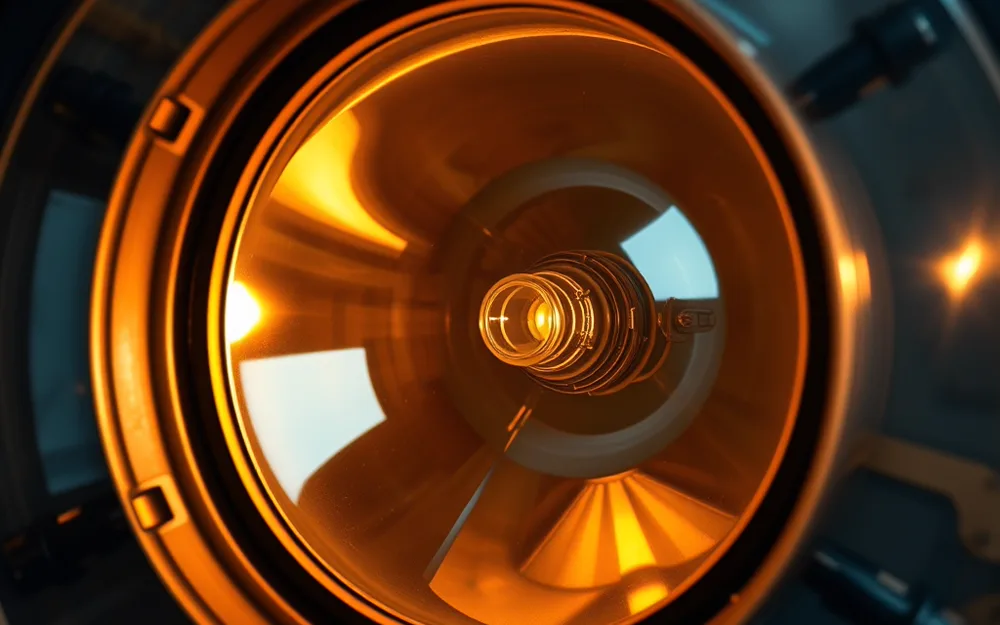
A Fresnel lens, its prisms catching the lamp’s light. Image generated by AI.
Fresnel lenses came in sizes called orders, from the huge first-order lenses of great coastal lights down to small harbour lights. A first-order lens could stand taller than a person and weigh tons, and its glass had to be polished and kept spotless. To make the light flash, the whole lens was turned on a clockwork mechanism, its weight carried on a bath of mercury or on rollers, so that the beam swept the horizon in a slow, regular rhythm. Fog, which swallows light, was answered with sound: bells, horns and sirens that carried the warning when the beam could not.
The keepers’ lonely, exacting life
For most of their history, lighthouses were kept by people, and the keeper’s life was one of routine under pressure. Lamps had to be trimmed and filled, lenses polished until they were free of soot and salt, clockwork wound, oil stored, and logbooks kept through the night. At sea-washed rock towers, keepers lived for weeks at a time in a few small rooms, cut off by weather, listening to the sea strike the tower below. The work was solitary, but it was never casual: a light missed for one night could mean a wreck.
England’s Eddystone lighthouse tells the story in miniature. The first tower on the Eddystone rocks, built in 1698, was washed away with its keeper in a great storm. A second, built in 1709, burned down. The third, built by the engineer John Smeaton in 1759, stood for more than a century and proved that a stone tower could survive on a wave-swept rock. Each rebuilding taught the next generation something new about foundations, shape and stone, and Smeaton’s dovetailed granite blocks became the model for rock lighthouses around the world.
America’s first lighthouse station was Boston Light, first lit on Little Brewster Island in Boston Harbor in 1716. Its first keeper, George Worthylake, drowned with his family while returning to the island, a reminder of how dangerous even the journey to work could be. The tower was destroyed by the British in 1776 and rebuilt in 1783, and it went on to become the last lighthouse in the United States to be automated, in 1998. Its last official keeper, Sally Snowman, the first woman to hold the post, retired in December 2023 after twenty years, closing a chapter of American working life that had lasted more than three centuries.
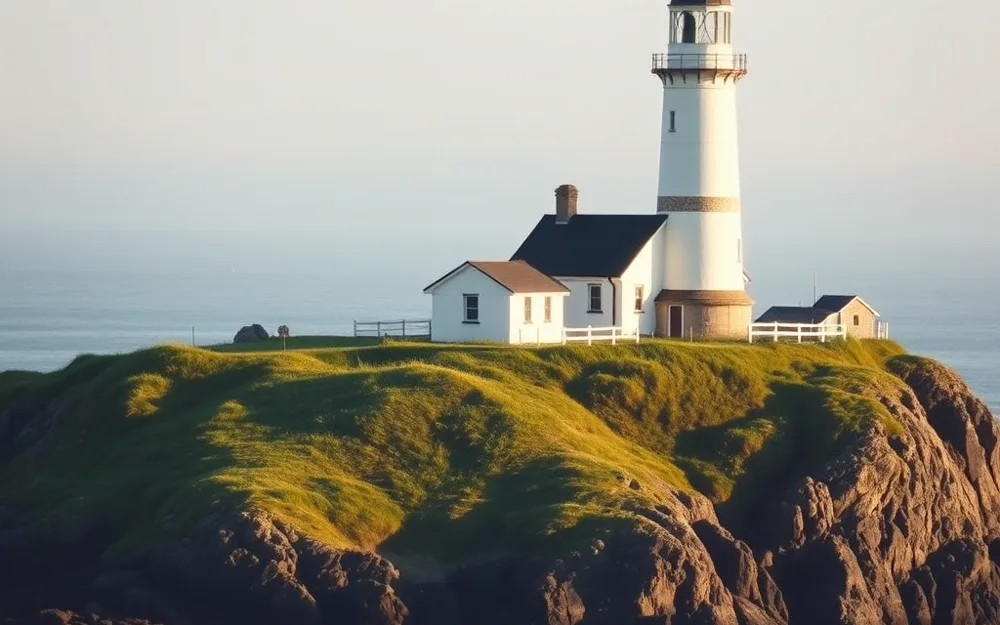
A lighthouse tower with its keeper’s cottages on a grassy cliff. Image generated by AI.
The great automation
Electricity changed the keeper’s job first, and then removed it. Electric lamps were brighter and cleaner than oil, and they could be switched on by a timer or a light sensor. In the United States, the Lighthouse Service began automating lights in 1923, and the Coast Guard carried the work on, so that by the late twentieth century most lights ran themselves. A modern lighthouse is a sturdy tower with a small, efficient optic, a solar panel, a battery and a sensor, visited a few times a year for maintenance.
Automation also changed what a lighthouse is for. Satellite navigation tells a ship its position to within a few metres, and few vessels now steer by a light alone. But a light still does something a satellite cannot: it marks a rock, a reef or a harbour mouth in the world itself, visible to any eye, needing no receiver, no power aboard and no signal. Pilots still use lights to confirm what their instruments say, and small boats still steer by them. The light remains the backup that never needs a password.
Why they still stand
Many lighthouses have found second lives. Some are museums, where visitors climb the tower stairs and stand in the lamp room where keepers once worked. Some are holiday cottages, rented to people who want a week of sea and solitude. Some are simply landmarks, painted and photographed, their stripes recognised the world over. Preservation groups fight to keep them standing because a lighthouse is hard to replace once it is gone: the tower, the lens and the keeper’s house belong together, and together they tell a story about a coastline.
Artists and writers have helped too. The lighthouse has become a symbol of guidance, loneliness and homecoming, and it burns all night for people its keeper will never meet, asking nothing in return.
Why it matters
Lighthouses matter because they are a rare kind of optimism made concrete. They were built on the belief that a dangerous coast could be made safer by patience, good glass and a light kept burning on schedule. They remind us that infrastructure can also be beautiful, and that a public good need not be loud to be loved. In an age of invisible systems, there is something reassuring about a tower whose whole purpose is visible from miles away: here is the danger, here is the way home.
Related reading
For another story of patient builders that reshape the land around them, read our explainer on beaver dams and the wetlands they engineer.
Frequently asked questions
Do lighthouses still matter now that ships have GPS?
Yes. Satellite navigation gives a position, but a lighthouse marks the danger itself, in the real world, for any vessel to see. Lights confirm electronic fixes, guide small boats without advanced equipment, and keep working when receivers fail.
Why do different lighthouses flash differently?
Each light has its own flashing pattern, called its character, so sailors can tell lights apart at night. Charts list each character, and matching the pattern to the chart identifies the light and therefore the ship’s position.
Can you visit a lighthouse?
Many lighthouses are open to visitors, and some offer tours of the tower and lamp room or stays in the keeper’s house. Opening times and access vary, and working lights on remote rocks are usually not open, so it is worth checking before travelling.
Sources
- Fresnel Lenses: Illuminating the Seacoast, The Pursuit of History
- Lighthouse Spotlight: Boston Light, Boston Harbor Islands (National Park Service)
- Boston Light, United States Coast Guard Historian’s Office
- Eddystone Lighthouse, Wikipedia (construction dates 1698, 1709, 1759, 1878-1881; automated 1982)




0 Comments