

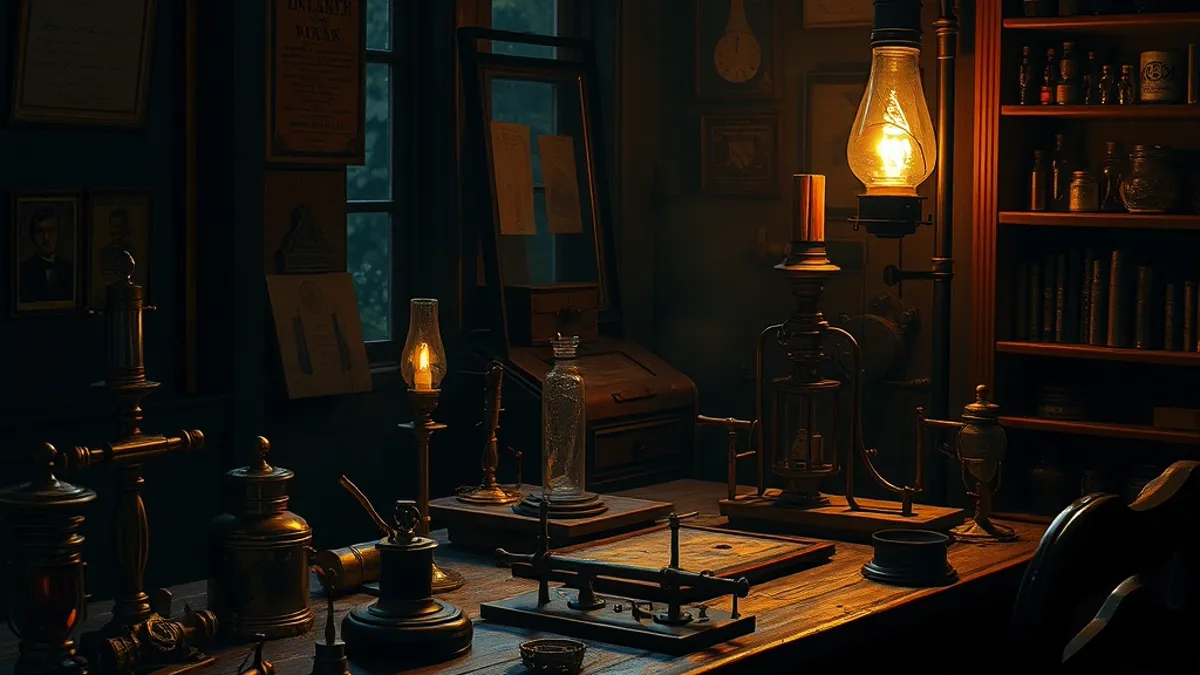
A TeaLamp book summary of The Time Machine by H. G. Wells, first published in 1895. In the public domain. Prepared by the TeaLamp Editorial Team with the help of AI.
This summary of The Time Machine follows a book that gave the world its most famous idea: a machine for travelling through time. H. G. Wells was not yet thirty when it appeared, and it was his first novel. In it, a Victorian inventor known only as the Time Traveller builds a machine of brass, ivory and crystal, rides it nearly a million years into the future, and returns with a story his dinner guests can barely believe. What he finds there is not a shining utopia but a warning: humanity split in two, one half living in careless ease above ground, the other labouring in darkness below, and both slowly losing what made them human.
Key takeaways on The Time Machine summary
- The Time Machine, published in 1895, is H. G. Wells’s first novel and the book that popularised time travel by machine.
- A nameless Victorian inventor, the Time Traveller, journeys to the year 802,701 and finds humanity divided into two species.
- The gentle Eloi live above ground in ease and plenty, while the ape-like Morlocks work underground and hunt the Eloi by night.
- The Traveller escapes with his machine, races on to a dying Earth under a huge red sun, and returns home just hours after leaving.
- Readers have long read the Eloi and Morlocks as a fable about class division, and the book as a warning against complacency.
A dinner party and a fourth dimension
The story opens at an ordinary Victorian dinner party in Richmond, outside London. The host, an inventor his guests call only the Time Traveller, argues that time is a fourth dimension, just as real as length, breadth and thickness, and that a machine ought to be able to move through it. To prove his point he shows his guests a small model. He presses a lever, and the model vanishes before their eyes. The guests are amused and sceptical, and the Traveller tells them his full-size machine is nearly finished. He invites them back next week to hear what happened.
A week later he keeps his word, though he arrives late, exhausted and dishevelled, and eats hungrily before he will speak. Then he tells his tale. He had ridden his machine forward through time, watching the world blur past him, until he stopped in the year 802,701, on ground that was once London. What he found there changed everything he thought he knew about progress.
The year 802,701
The London of the far future is green and quiet. Great ruined halls stand among gardens, and the people, the Eloi, are small, graceful and childlike. They wear soft robes, eat only fruit, and spend their days playing, resting and bathing in the sun. There are no shops, no laws, no work and no want. Disease and danger seem to have vanished, along with most animals and birds. At first the Traveller thinks humanity has finally achieved a perfect, effortless life.
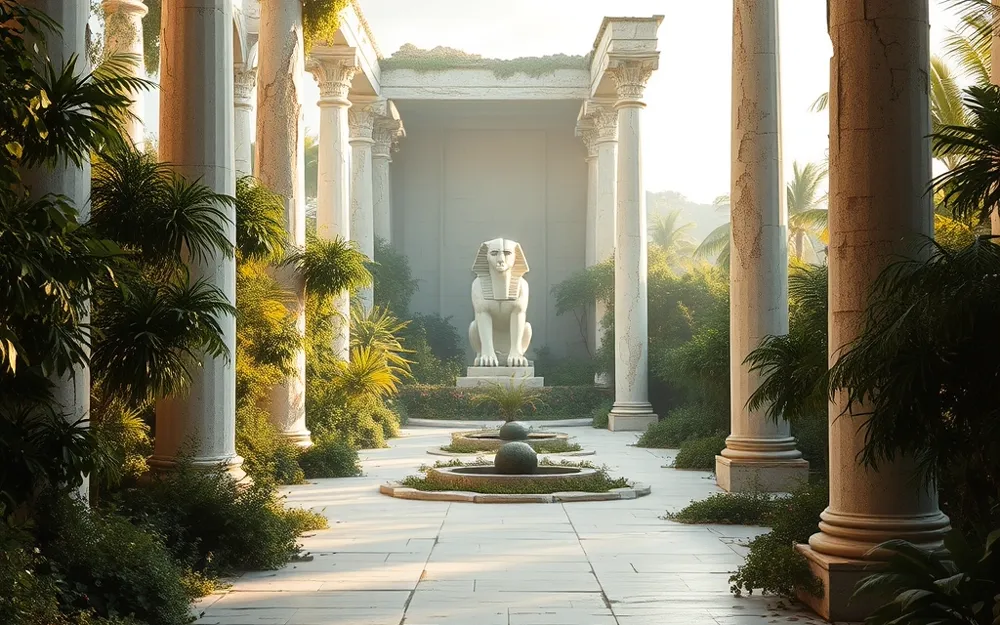
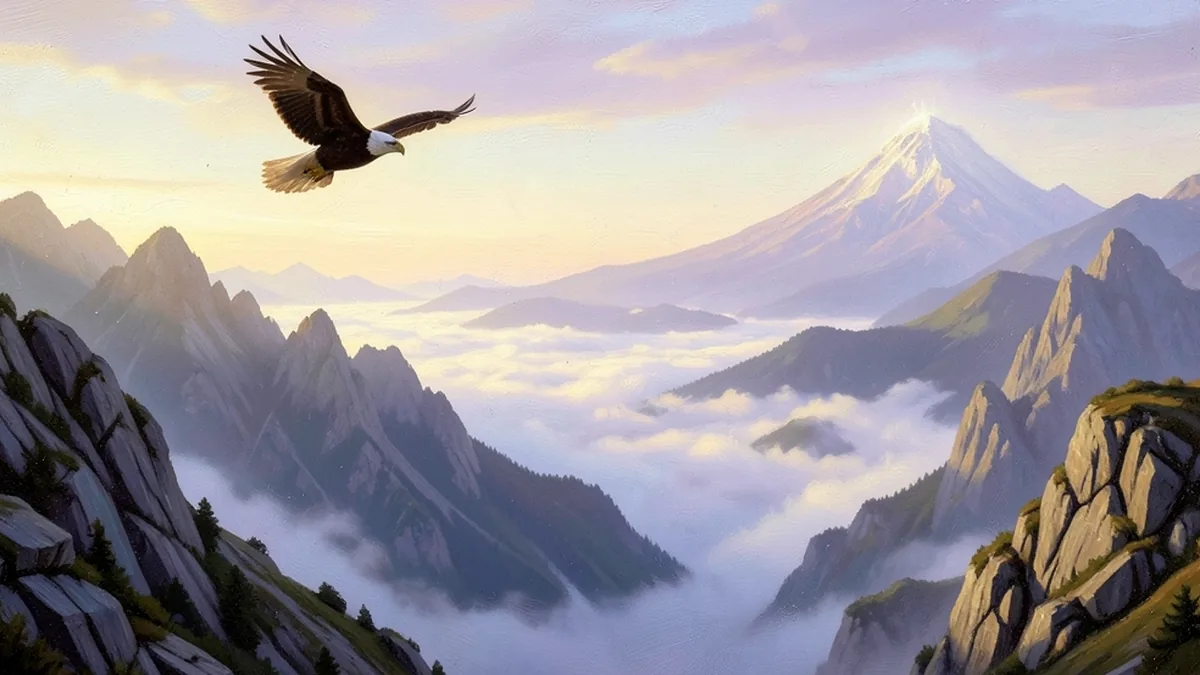
The ruined garden hall of the far future, with its white sphinx. Image generated by AI.
But the perfection is thin. The Eloi are incurious and easily frightened. They cannot concentrate, they cannot plan, and they show no interest in the Traveller’s machine or his questions. Worst of all, they are terrified of the dark. As night falls they huddle indoors, and they will not go near the round wells that dot the landscape, the deep shafts leading down into the earth. The Traveller begins to understand that a life without struggle has a price: with nothing to strive against, intelligence and courage have withered away.
The Eloi above, the Morlocks below
The truth comes out when the Traveller’s machine disappears. He had removed its levers, so it cannot have travelled on its own. Someone must have moved it, and the only suspects are the creatures who live down the wells: the Morlocks. They are pale, ape-like beings with large eyes made for darkness, who spend their lives tending machinery far underground. The machines still run, and they still feed, clothe and house the Eloi above. But the relationship is not what it seems. On moonless nights the Morlocks come up from below and hunt the Eloi for food.
Wells’s meaning is not hidden. In his own century, the comfortable classes lived above while workers laboured below, in basements, mines and factories. The Time Machine pushes that division to its end: the rich have become soft, helpless Eloi, and the workers have become the Morlocks, still keeping the world running, but now feeding on those they serve. Both halves have lost something essential. The Eloi have lost strength and spirit, and the Morlocks have lost light and mercy. Neither is a villain and neither is a hero. Both are what is left of humanity.
The Traveller’s own story turns on a friendship. He rescues a young Eloi woman, Weena, from drowning while the other Eloi watch without moving, and she follows him devotedly afterwards. With her beside him he explores a ruined museum, the Palace of Green Porcelain, where he finds matches and makes a rough weapon. When the Morlocks attack in a forest at night, he fights them off with fire, but the fire spreads, and Weena is lost in the blaze. Grieving, he follows the Morlocks’ trap into a great white Sphinx statue, where his machine waits as bait. He fits the levers back, and escapes.
The end of the world
Instead of going home, the Traveller pushes further forward, some thirty million years ahead. There he finds a dying Earth under a huge, dim red sun. The sea is shallow and blood-red, the beaches are covered in lichen, and the last living things are giant crab-like creatures chasing enormous butterflies. He travels on and watches the sun grow larger and redder, the Earth’s turning slow to a stop, and the last life freeze and fall silent. Overwhelmed, he turns his machine back and arrives home only three hours after he left, with two small white flowers in his pocket that Weena pressed into his hand.
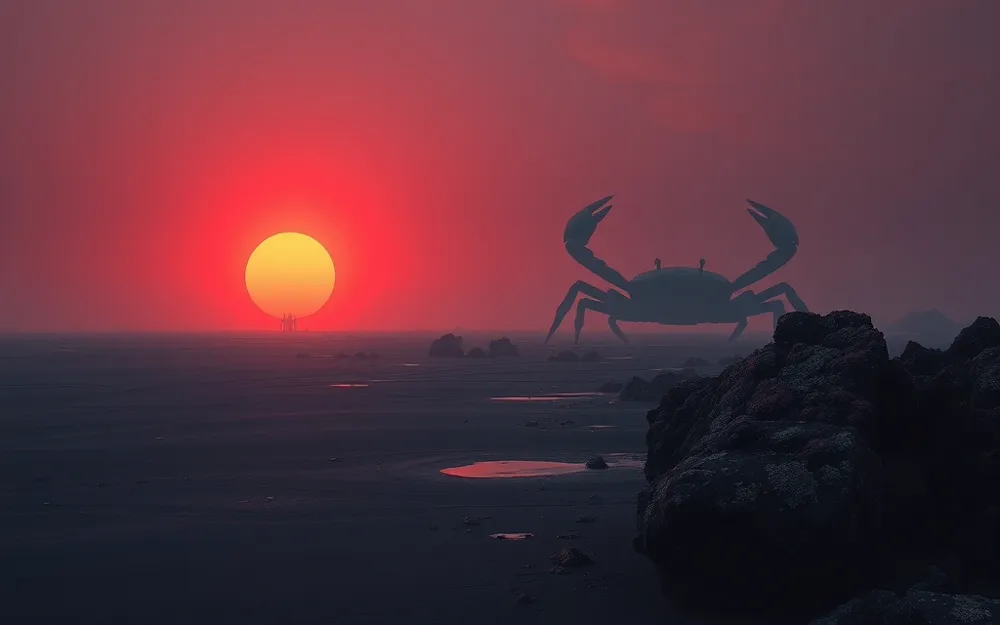
A dying Earth shore beneath a huge red sun, with a giant crab in the distance. Image generated by AI.
His guests do not believe him. But the next day, when the narrator of the story returns to the Traveller’s house, he finds his friend packing for another journey, promising to return shortly. The narrator has waited three years, and the Time Traveller has never come back.
Why The Time Machine still matters
The Time Machine endures because it does two things at once. It is a gripping adventure, short enough to read in an evening, full of strange sights and narrow escapes. And it is an argument. Wells believed that comfort without purpose would rot a society from within, and that a divided society would eventually split into two species that could no longer understand each other. Later writers took his machine and ran with it, but few matched the bleakness of his warning: progress is not automatic, and a world that stops striving may not end in disaster, but in a slow, gentle fading.
Wells himself later called the book a youthful effort, and in a 1933 preface he described it as an assault on human self-satisfaction. Readers have agreed with him for more than a century. The Eloi and the Morlocks have become shorthand for what happens when ease and labour stop meeting each other halfway, and the dying Earth at the end remains one of the most haunting images in all of science fiction.
Why it matters
Books that invent a genre are rare. The Time Machine gave science fiction its vehicle, its method and much of its vocabulary, and it did so while asking a question that still stings: if we could see where our own divisions lead, would we change course? Wells’s answer, told through a man who rides into the future and comes home unheeded, is not comforting. That is exactly why the book is still read.
Related reading
For another classic summary from the same shelf, read Dracula Summary: The Count Who Would Not Die.
Frequently asked questions
Is The Time Machine hard to read today?
No. It is short, about 32,000 words, and Wells writes plainly for a Victorian novelist. A modern reader can finish it in one or two sittings, and its ideas carry it along even where its language feels old-fashioned.
Did Wells invent time travel?
Not quite. Earlier stories had played with journeys through time, and Wells himself had tried the idea in an 1888 story called The Chronic Argonauts. But The Time Machine was the first to make time travel happen with a machine the traveller could steer, and it coined the term time machine itself.
What do the Eloi and Morlocks mean?
Most readers see them as a fable about class. The Eloi stand for a comfortable upper class grown soft through ease, and the Morlocks for a working class driven underground and turned harsh by labour. Wells never spells this out in the book, but he confirmed in later writing that the story was meant as a criticism of his own society.
Sources
- The Time Machine, Wikipedia
- The Time Machine, Encyclopaedia Britannica
- The Time Machine Summary and Study Guide, SuperSummary







0 Comments