

A TeaLamp book summary. Prepared by the TeaLamp Editorial Team with the help of AI.
This A Christmas Carol summary follows Ebenezer Scrooge through a single Christmas Eve in London, from cold-hearted miser to a man who learns to keep Christmas well. Charles Dickens first published the story on December 19, 1843, just six days before Christmas, and it has never been out of print since. It is a short book, a novella in five chapters that Dickens called staves, like the staves of a song, and it can be read in one sitting by the fire. Yet it carries a large idea: that a person can change, even late in life, and that kindness is a habit anyone can learn.
Key takeaways on A Christmas Carol summary
- Ebenezer Scrooge, a London moneylender, hates Christmas and calls it “Bah! Humbug!”, until the ghost of his dead partner Jacob Marley warns him that three spirits will visit him in one night.
- The Ghost of Christmas Past shows Scrooge his lonely boyhood, his kind first employer Mr Fezziwig, and the fiancée Belle, who left him because he loved money more than her.
- The Ghost of Christmas Present shows him the Cratchit family Christmas, where his clerk Bob’s youngest son Tiny Tim is seriously ill, and two starving children named Ignorance and Want.
- The Ghost of Christmas Yet to Come shows Scrooge his own unmourned death, the Cratchits grieving for Tiny Tim, and a neglected grave bearing his own name.
- Scrooge wakes on Christmas morning a changed man, sends a turkey to the Cratchits, raises Bob’s pay, and becomes a second father to Tiny Tim.
- First published by Chapman & Hall on December 19, 1843, with pictures by John Leech, the first edition of 6,000 copies sold out by Christmas Eve.
Christmas Eve in London
The book opens on a bleak, cold Christmas Eve, seven years after the death of Jacob Marley, Scrooge’s business partner and only friend. Scrooge is counting money in his office while his clerk, Bob Cratchit, works in the cold next door. Scrooge refuses an invitation to Christmas dinner from his nephew Fred, the son of his late sister Fan. He turns away two men collecting money for the poor, asking whether there are no prisons and workhouses, and telling them that those who would rather die than go there had better do it, and decrease the surplus population. He lets Bob have Christmas Day off, but only grudgingly.
That night, at home, Marley’s ghost appears, wrapped in heavy chains and money boxes that he forged in life, link by link, through greed and selfishness. Marley tells Scrooge he has one chance to escape the same fate: three spirits will visit him that night, and he must listen to them. “Mankind was my business,” Marley says. “The common welfare was my business; charity, mercy, forbearance, and benevolence were all my business.” It is the first crack in Scrooge’s armour, and the night has only just begun.
The Ghost of Christmas Past
The first spirit takes Scrooge back to the Christmases of his own life. He sees himself as a lonely boy at boarding school, left behind at Christmas, until his beloved sister Fan comes to fetch him home. He sees a Christmas party at the warehouse of his first employer, Mr Fezziwig, who treated his workers like family and made a small party feel like a feast. Fezziwig’s kindness stays with Scrooge: the happiness he gave, the spirit says, was quite as great as if it cost a fortune.
Then the past turns harder. Scrooge watches his younger self lose Belle, the woman he was going to marry. She ends the engagement because another idol has displaced her, a golden one, and she can see that he will never love her as much as he loves money. He sees Belle years later, married, with a large and happy family, on the very Christmas Eve that Marley died. Scrooge begs the spirit to take him away. He is beginning to understand what his choices have cost him.

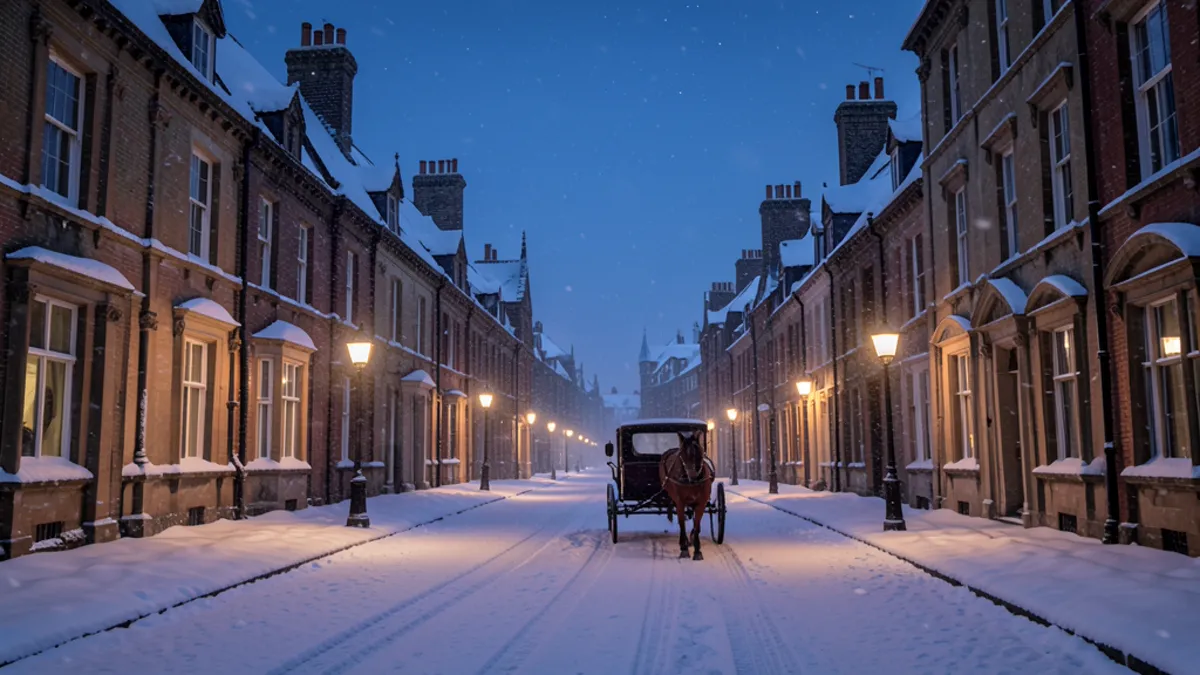
A Victorian parlour at Christmas, by the fire. Image generated by AI.
The Ghost of Christmas Present
The second spirit is large, cheerful and generous, and it shows Scrooge Christmas as it is happening now. They visit a busy Christmas market, a miner’s cottage and a lighthouse, where even lonely workers keep the day, and Fred’s Christmas party, where his friends laugh at Scrooge and toast him anyway.
Most of this stave belongs to the Cratchits. Bob earns little, but his family’s Christmas dinner is full of warmth. His youngest son, Tiny Tim, is a happy boy who is seriously ill, and the spirit tells Scrooge that the child will die unless the course of events changes. Scrooge, who once spoke so coldly about the surplus population, hears his own words thrown back at him. Before the spirit leaves, it shows Scrooge two hideous, starving children hiding under its robe, named Ignorance and Want. Beware them both, the spirit says, but most of all beware Ignorance, for on his brow is written Doom, unless the writing is erased.
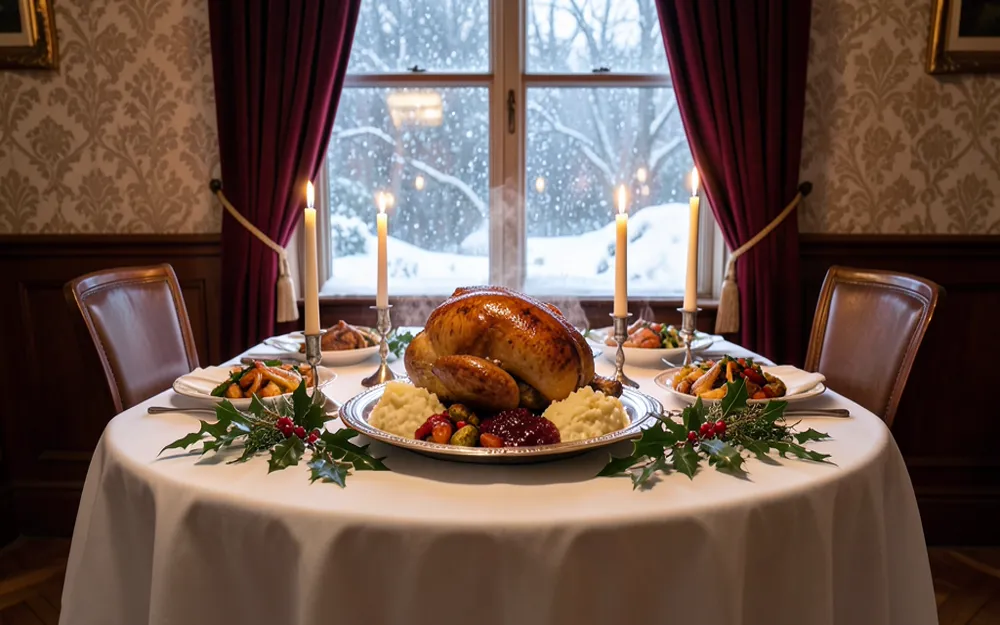
The Cratchits’ Christmas dinner, turkey and all. Image generated by AI.
The Ghost of Christmas Yet to Come
The third spirit says nothing at all. It only points. It shows Scrooge a Christmas Day in the future, where a disliked man has died and no one mourns him. Businessmen will attend his funeral only if lunch is provided. His charwoman, his laundress and the undertaker steal his belongings to sell. A poor couple rejoice that his death gives them more time to pay their debts. When Scrooge asks to see tenderness connected with any death, the spirit shows him the Cratchits mourning Tiny Tim.
Then the spirit shows him a neglected grave, with a tombstone bearing his own name. Scrooge falls to his knees and begs. Are these the shadows of the things that will be, or only of the things that may be? If he changes his ways, will the ends change too? The spirit’s hand trembles, and Scrooge makes his promise: “I will honour Christmas in my heart, and try to keep it all the year. I will live in the Past, the Present, and the Future.”
Christmas Morning
Scrooge wakes on Christmas morning in his own bed, in his own room, and the time before him is his own, to make amends in. He laughs and cries at once, light as a feather and merry as a schoolboy. He sends a great turkey to the Cratchits, anonymously, and gives a large donation to the charity collector he turned away the day before. He spends the afternoon at Fred’s Christmas party. The next day he raises Bob’s salary, and promises to help his struggling family.
From then on, Scrooge does it all, and infinitely more. To Tiny Tim, who did not die, he becomes a second father. He becomes as good a friend, as good a master, and as good a man as the good old city knew. Some people laughed at the change in him, but he little heeded them. His own heart laughed, and that was quite enough for him. And so, as Tiny Tim observed, God bless us, every one!
Why Dickens Wrote It
Dickens wrote the book at white heat, in about six weeks, starting in October 1843. He was under money pressure: sales of his novel Martin Chuzzlewit were falling, and his publishers had threatened to cut his income. But the book was also born of anger. As a boy of twelve, Dickens had worked in a shoe-blacking factory after his father was sent to a debtors’ prison, and he never forgot what poverty did to children. Early in 1843 he visited the Field Lane Ragged School, one of several London schools for half-starved street children, and read a parliamentary report on child labour that horrified him.
He had planned to write a political pamphlet on behalf of the poor man’s child. Instead, after a speech in Manchester in October 1843, he decided a story would reach far more people than a pamphlet. He was right. The first edition, priced at five shillings with four coloured pictures by John Leech, sold out by Christmas Eve, and thirteen editions had appeared by the end of 1844. Dickens went on to give public readings of the story, 127 performances in all, until the year of his death in 1870. The book helped to shape the modern Christmas itself: family gatherings, seasonal food, dancing, games and a generous spirit.
Why It Still Matters
A Christmas Carol has lasted because it is two things at once. It is a ghost story, full of fog, chains, cold rooms and a silent spirit, and it is a story about fairness, about what a society owes its poorest children. Scrooge’s change is not magic. He changes because he is shown, clearly and in order, what his life has been, what it is, and what it will become. Anyone who has ever put off a kindness will recognise the shape of it.
It also lasts because it is short and plain. There is no wasted scene, and the five staves move fast: one evening, three ghosts, one morning. Readers return to it every December, many reading a stave a night in the week before Christmas. It is a book for readers who like a story with a clear moral and a warm ending, and for anyone who wants to remember that it is never too late to change. The ghosts do not punish Scrooge. They teach him. That is the whole point.
If you enjoy Dickens, you may also like our review of Great Expectations, his great novel of ambition, love and second chances.
Frequently asked questions
Is A Christmas Carol scary?
It has ghostly moments, especially Marley’s chains and the silent Ghost of Christmas Yet to Come, but it is a gentle ghost story, not a frightening one. The ghosts are there to teach Scrooge, not to harm him, and the book ends happily. Most children from about nine or ten enjoy it, and it is a favourite read-aloud book at Christmas.
Why does Dickens call the chapters staves?
A stave is a verse or stanza of a song, and Dickens called the book a carol, which is a Christmas song. The five staves are the five verses of the story, and the book’s full first title was A Christmas Carol. In Prose. Being a Ghost Story of Christmas. The musical shape fits the story: it opens in a minor key and ends in joy.
How long is A Christmas Carol?
It is a novella of about 28,000 words, and the first edition ran to 166 pages. Most readers finish it in two or three sittings, or in a single quiet evening. It is one of the shortest of Dickens’s famous books, which is part of why it is so often read aloud at Christmas.
Sources
- A Christmas Carol, Wikipedia (Charles Dickens, Chapman & Hall, December 19, 1843; John Leech; 166 pages; plot, background and reception)
- A Christmas Carol, Wikiquote (“Bah! Humbug!”, “Mankind was my business”, “I will honour Christmas in my heart”, “God bless us, every one!”)
- A Christmas Carol, Project Gutenberg (ebook 46, the public-domain text of the 1843 novella)









0 Comments