


A TeaLamp book summary, written in our own words from the novel itself and the reference works listed below. Prepared by the TeaLamp Editorial Team with the help of AI.
It is April 1625, and a young man from the French countryside rides toward Paris on a tired yellow horse, carrying a letter of introduction and a head full of plans. His name is d’Artagnan, and he wants to join the Musketeers of the Guard, the king’s elite swordsmen. Within a day of arriving he has offended three of the best swordsmen in France, challenged each to a duel, and stumbled into a plot that reaches the queen herself. The Three Musketeers summary in a sentence is this: a hot-headed young man finds three friends, and the four of them take on cardinals, spies and armies together.
Key takeaways on The Three Musketeers summary
- A young Gascon named d’Artagnan rides to Paris in 1625 to become a musketeer, and instead of duelling Athos, Porthos and Aramis, he fights beside them and wins their friendship.
- The four friends race to England to fetch the queen’s diamond studs before a court ball exposes her secret, outwitting Cardinal Richelieu.
- Their enemy Milady de Winter, a ruthless spy, drives the darkest part of the story, and her past is tied to Athos in a way nobody expects.
- The novel mixes real history with invented adventure: Louis the Thirteenth, Queen Anne and Richelieu were real people, and the siege of La Rochelle really happened.
- Published in 1844, the book is still read today for its pace, its humour and its famous motto.
A young man rides to Paris
D’Artagnan is eighteen, poor, proud and quick to take offence. His father, an old soldier, gives him a letter to Monsieur de Tréville, captain of the Musketeers. The ride to Paris does not go well. At an inn in the town of Meung, an older man laughs at his horse. D’Artagnan demands satisfaction, and the man’s companions beat him senseless and break his sword. Worse, his letter is stolen. The older man, he will later learn, is the Comte de Rochefort, an agent of Cardinal Richelieu, the most powerful man in France after the king.

A coaching inn at dusk, with a fire in the hearth. Image generated by AI.
Paris in 1625 is a city of two powers. King Louis the Thirteenth sits on the throne, but the man who truly runs France is his chief minister, Cardinal Richelieu. The king’s Musketeers, superb swordsmen in blue cloaks, answer to the king; the cardinal has his own guards, in red. The two groups hate each other, and street fights between them are a regular sight.
At the Musketeers’ headquarters d’Artagnan meets Tréville, who is kind but cannot take him on without the letter. Instead Tréville writes him a note to a fencing academy, where young gentlemen train for future service. Then, as d’Artagnan leaves, he spots Rochefort in the street below and rushes after him. In his hurry he bumps into three men, one after another, and insults all three. Each one is a musketeer, and each one demands a duel that afternoon. By sunset, d’Artagnan has three duels arranged with Athos, Porthos and Aramis, the three finest swordsmen in the company.
Three duels that never happen
At the duelling ground, d’Artagnan discovers that Athos’s seconds are Porthos and Aramis. The three are astonished that a boy from the country means to fight all three of them, and they admire him for it. Before the first sword is drawn, the cardinal’s guards arrive to arrest the duellists, since duelling is forbidden by law. Instead of surrendering, the four men draw their swords together and fight side by side against the guards. They win, and in that one shared fight a friendship is made that will carry the whole novel.
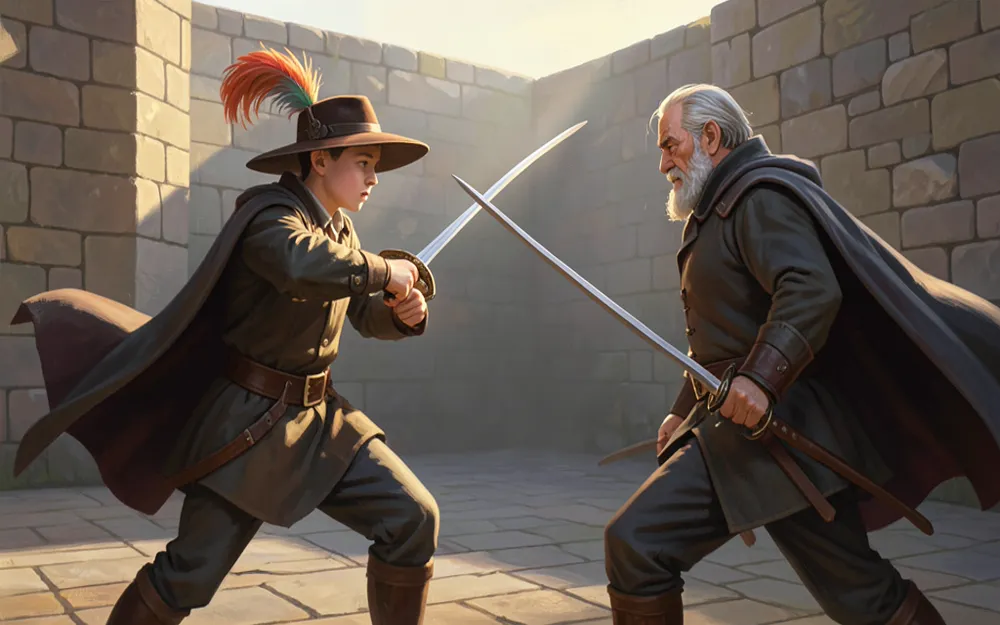
Two swordsmen cross rapiers in a quiet courtyard. Image generated by AI.
The three musketeers could hardly be more different, and that is part of the fun. Athos is the oldest, quiet, noble and melancholy, a man who drinks too much and never speaks of his past. Porthos is big, loud and vain, fond of fine clothes and showing off. Aramis is gentle and bookish, forever talking about leaving the sword to become a priest, and forever failing to do so. D’Artagnan, the youngest, is brave, impulsive and fiercely loyal, and always short of money. Together they are the inseparables, and their motto becomes one of the most famous lines in all of literature.
“One for all, and all for one.”
Alexandre Dumas, The Three Musketeers
The motto is not just a slogan. It is the rule the four friends live by: every time one of them is in danger, the other three drop everything and ride to help. It is a simple idea, and the whole book is built on it.
The diamond studs
The first great adventure begins at court. Queen Anne of Austria, the king’s wife, has a secret: she has given a set of diamond studs, a gift from the king, to her admirer, the Duke of Buckingham in England. Richelieu knows this, and he arranges a trap. He persuades the king to hold a ball and ask the queen to wear the diamonds. If she cannot produce them, her secret is exposed and the cardinal’s power grows stronger.

The queen’s diamond studs, resting on blue velvet by candlelight. Image generated by AI.
The queen’s dresser, Constance Bonacieux, turns to d’Artagnan for help. D’Artagnan has fallen in love with Constance, and he agrees at once. The plan is simple to say and nearly impossible to do: ride to London, collect the studs from Buckingham, and be back in Paris before the ball. The cardinal’s agents try to stop them at every step. One friend is wounded on the road, then another, then another, until d’Artagnan rides on alone, reaches London, and returns with the studs just in time. The queen wears them to the ball, and Richelieu’s trap fails.
Milady de Winter
If the diamond studs give the novel its first half, the second half belongs to Milady de Winter. She is beautiful, clever and utterly ruthless, a spy for the cardinal and the most dangerous person in the book. She is also one of the most interesting, because Dumas gives her real motives: she is fighting for her own survival in a world that has already punished her once.
Milady carries a secret of her own. On her shoulder she bears a brand, the mark of a convicted criminal. And her past is tied to Athos in the most painful way: years before, Athos was married to her, when she was a young woman in his village and he had no idea who she really was. When he discovered the brand, he had her hanged from a tree and left her for dead. She survived, and has spent the years since building a new life as a spy, a courtier and a killer.
The revelation changes the book. Until then, Milady is a villain in the shadows. After it, she is a person with a history, and Athos, the noblest of the four friends, is shown to have done something terrible himself. Dumas does not excuse either of them.
Milady’s revenge drives the darkest chapters. She charms a young Puritan soldier, John Felton, into murdering the Duke of Buckingham. She poisons Constance, the woman d’Artagnan loves, before the musketeers can reach her. At last the four friends track Milady down, hold an improvised trial by torchlight on a riverbank, find her guilty, and carry out the sentence. It is the grimmest scene in the novel, and Dumas writes it without flinching.
The siege of La Rochelle
Running through the whole story is a real piece of history. The city of La Rochelle, a stronghold of French Protestants, has rebelled against the king, and Richelieu is determined to starve it into surrender. The siege, which lasted from 1627 to 1628, really happened, and Dumas sends his four friends there as soldiers in the king’s army. One of the novel’s most memorable scenes takes place during a lull in the fighting: the four friends sit down to breakfast in a captured fort, calmly eating and talking while enemy soldiers shoot at them. It is absurd, funny and brave all at once.
When the book ends, d’Artagnan has what he came to Paris for. The cardinal, impressed by his courage, offers him a commission as a lieutenant in the Musketeers. He offers it to his friends first, but each refuses it, so d’Artagnan takes it himself. He has lost Constance, and the book does not pretend otherwise. But he has his three friends, his sword and his future. The story continues in Twenty Years After and The Vicomte of Bragelonne.
Why it still works
The Three Musketeers was first published in 1844, serialised in the Paris newspaper Le Siècle from March to July of that year, and it has hardly ever been out of print since. Readers keep coming back for how it feels to read: the pace never flags, the dialogue sparkles, and you can tell Athos from Porthos from Aramis after a single page. The friendship at its centre is the kind most readers recognise from their own lives: loyal, quarrelsome, funny and tested.
Under the sword fights and the chases, Dumas is writing about power: who holds it, how it is used, and what it costs the people caught underneath it. Richelieu is not a cartoon villain. He believes order is worth almost any price.
For a first-time reader, the best advice is simple: do not worry about the history. Just enjoy the ride from Gascony to Paris, from Paris to London and back, and from the ballroom to the siege lines.
Why it matters
Some books survive because they are important. The Three Musketeers survives because it is loved. It gave the world a motto that outlived its century, and four friends who feel like people you know.
For another Dumas adventure, read our review of The Count of Monte Cristo.
Frequently asked questions
Is The Three Musketeers based on a true story?
Partly. The real d’Artagnan was a soldier named Charles de Batz-Castelmore, and the king, the queen and Cardinal Richelieu were real people. The siege of La Rochelle really happened in 1627 and 1628. But the diamond studs, Milady and most of the plot are Dumas’s invention, built on an old memoir he found while researching the period.
Who are the three musketeers?
Athos, Porthos and Aramis, the three finest swordsmen in the king’s Musketeers of the Guard. D’Artagnan, the young hero, is not one of the three at the start. He becomes their inseparable fourth friend.
Is The Three Musketeers suitable for younger readers?
It is an adventure story, and older children have enjoyed it for generations, but it is a long novel with adult themes: betrayal, revenge and a murder at the end. A younger reader will get more from an abridged edition.
Sources
- The Three Musketeers, Wikipedia, retrieved 22 November 2026.
- The Three Musketeers Summary & Analysis, American Literature, retrieved 22 November 2026.
- The Three Musketeers, Penguin Classics Deluxe Edition, San José Public Library, retrieved 22 November 2026.









0 Comments