

A TeaLamp book review. Prepared by the TeaLamp Editorial Team with the help of AI.
This Emma review is about a young woman who has everything, knows it, and still makes a splendid mess of other people’s lives before she learns to see herself clearly. Jane Austen published Emma in December 1815, and it is the warmest and funniest of her six novels. It is set in one small English village, and it has delighted readers for more than two hundred years.
Key takeaways on Emma review
- Emma Woodhouse, handsome, clever and rich, is the mistress of Hartfield in Highbury, and she fancies herself a matchmaker.
- Her matchmaking goes wrong again and again: she talks Harriet Smith out of a good marriage, pushes her toward a vicar who wants Emma herself, and reads a secret engagement backwards.
- Mr Knightley, her neighbour and oldest friend, is the only person who tells Emma the truth, and his scolding after the Box Hill picnic is the turning point of the book.
- Austen wrote Emma at Chawton in Hampshire, finished it in March 1815, and published it in three volumes in December 1815, dedicated to the Prince Regent.
- The novel has never been out of print, and it lives on in film, from Clueless in 1995 to the 1996 and 2020 versions of Emma.
A Heroine Nobody Was Supposed to Like
Before she began, Austen wrote, “I am going to take a heroine whom no one but myself will much like.” It was a bold promise, and she kept it. Emma opens the book as one of the most confident heroines in fiction: “Emma Woodhouse, handsome, clever, and rich, with a comfortable home and a happy disposition, seemed to unite some of the best blessings of existence; and had lived nearly twenty-one years in the world with very little to distress or vex her.”
Emma is nearly twenty-one, and she has been mistress of Hartfield since her elder sister married and moved to London. Her mother died when she was young. Her father, Mr Woodhouse, worries about draughts and everybody’s health, and Emma looks after him with real affection. She has money and standing, and she has decided she will never marry. What she will do instead is arrange everybody else’s happiness.
That is the joke at the heart of the book. Emma is clever, but her cleverness works best on herself: she is very good at finding reasons why the thing she already wants must be right. Readers love her anyway, because she is warm, funny, and honest enough to admit she was wrong.
Highbury and Its People
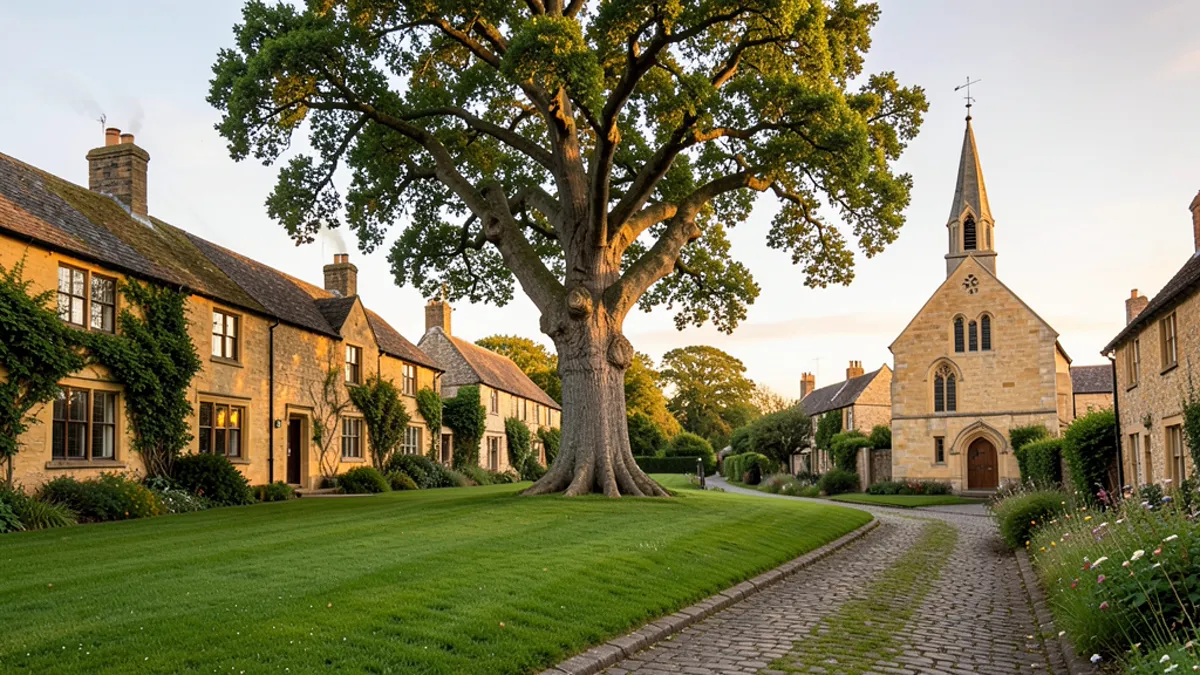
Emma lives in Highbury, a fictional village in Surrey, and the whole novel takes place within a few miles of Hartfield. There are no grand journeys and no great events. The drama comes from visits, dinners, a ball, a picnic and a great many letters, among a handful of families.
The people are drawn so sharply that each one feels like somebody you have met. Mr Knightley, aged thirty-seven, owns Donwell Abbey and is Emma’s neighbour and her only real critic. Mrs Weston has just married Mr Weston, and Emma takes the credit. Harriet Smith, seventeen, is a sweet, simple girl at the village school, whose father nobody quite knows. Miss Bates talks a great deal and has very little money; her niece Jane Fairfax, beautiful and accomplished, has come home with no fortune and a governess’s life ahead of her. Frank Churchill, Mr Weston’s son, was raised by rich relations and rarely visits his father.
In a village this size, every visit matters and every misunderstanding has time to grow.
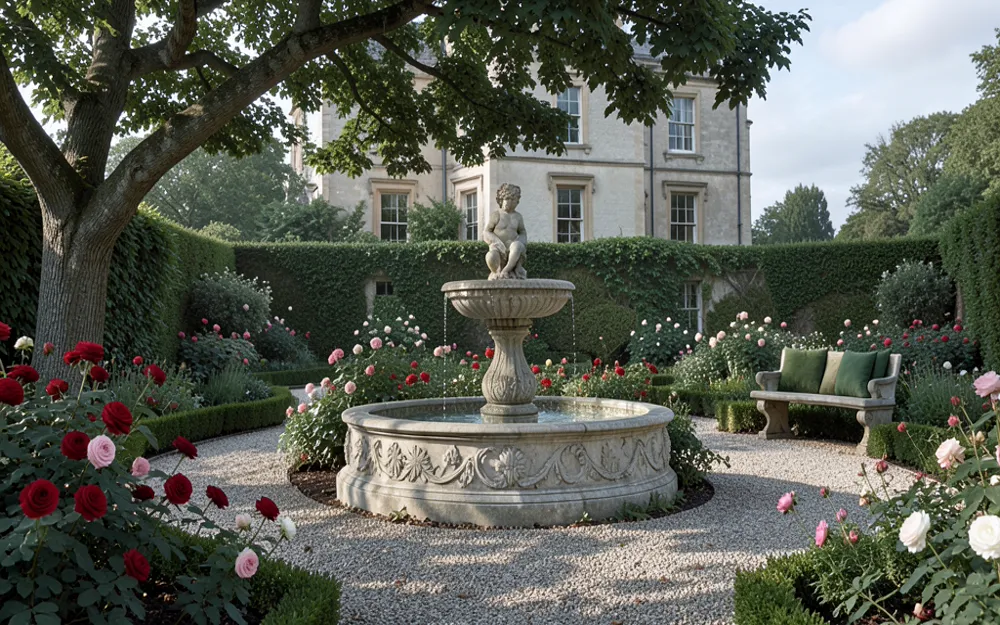
The garden at Hartfield, roses and a fountain. Image generated by AI.
The Matchmaking Goes Wrong
Emma’s first project after the Weston wedding is Harriet. Harriet has received a proposal from Robert Martin, a well-to-do young farmer who is kind, steady and fond of her. Emma talks her out of it. A farmer, she insists, is far beneath Harriet, who must surely be the daughter of a gentleman. Instead Emma steers Harriet toward Mr Elton, the young vicar. Mr Knightley warns her against it, and he is right. Mr Elton has no interest in Harriet at all. He wants Emma, and her thirty thousand pounds. When he proposes to Emma herself, she is horrified, and he is outraged to learn she meant him for Harriet. He leaves for Bath and comes back married to Augusta Hawkins, a loud woman with ten thousand pounds and no manners.
Meanwhile Frank Churchill arrives, and Jane Fairfax comes to stay with her aunt. Emma decides, with great confidence, that Jane must be in love with Mr Dixon, a married friend of the family, and that she herself is falling in love with Frank. Both guesses are wrong. Frank and Jane have been secretly engaged since the previous autumn, and Frank is only playing along with Emma to hide it. A piano arrives for Jane from an unknown giver, and Emma reads that wrong too: it is Frank’s gift.
What makes these mistakes so enjoyable is that Austen never cheats. Every clue is there for the reader to spot, and Emma walks past all of them, certain she knows best. The comedy stays gentle, because Emma means well.
An empty ballroom, waiting for the dancing to begin. Image generated by AI.
Box Hill: The Lesson
The turning point comes on a summer picnic at Box Hill, a beauty spot near Highbury. Frank sets a game: each person must say one very clever thing, or two things moderately clever, or three things very dull indeed. Miss Bates says she will have no trouble with the dull things. Emma cannot resist. “Ah! ma’am, but there may be a difficulty. Pardon me—but you will be limited as to number—only three at once.”
Miss Bates is hurt, though she is too kind to show it for long. On the drive home, Mr Knightley speaks to Emma as he has always done, plainly and without flattery. He tells her she has been unfeeling to a poor, kind woman who has known her since she was a child, and he finishes with a judgement that lands like a bell: “It was badly done, indeed!”
Emma goes home in tears, and the tears are the beginning of her education. The next day she visits Miss Bates to make amends, and from this point on she starts, slowly, to see herself as others see her. It is the most serious scene in a comic novel, and Emma’s change of heart is earned.
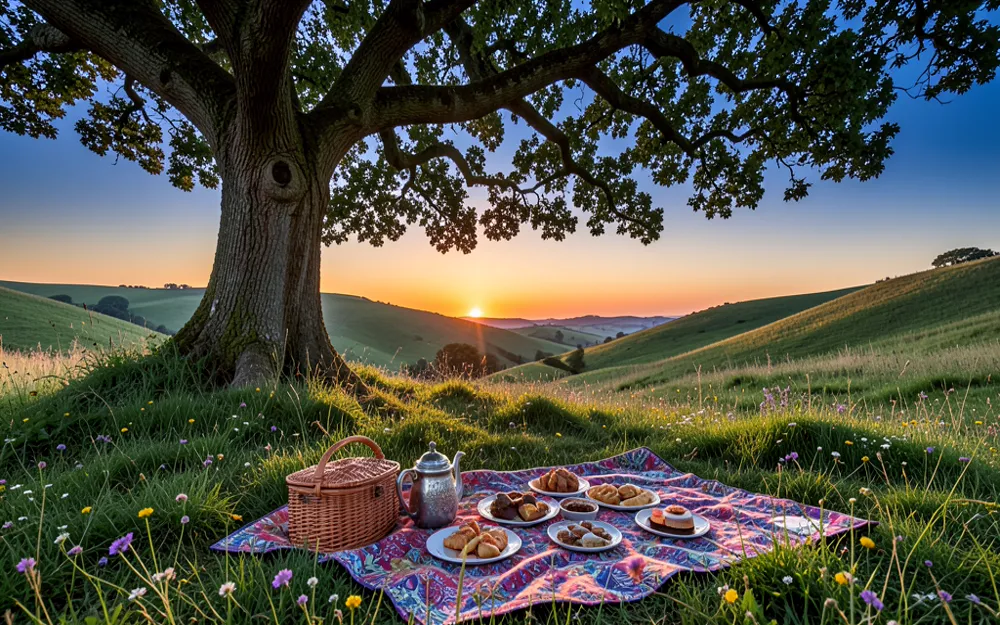
A picnic on a hilltop at sunset, like the one at Box Hill. Image generated by AI.
Mr Knightley, the Only Honest Voice
Every comedy needs somebody who tells the truth, and in Emma that person is Mr Knightley. He is the only character who criticises Emma to her face, from the first chapter to the last. He warns her about Harriet and Mr Martin, and about Mr Elton, he distrusts Frank Churchill, and he guesses that Frank has a secret understanding with Jane Fairfax. He is right about nearly everything.
That is one of the book’s great strengths. Knightley is not a scold and not a saint. He is a working landowner and a local magistrate, a man who knows his tenants and his neighbours, and his judgement comes from paying attention rather than from pride. When he dances with Harriet at the ball after Mr Elton has snubbed her, it is the kindest moment in the book.
The love story grows out of this honesty. Emma realises she loves Knightley only after Harriet tells her she hopes to marry him herself, and the shock shows Emma what her own heart has been doing all along. Knightley proposes, Emma accepts, and they agree to live at Hartfield so Emma can go on caring for her father. Harriet, wiser now, accepts Robert Martin’s second proposal, and Frank and Jane will marry too. It is a happy ending, but it feels earned.
Why Emma Still Matters
Emma was Austen’s fourth published novel, after Sense and Sensibility, Pride and Prejudice and Mansfield Park, and the last to appear in her lifetime. She wrote it at Chawton, where she lived with her mother and sister, beginning in January 1814 and finishing in March 1815. It appeared anonymously, credited only to the author of Pride and Prejudice, in three volumes running to 1,036 pages, from the London publisher John Murray, and it was dedicated to the Prince Regent, whose librarian had suggested the honour.
The reviews were kind. Sir Walter Scott, reviewing it anonymously in the Quarterly Review in March 1816, praised Austen’s gift for making ordinary life interesting. Readers agreed: Emma has never been out of print since, and it is often called Austen’s most perfectly built novel.
The story keeps finding new audiences. Two versions appeared in 1996, a film with Gwyneth Paltrow and a television version with Kate Beckinsale, and a new film arrived in 2020 with Anya Taylor-Joy. Before all of them, Clueless in 1995 moved the story to a Beverly Hills high school, with Alicia Silverstone as Cher, a matchmaker just as confident and just as wrong as Emma herself. Each version works because the story underneath is sturdy.
Who Will Enjoy Emma
Emma suits readers who like comedy that depends on character rather than on jokes. If you enjoy watching a likeable person make mistakes and then own them, this is the book for you. It also suits anyone who loves village life in fiction.
It is a good first Austen for readers who found Pride and Prejudice a little too grand, because Emma’s world is smaller and her heroine is funnier. It also rewards rereading: the second time through, you can watch the clues Austen leaves in plain sight. Readers who want fast action may find the pace gentle, but that gentleness is the point.
If you enjoy Austen’s comedy of manners, you may also like our summary of Pride and Prejudice, where Elizabeth Bennet and Mr Darcy misjudge each other just as badly.
Frequently asked questions
Is Emma a true story?
No, it is a novel, though it is built on the world Austen knew. She wrote it at Chawton in Hampshire, and the village life, the balls and the calls are drawn from the England of her own time. The people are invented, but the manners and the marriage market are real.
Do I need to read Pride and Prejudice first?
No. Emma stands entirely on its own, with its own village, its own heroine and its own story. Nothing in it depends on the earlier book.
Which Emma film should I watch first?
Start with the 1996 film with Gwyneth Paltrow, or the 2020 film with Anya Taylor-Joy if you want a livelier Emma. If you like modern comedy, watch Clueless from 1995 afterwards: Emma in a Beverly Hills high school, and great fun once you know the original.
Sources
- Emma (novel), Wikipedia (Jane Austen; John Murray; published 23 December 1815, title page dated 1816; 1,036 pages in three volumes; Prince Regent dedication; Walter Scott review, Quarterly Review, March 1816; plot and characters)
- Emma, Wikisource (the public-domain text of the 1815 novel; Box Hill chapter, Volume 3 Chapter 7)
- Emma, Jane Austen Society of North America (adaptations: Clueless 1995, Emma 1996, Emma 2009, Emma 2020)










0 Comments