


An original TeaLamp explainer based on the sources listed below. Prepared by the TeaLamp Editorial Team with the help of AI.
The science of napping has a surprisingly clear message for anyone who feels their eyelids drooping after lunch: a short nap, taken at the right time, can sharpen the mind for hours, while a long one can leave you groggier than before. Researchers have tested naps on students, pilots, drivers and hundreds of thousands of middle-aged volunteers. Here is what they found about how long a nap should be, when to take it, whether a cup of coffee helps, and what regular napping may mean for long-term health.
Key takeaways on the science of napping
- In a careful laboratory comparison, a nap of about 10 minutes gave the quickest and longest-lasting boost to alertness and performance.
- Naps of around 30 minutes or more often cause “sleep inertia”, a groggy spell after waking, although benefits can follow once it passes.
- NASA’s famous study of long-haul pilots found that a planned cockpit rest, in which pilots slept for about 26 minutes, kept them more alert through descent and landing.
- Taking caffeine just before a nap of under 15 minutes reduced sleepy driving errors far more than caffeine alone in a simulator study.
- Occasional napping has been linked with better heart and brain health in large studies, but very long daily naps are linked with higher risks and can be a sign of poor night-time sleep.
Why we feel sleepy after lunch
Many people blame a heavy lunch for the mid-afternoon slump, but the meal is only part of the story. Our sleepiness is shaped by two forces: a pressure to sleep that builds the longer we are awake, and a daily body clock that rises and falls over roughly 24 hours. In the early afternoon, the clock’s alerting signal dips slightly while sleep pressure has already been building since morning. The result is a natural window, often between about 1 and 3 p.m., when a quiet room and a comfortable chair suddenly feel irresistible.
In many cultures this dip is built into the day. The Spanish siesta and the afternoon rest common around the Mediterranean are well known, and in parts of East Asia a short desk nap at lunchtime is ordinary office behaviour. In much of North America and northern Europe, by contrast, napping can still carry a whiff of laziness. Sleep science suggests that this reputation is undeserved, as long as the nap is the right kind.

The early afternoon dip makes a short rest feel irresistible. Image generated by AI.
How long should a nap be?
The most useful single experiment on nap length comes from Amber Brooks and Leon Lack at Flinders University in Australia, published in the journal Sleep in 2006. They restricted 24 healthy young adults to about five hours of sleep at night and then, at 3 p.m. the next day, gave them either no nap or a nap of exactly 5, 10, 20 or 30 minutes of actual sleep, measured with brain recordings. For three hours afterwards, the volunteers completed tests of sleepiness, mood and mental performance.
The results were striking. A 5-minute nap did very little. A 10-minute nap produced immediate improvements in every measure, including how sleepy people felt, how quickly they could fall asleep again, their fatigue, vigour and cognitive performance, and some benefits lasted for as long as 155 minutes. A 20-minute nap also helped, but its benefits only appeared about 35 minutes after waking. A 30-minute nap was followed by a period of impaired alertness and performance before its benefits arrived. The authors concluded that, of the lengths they tested, the 10-minute nap was the most effective overall.
The likely reason is sleep depth. In the first few minutes of sleep we drift through light stages, from which it is easy to wake feeling refreshed. If a nap runs long enough to reach deep, slow-wave sleep, waking up in the middle of it brings on sleep inertia: that heavy-headed, slightly confused feeling that can last from a few minutes to half an hour. So if you have ever woken from an afternoon nap feeling worse than when you lay down, you probably slept a little too long.
The NASA nap
The idea of the “power nap” owes a lot to NASA. In the early 1990s, researchers led by Mark Rosekind at NASA Ames Research Center studied long-haul airline crews to see whether a planned rest on the flight deck could fight fatigue. Pilots in the rest group were allowed a 40-minute rest period during the quiet cruise portion of the flight, while a comparison group carried on as usual. The pilots who rested fell asleep on 93 percent of the opportunities, dropping off in about 5.6 minutes and sleeping for about 25.8 minutes on average.
That nap was associated with better physiological alertness and performance than in the no-rest group, and the benefits carried through the demanding descent and landing phases. It did not disrupt the pilots’ sleep on their layovers. Rosekind later summarised the findings as a 34 percent improvement in performance and a 54 percent improvement in alertness, which is how the “26-minute NASA nap” entered popular culture. It is worth remembering, though, that these were tired crews working through long night flights, a rather different situation from a desk worker at 2 p.m.

NASA studied planned rest on long night flights. Image generated by AI.
The coffee nap: caffeine first, then sleep
A coffee nap sounds like a contradiction, but it has a neat logic. Caffeine takes a little while to kick in after you drink it, so if you have a cup and then nap immediately, you can wake just as it begins to work. In a 1997 study published in Psychophysiology, Louise Reyner and Jim Horne at Loughborough University tested this on 12 sleepy volunteers in a driving simulator. During a 30-minute break before a two-hour monotonous afternoon drive, they took 200 mg of caffeine followed by a nap of under 15 minutes, caffeine alone, or a placebo.
With the placebo, the familiar mid-afternoon peak in sleepiness showed up in driving errors, in how sleepy people felt and in their brain activity. Caffeine alone reduced that peak; caffeine plus a nap eliminated it, cutting driving incidents to 9 percent of the placebo level, compared with 34 percent for caffeine alone. Interestingly, even naps in which people only dozed without truly falling asleep were still effective. A cup of strong black tea contains less caffeine than the dose used in the study, but the principle is the same. And of course, a coffee nap is a short-term fix; a driver who is fighting sleep should stop driving.
Napping and long-term health
Beyond the afternoon boost, researchers have asked whether regular napping is good or bad for health over years. The answer seems to depend on how often and how long people nap. In a Swiss study published in the journal Heart in 2019, Nadine Häusler and colleagues followed 3,462 adults in Lausanne for a median of about five years. People who napped once or twice a week had a 48 percent lower risk of heart attack, stroke or heart failure than people who did not nap, even after accounting for age, night-time sleep and other cardiovascular risks. Napping more often showed no clear benefit, and nap length made no difference. Because this was an observational study, it cannot prove that the naps themselves were protective.
For the brain, a 2023 study in Sleep Health by Valentina Paz, Hassan Dashti and Victoria Garfield used genetic data from the UK Biobank, covering up to 378,932 people. Using a method called Mendelian randomisation, which compares people with gene variants linked to habitual napping, they found a modest link between a genetic tendency to nap and a larger total brain volume, though not with reaction time, visual memory or the size of the hippocampus. University College London described the average difference in brain volume as equivalent to roughly 2.6 to 6.5 years of ageing.
There is a caution on the other side. A 2015 dose-response meta-analysis in Sleep found that daytime naps of 60 minutes or more were associated with a higher risk of cardiovascular disease and death from any cause, while naps under an hour were not. Long, frequent naps may partly reflect poor sleep at night or an underlying illness rather than cause harm themselves, so persistent daytime sleepiness is worth discussing with a doctor.
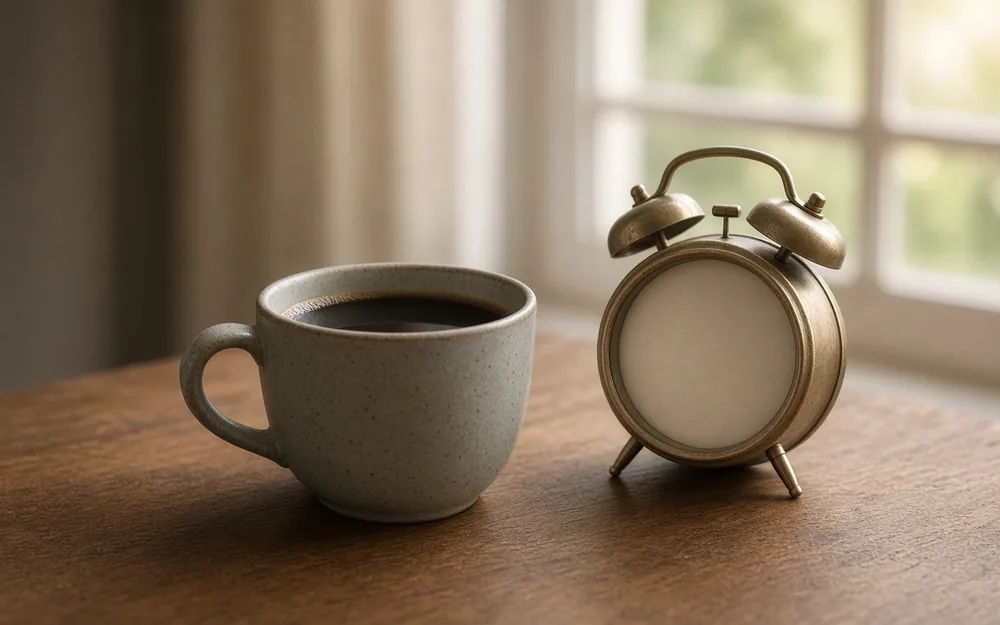
Caffeine first, then a short nap. Image generated by AI.
How to take a better nap
- Keep it short. Aim for about 10 to 20 minutes of sleep. Set an alarm for around 20 to 25 minutes to allow a few minutes to drift off.
- Time it well. The early afternoon dip is ideal. A late-afternoon or evening nap can make it harder to fall asleep at night.
- Make it easy. A dim, quiet spot, an eye mask or a reclining chair all help. Lying down is not essential; even resting with your eyes closed has some value.
- Try a coffee nap if you need a big boost. Have your coffee or strong tea, then nap straight away, keeping it under about 15 to 20 minutes.
- Give yourself a moment. If you do wake groggy, a little daylight, a glass of water and a few minutes of movement will help sleep inertia fade.
- Do not let naps replace night-time sleep. If you feel you need a long nap every day, look first at how much and how well you sleep at night.
Related reading
For more ways to sleep well, see our guide to the best room temperature for sleep, and for another way to structure an afternoon, read what the research says about the Pomodoro Technique.
Why it matters
Many of us live with a small, chronic sleep debt, and the afternoon slump is when it shows. The research suggests that a well-timed short nap is not a sign of laziness but a simple, free tool for staying alert, safe and in a better mood, especially for shift workers, new parents, students and drivers. The key is to treat the nap like a good cup of tea: brief, warm and taken at the right moment, rather than a replacement for a proper night’s rest.
Frequently asked questions
Is a 10-minute nap really enough?
In the Flinders University study, a 10-minute nap gave immediate benefits that lasted up to about two and a half hours, making it the most effective of the lengths tested. Longer naps can also help but may leave you groggy at first.
What is sleep inertia?
Sleep inertia is the temporary grogginess and slower thinking that can follow waking, especially from deep sleep. It usually fades within minutes to about half an hour.
Is daily napping bad for you?
Short naps appear to be safe for most people. Large studies have linked naps of an hour or longer with higher health risks, but long naps can also be a sign of poor night-time sleep or illness, so the cause is not always the nap itself.
Does it count as a nap if I don’t fall asleep?
Resting with your eyes closed still helps a little, and in one driving study even light dozing combined with caffeine reduced sleepiness.
Sources
- Brooks and Lack (2006): which nap duration is most recuperative? (Sleep, via PubMed)
- Rosekind et al.: effects of planned cockpit rest on crew performance and alertness (NASA Technical Reports Server)
- How long is the ideal nap? Mark Rosekind on the 26-minute nap (BBC News)
- Reyner and Horne (1997): suppression of sleepiness in drivers with caffeine and a short nap (Psychophysiology, via PubMed)
- Häusler et al. (2019): napping frequency and cardiovascular events (Heart)
- Paz, Dashti and Garfield (2023): daytime napping, cognition and brain volume (Sleep Health, via PubMed)
- Regular napping linked to larger brain volume (UCL News)
- Daytime napping and the risk of cardiovascular disease and all-cause mortality: dose-response meta-analysis (Sleep, via PubMed Central)










0 Comments