

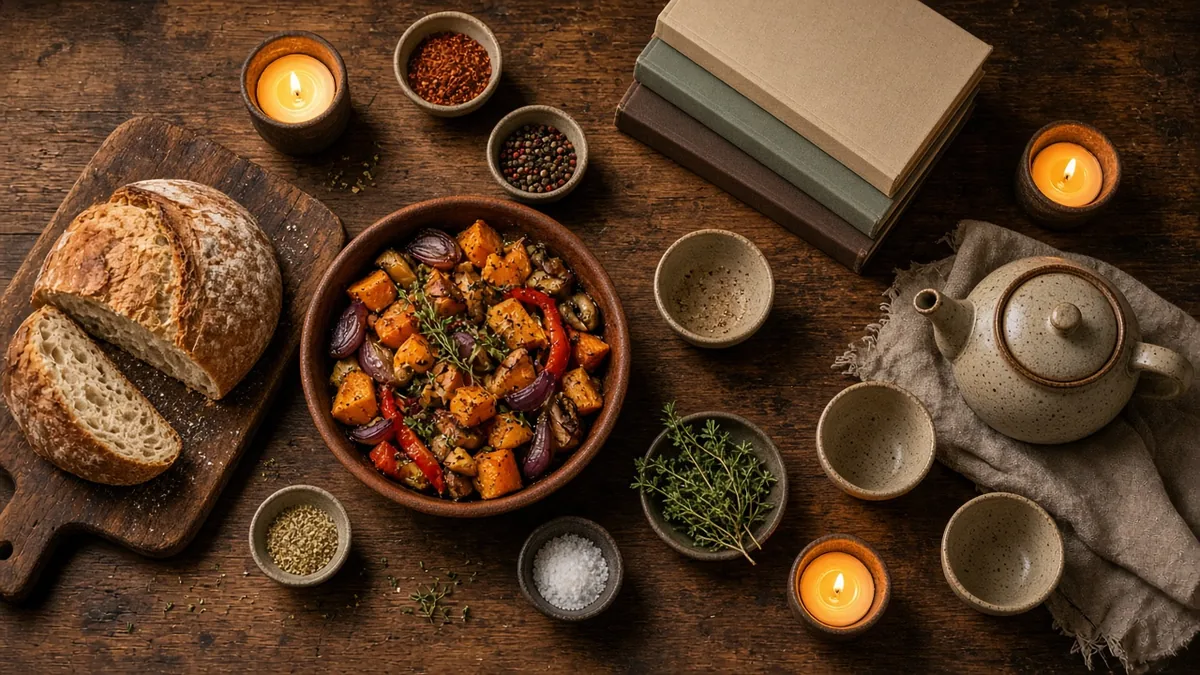
A TeaLamp reading list of five books about food, chosen and described in our own words. Prepared by the TeaLamp Editorial Team with the help of AI.
Some of the best books about food are not really about recipes at all. They are about memory, family, generosity, curiosity and the way a shared meal can change a day or even a life. This reading list gathers five books about food from France, Norway, India and the United States: a witty nineteenth-century classic, a short story about one unforgettable dinner, a joyful memoir, a landmark of food journalism and a warm modern novel about two rival kitchens. Each one is a pleasure to read slowly, ideally with something good to eat and a pot of tea close by.
Why books about food are so satisfying
Food is one of the few subjects that touches everyone. We all eat, most of us cook at least a little, and almost everyone has a dish that carries a memory. That makes food a natural way into much bigger stories. A meal can show us a culture, a family’s history, a social class or a moment of change. Writers also love food because it engages every sense at once, so a well-described dish can feel almost real on the page. The five books below use food in five quite different ways: as philosophy, as grace, as a new beginning, as a question about how we live, and as a bridge between cultures.
The Physiology of Taste by Jean Anthelme Brillat-Savarin (1825)
Jean Anthelme Brillat-Savarin was a French lawyer and judge who survived the upheavals of the French Revolution, including nearly three years of exile in the United States, where he taught French and played the violin to make a living. Back in France, he spent years of spare time writing a book about the pleasures of the table. It was published, at first anonymously, in December 1825, just two months before he died, and it has stayed in print in France ever since.
The book is a delightful mix of essays, science of its day, travel stories and personal anecdotes, organised as a series of “meditations” on topics such as appetite, thirst, the senses, sleep, dreams and even the end of the world. It opens with a set of short aphorisms, including the famous line usually translated as “Tell me what you eat, and I will tell you what you are” (Brillat-Savarin, The Physiology of Taste). Some of its science has dated, of course, but the warmth, humour and curiosity have not. It helped invent the gastronomic essay as a form, and it is the ancestor of much of today’s food writing.
Best for: curious readers who enjoy history, wit and short essays to dip into. M. F. K. Fisher’s 1949 English translation is especially admired, and older translations are freely available online.
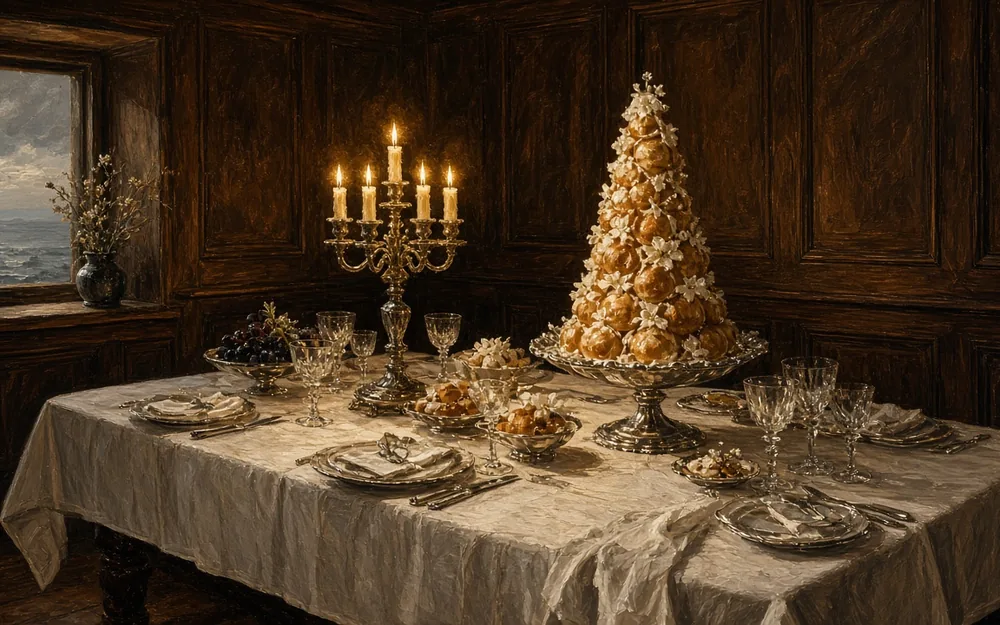
A single grand dinner lies at the heart of one story. Image generated by AI.
Babette’s Feast by Isak Dinesen (Karen Blixen) (collected 1958)
This short story by the Danish writer Karen Blixen, who published in English under the name Isak Dinesen, is only a few dozen pages long, yet it has become one of the best-loved stories about food ever written. It appeared in her collection Anecdotes of Destiny in 1958, the last book published in her lifetime, and later inspired an Oscar-winning Danish film in 1987.
In a small, windswept village on the coast of Norway, two elderly sisters lead a tiny, strict religious community founded by their late father. Years earlier, a Frenchwoman named Babette arrived at their door as a refugee from Paris, and she has worked as their cook ever since, preparing the plain meals the community expects. Then Babette wins a lottery prize and asks for one favour: to cook a real French dinner for the sisters and their friends. The guests, worried that such luxury might be sinful, agree to eat it but not to praise it. What happens at that table is best discovered for yourself, but it is a story about art, gratitude and the quiet ways generosity can heal old quarrels.
Best for: anyone who wants a short, beautiful read in a single evening, and readers who love stories about kindness and second chances.
My Life in France by Julia Child with Alex Prud’homme (2006)
In 1948, Julia Child moved to Paris with her husband, Paul, who worked for the United States government. On the day they arrived in France, she ate a lunch of sole meunière in Rouen that she later described as a turning point in her life. She could barely cook at the time. This memoir tells how that meal led her to the Cordon Bleu cooking school, to a long friendship and partnership with the French cooks Simone Beck and Louisette Bertholle, and eventually to the cookbook that became Mastering the Art of French Cooking.
Written with her husband’s grandnephew, Alex Prud’homme, during the last months of her life and completed after her death in 2004, the book focuses mainly on the years from 1948 to 1954 in Paris, Marseille and Provence. It is full of markets, kitchens, failed experiments and hard-won successes, and Julia’s energy and humour shine on every page. It is also a touching portrait of a marriage and a reminder that it is never too late to discover what you love.
Best for: readers who enjoy memoirs, travel writing and stories of late-blooming passion, whether or not they ever plan to cook a French dish.
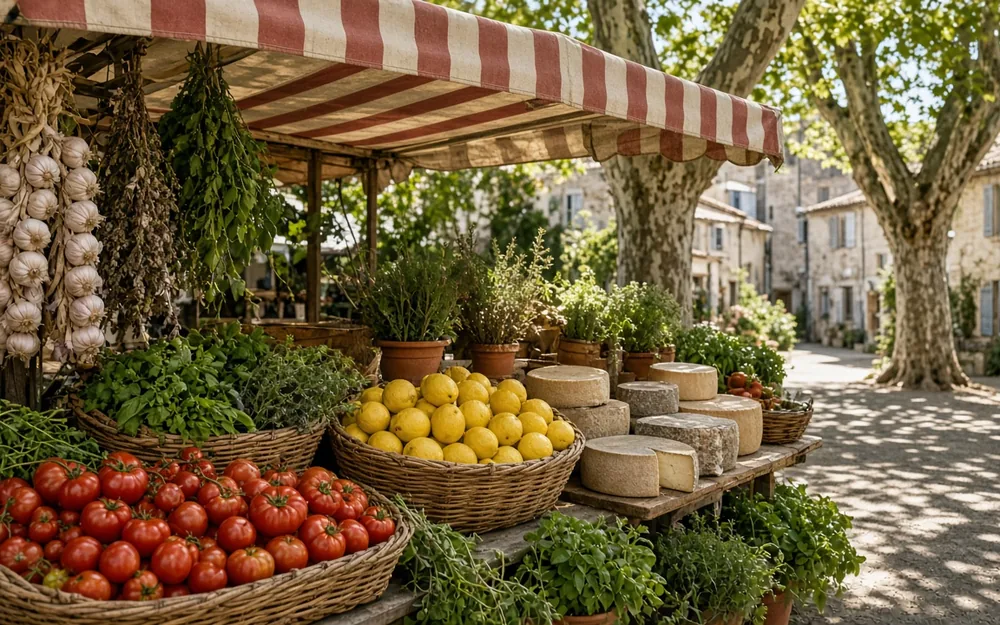
French markets inspired a famous cooking life. Image generated by AI.
The Omnivore’s Dilemma by Michael Pollan (2006)
American journalist Michael Pollan sets out to answer a deceptively simple question: what should we have for dinner? Because humans can eat almost anything, he argues, we have always needed culture and tradition to guide our choices. Modern technology has made nearly every food available all year round, and that abundance has left many people confused.
To make sense of it, Pollan follows four meals back to their sources. He traces an industrial fast-food meal to the vast cornfields of the American Midwest, looks behind the labels of large-scale organic farming, spends time on a small, carefully balanced family farm in Virginia where animals and pasture support one another, and finally tries to make a meal entirely from food he has hunted, gathered or grown himself. The result is part investigation, part nature writing and part personal adventure. Readers do not have to agree with all of his conclusions to find the journey eye-opening, and the book has shaped public conversations about where food comes from ever since.
Best for: readers who like thoughtful non-fiction, science and environmental questions, and anyone who has ever stood in a supermarket wondering what the labels really mean.
The Hundred-Foot Journey by Richard C. Morais (2008)
Hassan Haji grows up above his family’s restaurant in Mumbai, surrounded by the smells of his grandfather’s kitchen. After a family tragedy, the Hajis leave India, spend time in London and finally settle in a small French mountain town called Lumière, where they open an Indian restaurant directly across the road from an elegant French establishment run by the formidable Madame Mallory. The hundred feet between the two kitchens becomes the space where a rivalry, and eventually something much warmer, plays out.
Narrated by Hassan as he grows from a boy into a celebrated chef in Paris, the novel is a lively story about talent, ambition, family loyalty and what it means to belong in a new country. Its descriptions of spices, sauces and markets are mouth-watering, and its picture of two culinary traditions learning from each other is generous and hopeful. Morais, a journalist born in Portugal and raised largely in Switzerland, first published the novel in India in 2008, and it became an international bestseller before being adapted as a film in 2014.
Best for: readers who enjoy feel-good novels, stories about immigrant families and coming-of-age tales set in kitchens.
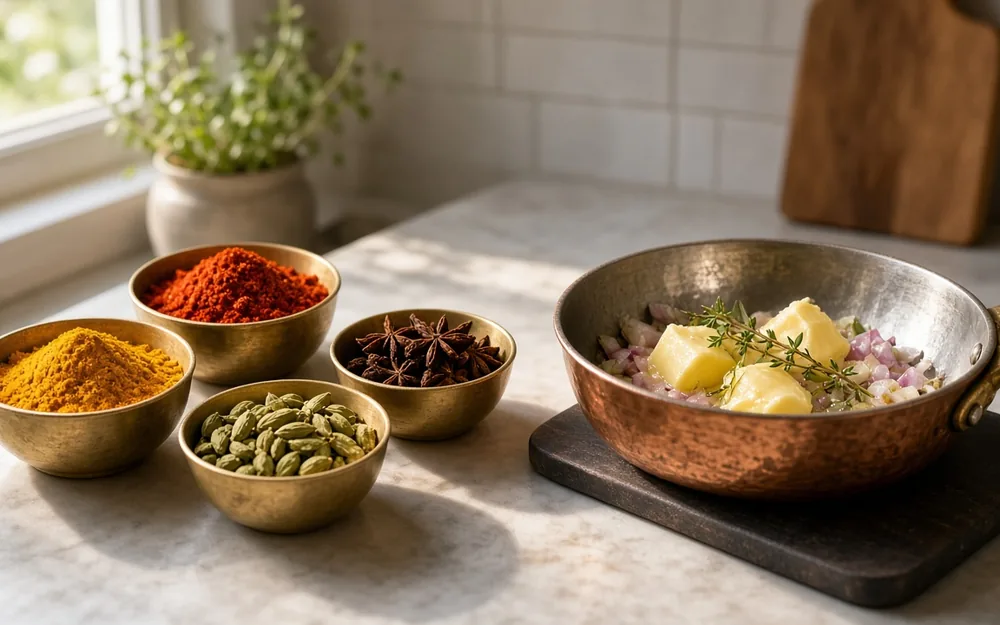
Two kitchens, two traditions, one hundred feet apart. Image generated by AI.
How to choose your first book about food
If you have only one evening, start with Babette’s Feast: it is short, moving and perfect for reading in one sitting. If you want something light and joyful that you can read in snatches, My Life in France is a happy companion. For a novel to sink into over a weekend, choose The Hundred-Foot Journey. Readers who want a book that will change how they shop and eat should try The Omnivore’s Dilemma. And if you love browsing short, witty essays with a sense of history, keep The Physiology of Taste by your armchair and read a meditation or two at a time.
Whichever you pick, these books share a simple, comforting idea: food is never only fuel. It is how people show care, keep memories alive and welcome strangers to the table.
Related reading
For more reading to enjoy with a warm drink, see our list of books about tea. And for stories of growing things from the soil up, try our five books about gardens.
Sources
- Jean Anthelme Brillat-Savarin: life and The Physiology of Taste (Wikipedia)
- Anecdotes of Destiny, the 1958 collection that includes Babette’s Feast (Wikipedia)
- Babette’s Feast: story setting and the 1987 film (Wikipedia)
- My Life in France: background and contents (Wikipedia)
- The Omnivore’s Dilemma: the four meals (Wikipedia)
- Richard C. Morais and The Hundred-Foot Journey (Wikipedia)










0 Comments