


A TeaLamp reading list. Prepared by the TeaLamp Editorial Team with the help of AI.
These five books about mountains take you from a Swiss alp to a Scottish plateau, from a boy’s hollow tree in the Catskills to a sheer ice face in Peru, and finally to a peak that never existed at all. Mountains make a fine subject for a reading list because they do so many jobs in a story. They can be a home, a test, a place to hide, a place to heal, or simply the most beautiful thing a character has ever seen. The five books below span more than a hundred years, from 1880 to 1988: two children’s classics, a quiet masterpiece of nature writing, a true story of survival, and a comedy about an expedition that goes wrong in every way it possibly can.
Key takeaways on books about mountains
- Mountains in these books are never just scenery: they are home, teacher, test and refuge.
- The list mixes fiction and true stories, so there is a mountain book here for every mood.
- Two of the five were written for young readers and suit readers of any age.
- The Living Mountain waited more than thirty years in a drawer before it was published.
- Touching the Void is a true survival story, told plainly and without graphic detail.
Heidi by Johanna Spyri (1880)
Five-year-old Heidi is sent to live with her grandfather, a gruff old man known as Alm-Uncle, in a small hut high in the Swiss Alps. At first he wants nothing to do with her, but Heidi wins him over, and the mountains win her: the goats, the goatherd Peter, the wind in the fir trees, the flowers on the slopes, the view down the valley. When her aunt takes her away to Frankfurt to be a companion to Clara, a girl who cannot walk, Heidi grows homesick for the mountains in a way that makes her ill, and only the Alps can set her right. Spyri’s novel first appeared in two parts, in 1880 and 1881, published by Friedrich Andreas Perthes, and it has been loved ever since. Best for readers who want a warm classic, and for anyone who has ever missed a place the way Heidi misses her mountain.
The Living Mountain by Nan Shepherd (1977)
Nan Shepherd spent a lifetime walking the Cairngorm Mountains of north-east Scotland, and this short book is what she made of all those walks. She wrote it during the Second World War, then put the manuscript in a drawer, where it stayed for more than thirty years, until Aberdeen University Press published it in 1977. It is not a story and it has no plot. Instead Shepherd looks closely at one mountain range, chapter by chapter: its rocks and water, its weather, its birds and plants, the way light moves across the high plateau. Her point is that you do not conquer a mountain by climbing to the top of it. You come to know it by going into it, slowly, in all weathers, again and again. At about 30,000 words it is a short book, but one readers return to for years. Best for readers who like to walk, and for anyone who wants a quiet book that changes the way they look at hills.
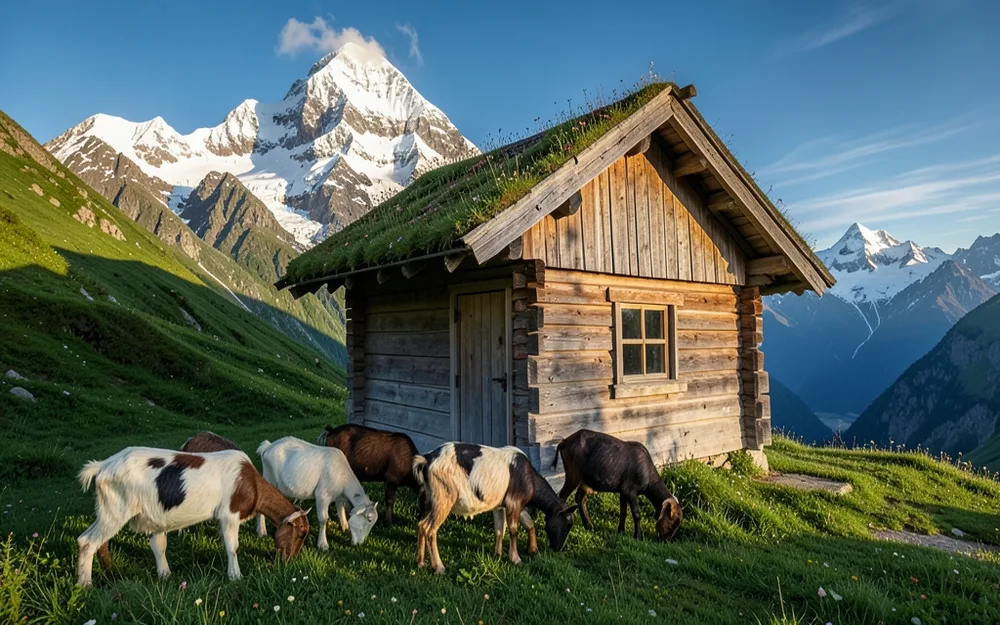
A hut above the valley, with goats on the slope. Image generated by AI.
My Side of the Mountain by Jean Craighead George (1959)
Sam Gribley is tired of living in a crowded New York City apartment with his large family, so he runs away to the Catskill Mountains to live on his own. He finds a hollow hemlock tree, makes a home inside it, learns to catch fish and cook over a fire, and trains a young falcon he names Frightful. It is hard work, and sometimes lonely work, and the book never pretends otherwise: Sam is cold, hungry and scared as often as he is free and happy. George wrote and illustrated the book herself, and E. P. Dutton published it in 1959. It won a Newbery Honor in 1960 and has been a favourite with young readers ever since. The mountain here is a place to grow up in, and Sam grows up fast. Best for young readers who dream of running away to the woods, and for adults who remember dreaming the same dream.
Touching the Void by Joe Simpson (1988)
In 1985 Joe Simpson and Simon Yates climbed the west face of Siula Grande, a 6,344-metre peak in the Peruvian Andes that no one had climbed that way before. They reached the summit. On the way down, Simpson broke his leg badly, and then fell into a deep crevasse. Yates, believing his friend was dead, made his own way down. Simpson survived the fall, and then crawled and hopped for days across glacier and rock to reach base camp. His book, first published by Jonathan Cape in 1988, tells the story in his own words, plainly and without drama for its own sake. It is the most gripping book on this list, and also the most serious: a story about what a person can endure, and about a friendship tested in the worst possible way. There is nothing graphic in the telling, but the danger is real throughout. Best for readers who want a true adventure story, and who do not mind holding their breath for a few chapters.

Small figures on a high ridge, at first light. Image generated by AI.
The Ascent of Rum Doodle by W. E. Bowman (1956)
After four serious mountain books, here is the joke. Rum Doodle is a 40,000-and-a-half-foot peak in the imaginary country of Yogistan, slightly higher than Everest, and a bumbling British expedition sets out to climb it. Everything that can go wrong does: the porters, the food, the equipment, the leadership, the weather, the language. Bowman wrote it as a loving parody of the stiff expedition books that were bestsellers in the 1950s, when the world’s highest peaks were being climbed for the first time. Max Parrish published it in 1956, and climbers have quoted it ever since; a new edition in 2001 even carried an introduction by Bill Bryson. Best for readers who want to laugh at mountains instead of shivering on them, and for anyone who has ever been on a trip where nothing went to plan.
Why it matters
Mountains ask something of the people who go to them, and that is why they make such good books. Heidi learns to belong somewhere. Nan Shepherd learns to pay attention. Sam Gribley learns to look after himself. Joe Simpson learns what he can survive. And the Rum Doodle expedition learns, more or less, nothing at all, which is the joke. Read one of these books with tea, and the mountain will come to you, even on a flat grey day.
For another mountain journey, read our review of The Hobbit Review: Tolkien’s Cozy Road to Adventure.
Frequently asked questions
Which of these books should I read first?
Start with Heidi if you want something warm and gentle, or My Side of the Mountain if you want an adventure. Both are easy to pick up and hard to put down, and both suit readers of any age.
Are these books suitable for younger readers?
Heidi and My Side of the Mountain were written for young readers and suit them well. The Ascent of Rum Doodle suits older children and adults. The Living Mountain suits patient older readers, and Touching the Void, with its real danger and injury, suits older teenagers and adults.
Do I need to read them in order?
No. Each book stands on its own. Read them in any order, and start with whichever mountain sounds most like the one you would like to climb, or simply sit and look at.
Sources
- Heidi, Wikipedia (Johanna Spyri, published 1880 and 1881, Friedrich Andreas Perthes)
- Nan Shepherd celebrated, University of Cambridge (The Living Mountain, written in the 1940s, published 1977 by Aberdeen University Press)
- My Side of the Mountain, Wikipedia (Jean Craighead George, 1959, E. P. Dutton, Newbery Honor 1960)
- Touching the Void, Wikipedia (Joe Simpson, 1988, Jonathan Cape, Siula Grande 6,344 metres)
- The Ascent of Rum Doodle, Wikipedia (W. E. Bowman, 1956, Max Parrish and Co.)










0 Comments