

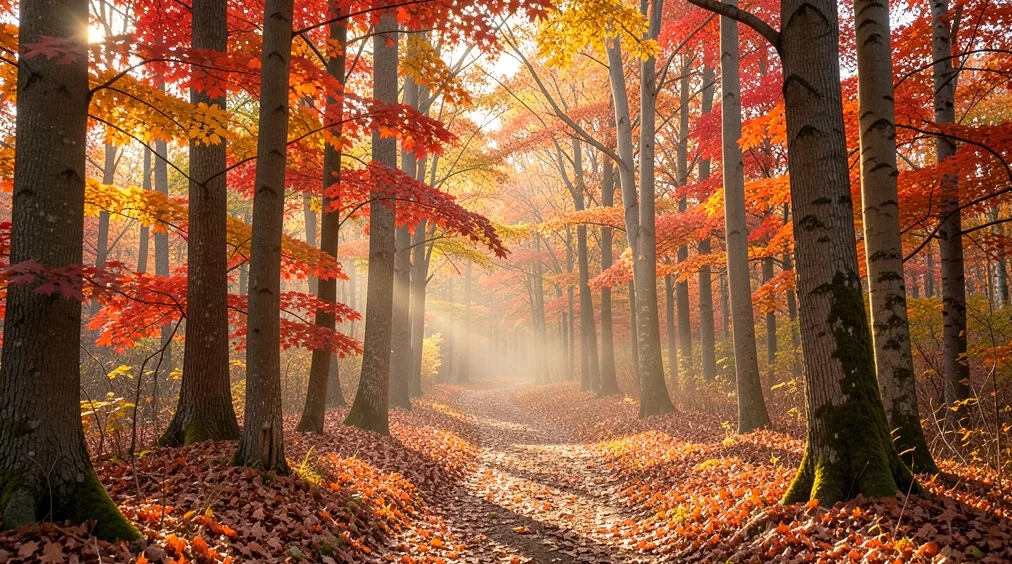
An original TeaLamp explainer based on the sources listed below. Prepared by the TeaLamp Editorial Team with the help of AI.
Why leaves change color in fall is one of those questions that sounds simple and turns out to be a small chemistry lesson. The short answer is that the reds, oranges and golds were not painted on in October. Most of the yellow was there all summer, hidden under green, and the reds are made fresh as the season turns. What looks like a single event, a forest “turning,” is really a careful shutdown that trees run every year to survive winter.
Key takeaways
- Green chlorophyll masks other pigments all summer. When trees stop making it in autumn, yellow and orange carotenoids show through.
- Reds and purples come from anthocyanins, which many trees make in autumn when sugars build up in the leaf under bright light.
- The main trigger is the lengthening night, not the first frost, but weather decides how bright the show is.
- Warm, sunny days with cool, frost-free nights tend to produce the most vivid reds. Drought, heat and long cloudy spells dull them.
- Climate change is shifting autumn timing, and recent research suggests the answer is not simply “later every year.”
Why leaves change color: three pigments, one season
A leaf is a solar panel and a kitchen in one. During the growing season it is packed with chlorophyll, the green pigment that captures sunlight so the tree can turn water and carbon dioxide into sugar. The US Forest Service describes chlorophyll as being constantly produced and broken down through the summer, which is why leaves stay a steady green. There is so much of it that it hides everything else.
Hidden underneath are the carotenoids, the same family of pigments that colors carrots, corn and daffodils. They sit in the leaf’s chloroplasts alongside chlorophyll and help with light capture and protection. The Texas A&M Forest Service notes that most plants hold roughly three times as much chlorophyll as carotenes and xanthophylls (the two main types of carotenoid), which explains why we rarely notice them in July.
The third pigment group is different. Anthocyanins, the pigments behind the color of cranberries, red apples and plums, mostly are not sitting in the leaf all summer. Many trees make them in late summer and autumn, dissolved in the watery sap of leaf cells. That is why yellows are fairly reliable from year to year, while reds can be spectacular one autumn and muted the next.
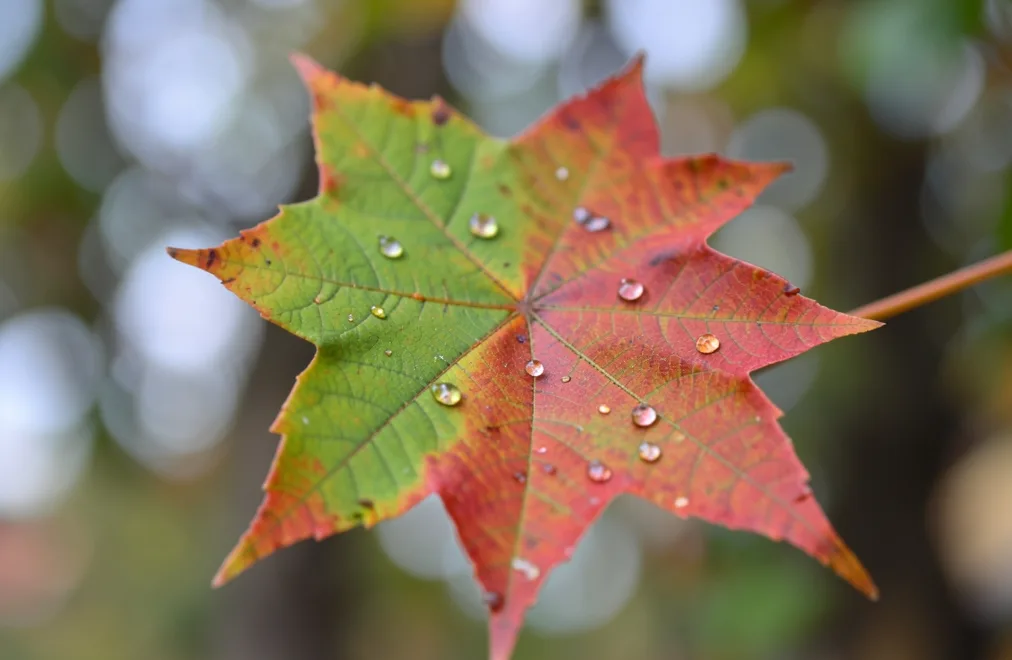
As chlorophyll fades, hidden yellows appear and new reds are made. Image generated by AI.
The real trigger: longer nights
It is tempting to think the first cold snap flips the switch, but the Forest Service points to something steadier: the length of the night. Temperature and rainfall wobble from week to week, while the steady growth of darkness after the September equinox is the same every year. Trees use it as a calendar.
As nights lengthen, a layer of cells called the abscission (or separation) layer starts to form where each leaf stalk meets the twig. Veins that carry water in and sugar out slowly close. Chlorophyll production slows and then stops, and the existing chlorophyll breaks down. With the green gone, the carotenoids are unmasked. In species able to make them, the sugars now trapped in the leaf feed the production of anthocyanins. Once the separation layer is complete, the leaf is sealed off and ready to drop, leaving a neat scar that protects the twig through winter.
This is not waste. Before letting go, trees pull valuable nutrients, especially nitrogen, back out of their leaves and store them in the wood and roots for next spring. Autumn color is, in part, the visible leftover of a recycling program.
Why some trees blaze red and others glow gold
Look at a mixed forest and you will see a pattern. Aspens, birches and many hickories turn clear yellow or gold. Sugar maples, red maples, sumacs, sweetgums and many oaks push into orange, scarlet and purple. Conifers such as spruce and pine stay green because they keep their needles through winter. The difference is mostly genetic: some species simply have the machinery to make large amounts of anthocyanin in autumn, and some do not.
Even within one tree the colors vary. The Texas A&M Forest Service notes that leaves in the upper crown, which get the most sun, usually develop the brightest reds. Leaf chemistry plays a part too. The USDA explains that the exact shade of red depends on how anthocyanins interact with the acidity and mineral content of leaf cells, which is one reason two maples on the same street can look slightly different.
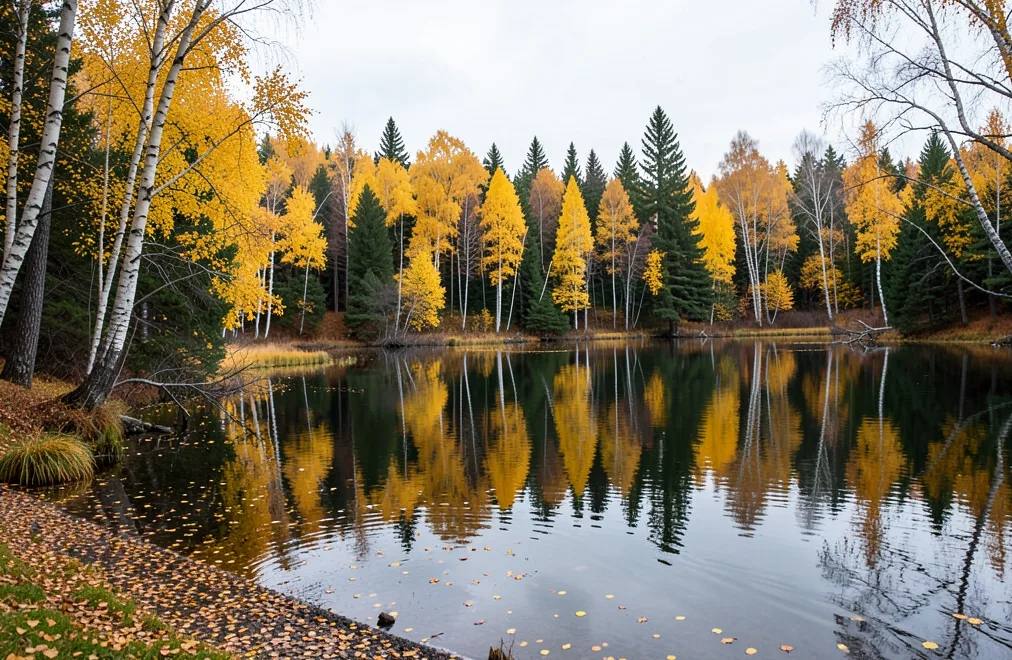
Aspens and birches turn gold, while evergreen conifers stay green. Image generated by AI.
How weather shapes a great (or dull) autumn
If night length sets the timing, weather sets the brightness. According to the Forest Service, the best displays come after a run of warm, sunny days and cool, crisp but not freezing nights. Sunny days mean plenty of sugar is made; cool nights and closing veins keep that sugar in the leaf; more trapped sugar and bright light mean more anthocyanin and brighter reds.
Other conditions work against the show. A severe summer drought can delay color by weeks or cause leaves to brown and drop early. A warm spell in autumn tends to soften the intensity. Long stretches of cloudy, rainy weather reduce the light and sugar that reds depend on. A hard early freeze can kill leaves before they finish turning. Soil moisture also matters, and because rain and temperature combine in endless ways, no two autumns look exactly alike.
Why would a tree bother making red leaves?
Here is the puzzle that still interests scientists. Yellow is essentially free, since the carotenoids were already there. Red costs the tree energy, because it is making new pigment in leaves it is about to drop. Why spend anything on leaves that are on their way out?
There is no single settled answer, but a leading idea is protection. In autumn, leaves are trying to pull nutrients back into the tree while their chlorophyll is falling apart, and that damaged light-harvesting system can be harmed by bright sun, especially on cold mornings. Anthocyanins absorb some of that light and may act as a kind of sunscreen, giving the leaf time to finish recycling nitrogen before it falls. Other researchers have suggested that bright colors might signal something to insects that lay eggs on trees, though that idea is more debated. For a leaf-peeper, the practical lesson is the same: the reds are a sign of a tree working hard right to the end.
What a warming climate means for fall color
Warmer autumns have stretched the growing season in many temperate forests, with leaves coming out earlier in spring and, in many places, hanging on later in autumn. For years, models predicted that this delay would keep growing. A 2020 study in Science by Deborah Zani and colleagues at ETH Zurich complicated that picture.
Working with more than 400,000 observations from the Pan European Phenology Project plus experiments, the team found that trees which photosynthesize more in spring and summer tend to start shutting down their leaves earlier in autumn. ETH Zurich summarized it as each 10 percent rise in spring and summer photosynthesis advancing leaf senescence by about eight days. When they built that effect into their model, the forecast flipped: instead of leaves senescing two to three weeks later by the end of the century, they projected senescence about three to six days earlier than today, if photosynthesis keeps rising.
That finding was based on European tree species, and autumn timing still depends heavily on local weather. But it carries an important point for climate: a longer season does not automatically mean forests soak up much more carbon, because trees appear to have a built-in limit on how much they can grow in a year.
How to enjoy the color more
Knowing the science can make a walk more fun. Notice which trees go yellow and which go red, and you will start to recognize species from across a valley. Check the sunny side of a maple against the shady side. After a warm, bright week with chilly nights, expect stronger reds. After a dry summer, look for color that comes early or fades fast. And in places where evergreens mix with broadleaf trees, the dark green of spruce and pine makes the golds look even brighter.
Related reading: how to keep your sleep on track after the fall back time change.
Frequently asked questions
Does frost make leaves change color?
Not mainly. Longer nights start the process. A light frost can speed the breakdown of chlorophyll, but a hard freeze can kill leaves before they reach full color.
Why are some autumns more colorful than others?
Weather. Warm, sunny days and cool, frost-free nights favor bright reds, while drought, warm autumns or long cloudy spells tend to dull the display. Yellows vary less from year to year.
Why do evergreen trees stay green?
Most conifers keep their needles for several years. Their tough, waxy needles cope with cold and dry winter air, so they do not need to shed them each autumn.
Sources
- Science of Fall Colors, US Forest Service
- The Biology of Fall Leaves: It’s All About Chemistry, US Department of Agriculture
- Autumn Colors, Texas A&M Forest Service
- Zani et al. (2020), Increased growing-season productivity drives earlier autumn leaf senescence in temperate trees, Science 370: 1066–1071
- Which factors trigger leaf die-off in autumn?, ETH Zurich news





0 Comments