


A TeaLamp reading list of five books about village life, chosen and described in our own words. Prepared by the TeaLamp Editorial Team with the help of AI.
Some of the best stories live in small places. A village has a church, a school, a shop or two, and a green where everyone passes each other sooner or later, and that is all a writer needs. Secrets travel fast, kindness travels faster, and a newcomer is noticed before the kettle boils. These five books about village life span more than a hundred years, from a Cheshire town in 1853 to a Kent farm in 1958, and each one shows a different side of village days: the comedy, the gossip, the hard work, and the quiet way neighbours look after each other.
Key takeaways on books about village life
- A village is the perfect setting for a story: everyone knows everyone, so small events matter and every character counts.
- These five books span 1853 to 1958, from Victorian England to the years just after the Second World War.
- Two of the books are drawn from real village life, and three are invented, but all five feel true to the place.
- The list mixes comedy, memoir and gentle drama, so it works as a tasting menu as well as a reading list.
- Every book here is warm at heart, even when the village in it is being gloriously awkward.
Cranford by Elizabeth Gaskell (1853)
The best place to begin is with the village that started them all. Cranford is a set of linked stories about a small Cheshire town, told by a young visitor named Mary Smith. The town is run almost entirely by genteel ladies of modest means, widows and unmarried sisters who guard their manners as carefully as their purses. They call on each other in strict order, they worry about what the neighbours will think, and they pretend to be richer than they are, all with great dignity and very little money.
At the centre of it all is Miss Matty Jenkyns, the kindest woman in Cranford. When her bank fails and her small income disappears, she does the bravest thing in the book: she opens a little tea shop in her own parlour and sells tea to her neighbours, rather than accept charity. Gaskell based Cranford on Knutsford, the Cheshire town where she grew up, and the book began as separate pieces in Charles Dickens’s magazine Household Words before it was published as a book in June 1853. Best for readers who enjoy gentle comedy, kind characters, and a village that feels like a place you have visited yourself.
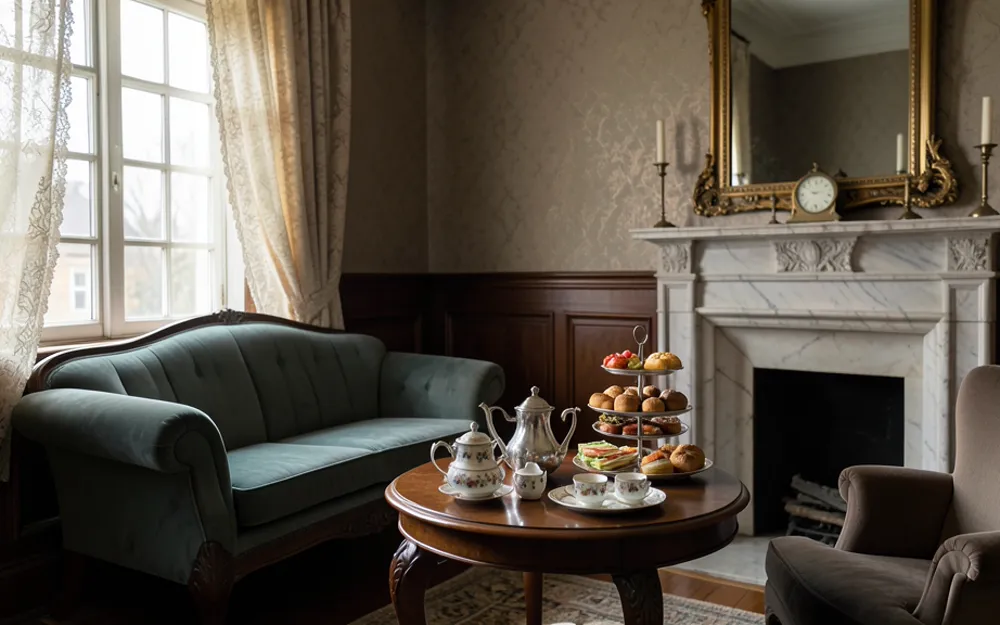
A quiet parlour, with tea things laid out. Image generated by AI.
Cold Comfort Farm by Stella Gibbons (1932)
What if a sensible young woman from London arrived in a village that had gone gloriously wrong? That is the delicious question at the heart of Cold Comfort Farm. Flora Poste, nineteen years old and newly orphaned, has an income of one hundred pounds a year and no idea how to earn a living. She writes to her relatives and chooses the Starkadders, who live at Cold Comfort Farm in the Sussex village of Howling, because they owe her family a favour from long ago.
The farm is a wonderful mess. The Starkadders are ruled from a locked bedroom by Aunt Ada Doom, who has not left her room for twenty years, ever since, as she puts it, she saw something nasty in the woodshed. Her son Amos preaches fire and damnation, her daughter-in-law Judith broods over old wrongs, and the cows are named Aimless, Feckless, Pointless and Graceless. Flora, armed with nothing but common sense and good manners, sets about tidying the whole family up, one cousin at a time.
“I saw something nasty in the woodshed.”
Stella Gibbons, Cold Comfort Farm
The book is a parody of the gloomy rural novels that were popular at the time, and it won the Femina Vie Heureuse Prize in 1933. It is funny from the first page to the last, and Flora is one of the most satisfying heroines in English comedy. Best for readers who like their humour sharp, their heroines practical, and their villages in need of a good tidy.
Lark Rise to Candleford by Flora Thompson (1945)
Not every book on this list is invented. Lark Rise to Candleford is the true story of a village childhood, told by a woman who lived it. Flora Thompson grew up in Juniper Hill, a tiny hamlet in Oxfordshire, in the 1880s, and she began writing about it when she was in her sixties. The three volumes, Lark Rise, Over to Candleford and Candleford Green, were published separately in 1939, 1941 and 1943, and first brought together as one book in 1945.
Thompson follows her younger self, called Laura in the books, from the hamlet schoolroom to her first job, at fourteen, behind the counter of the village post office in Fringford. She describes the harvest, the church, the pub, the games children played, and the way a whole community lived by the seasons. Nothing dramatic happens, and that is the point: the book is a careful portrait of ordinary days, written by someone who remembered them clearly and loved them. Best for readers who like quiet books, social history, and stories that slow you down.
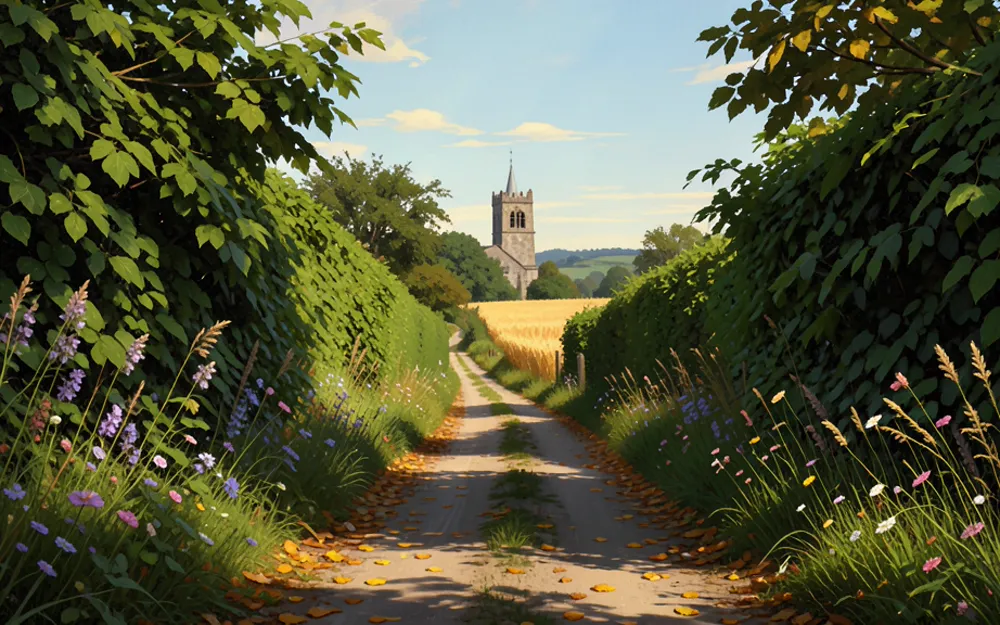
A country lane at harvest time, with the church tower ahead. Image generated by AI.
Village School by Miss Read (1955)
If Lark Rise to Candleford remembers a village childhood, Village School reports on a village schoolroom from the teacher’s desk. Miss Read, the pen name of Dora Saint, was a village schoolteacher herself, and her first novel follows one school year in Fairacre, a fictional village somewhere in southern England. Miss Read is the headmistress of a two-room school, teaching the older children, and she tells the story in her own voice, with a dry wit that never quite hides her affection for her pupils.
The year brings all the small dramas of village life: the Christmas pageant, a difficult inspector’s visit, the school cleaner Mrs Pringle and her strong opinions, and the children themselves, who lose mittens, skin knees and ask impossible questions. Saint wrote more than forty novels about Fairacre and its neighbouring village, Thrush Green, and this first one, published in 1955, became an instant bestseller. Best for readers who love school stories, gentle humour, and a narrator who knows exactly how a village works.
The Darling Buds of May by H. E. Bates (1958)
The final book is a feast, and the Larkins are the hosts. In The Darling Buds of May, Pop and Ma Larkin live on a small farm in Kent with their six children, and they enjoy life more than anyone else in England. There are strawberries and cream, long lunches in the garden, and a cheerful disregard for any rule that gets in the way of a good time. Then a timid tax inspector named Cedric Charlton arrives to ask about their taxes, and the Larkins set about feeding him, charming him, and marrying him off to their daughter Mariette.
The title comes from Shakespeare’s Sonnet 18, and H. E. Bates, who had watched a large, joyful family spill out of a shop in Kent one day, turned what he saw into the first of five books about the Larkins. The novel was published in 1958, and it became one of the best-loved comic novels of its time, later adapted for television. It is sunny, generous and a little naughty, and it ends, as all good village stories should, with a wedding. Best for readers who want a book that feels like a long summer afternoon.
“Rough winds do shake the darling buds of May.”
William Shakespeare, Sonnet 18
That line gave Bates his title, and it fits the book perfectly: a story about May, about blossom, and about a family that refuses to let rough winds spoil a fine day.
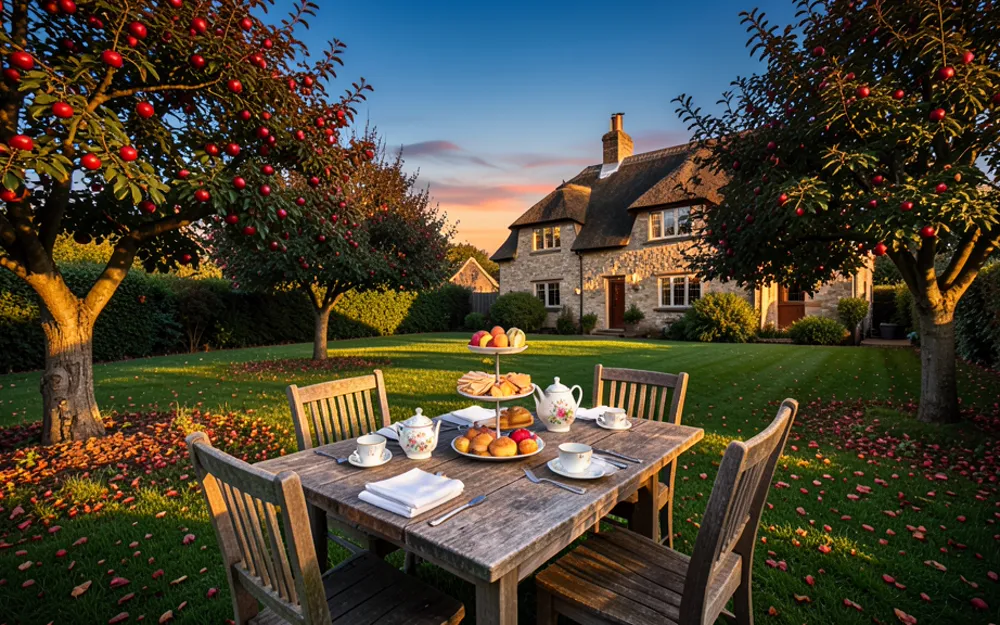
Tea in a farmhouse garden on a late summer evening. Image generated by AI.
Why these books matter
Villages make wonderful stories because they are small enough to know and large enough to surprise. A village holds the whole of life in a few streets: birth and marriage, work and rest, kindness and gossip, and the slow change of the seasons. These five books understand that. Each one uses a village to say something true about people: that we are funnier than we think, kinder than we admit, and often in need of a small, patient community to remind us to slow down.
The list also shows how far a single idea can travel. A Cheshire town in 1853, a Sussex farm in 1932, an Oxfordshire hamlet in the 1880s, a village school in the 1950s, and a Kent farm in 1958: five very different villages, one shared truth, that life is better when you know your neighbours.
Related reading
For another village story, see our review of Jane Austen’s Emma, set in the village of Highbury.
Frequently asked questions
Are these books suitable for children?
Village School and Lark Rise to Candleford are the gentlest books on the list, and older children will enjoy them. Cranford and The Darling Buds of May are adult novels, though neither is difficult to read. Cold Comfort Farm is the sharpest comedy here, best suited to grown-up readers.
Do I need to read them in order?
Not at all. Each book stands on its own, so start with whichever village calls to you. If you like, read them in the order they appear here, from 1853 to 1958, and watch the English village change across a century.
Which book should I start with?
Start with Cold Comfort Farm for something funny, or with Village School for something gentle and short. If you like quiet books, begin with Lark Rise to Candleford, and save The Darling Buds of May for a warm summer evening.
Sources
Lark Rise to Candleford — Wikipedia









0 Comments