


An original TeaLamp explainer based on the sources listed below. Prepared by the TeaLamp Editorial Team with the help of AI.
Think back to your last holiday. You probably do not remember every hour of it. You remember the best day, the worst delay, and how the trip ended. The peak-end rule says that is normal. We judge a past experience mostly by its most intense moment and by how it finished, while how long it lasted barely counts.
Key takeaways on the peak-end rule
- We remember an experience by two moments: the peak, its most intense point, and the end, how it finished. The rest fades, and the length of it hardly matters.
- In a 1993 cold-water test, 22 of 32 people chose to repeat a longer, more painful trial because it ended more gently.
- Hospital patients rated long medical procedures by their worst moment and their final minutes, not by how many minutes the procedure took.
- The rule shapes holidays, meals, workouts and customer service, and it can be used well: plan one high point and protect the ending.
The cold-water test
In November 1993, the psychologist Daniel Kahneman and his colleagues published a small experiment that still surprises people today. Thirty-two volunteers took part in two trials. In the short trial, each person held one hand in water at 14 degrees Celsius for 60 seconds. In the long trial, they held the other hand in the same cold water for 60 seconds, and then kept it there for 30 seconds more while the water warmed slightly, to about 15 degrees. The water was still cold and uncomfortable. It was only a little less so.
Then came the question that made the study famous. Which trial would you like to repeat? A sensible answer would be the short one. It held every second of the long trial’s pain, minus the extra 30 seconds. Yet 22 of the 32 people, about 69 percent, chose the long trial. They picked more total pain because it ended better.
The researchers had found something strange about how memory works. The people in the study knew, on average, that the long trial had lasted longer. What mattered was the shape of the experience: the worst moment and the final moment. The long trial’s ending was gentler, so the whole trial was remembered as the better one.
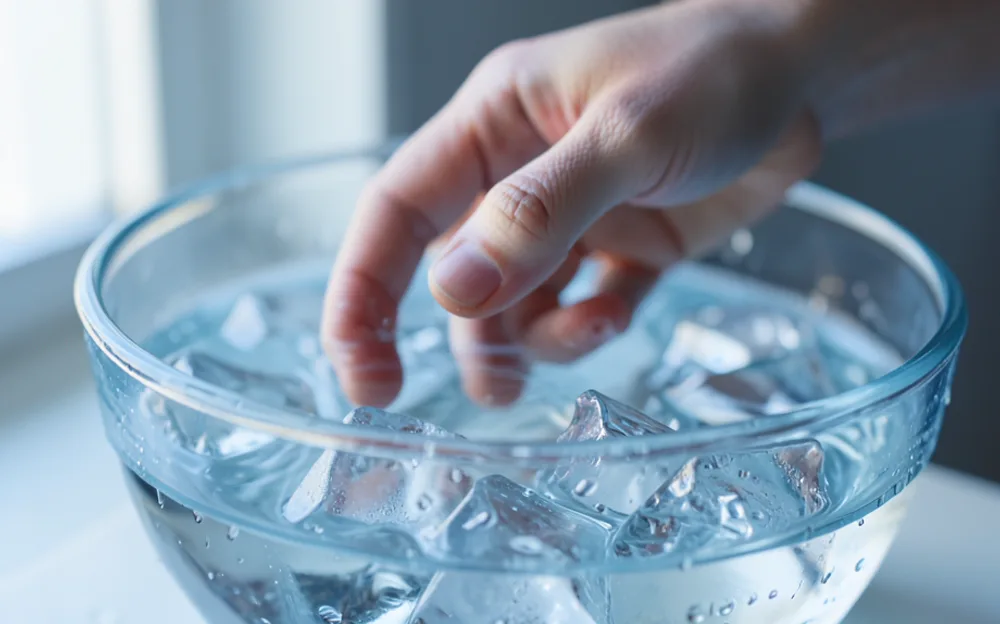
A hand over ice water, in the cold-water test. Image generated by AI.
Two selves: the one who lives and the one who remembers
The same year, Barbara Fredrickson and Kahneman showed the effect with film clips. Thirty-two people watched short films, some pleasant and some deeply unpleasant, in long and short versions. They rated how they felt moment by moment, and then gave an overall rating when each film ended. The length of a clip had almost no effect on the overall rating. What counted was the most intense moment and the final one. A second study, with 96 people, found the same pattern when people ranked the films from memory.
Kahneman later gave this a simple frame in his book Thinking, Fast and Slow, published in 2011. He described two selves inside each of us. The experiencing self lives through the moments as they happen. The remembering self keeps the story afterwards, and it is the remembering self that decides what we will do again. The trouble is that the remembering self is a careless editor. It keeps the peak and the end and throws the rest away, including how long something lasted. This is why a two-week holiday can be remembered as a single great day and a smooth flight home, while a short trip with a miserable last day can feel like a failure.
From the lab to the clinic
A laboratory trick would be easy to dismiss. So the researchers took the idea into a hospital. In 1996, Donald Redelmeier and Kahneman studied real patients having colonoscopies and lithotripsy, a treatment that breaks up kidney stones. There were 154 colonoscopy patients and 133 lithotripsy patients. Each patient rated their pain every 60 seconds during the procedure, and then gave an overall rating afterwards.
The result matched the cold-water test. Patients’ overall ratings tracked the worst pain they had felt and the pain of the final three minutes. How long the procedure lasted made almost no difference. Some procedures took a few minutes and some took over an hour, yet length had nearly no link to how bad the experience was remembered to be.
Then came the test that mattered most. In 2003, Redelmeier, Joel Katz and Kahneman ran a randomised trial with 682 colonoscopy patients. Half had the usual procedure. For the other half, the scope was left in place for three extra minutes at the end, still and not moved, so the patient felt mild discomfort instead of pain. The longer procedure was rated as less unpleasant, and those patients were more likely to come back for a follow-up. A gentler ending did not just change a memory. It changed a health decision.

A quiet hospital corridor, where the rule was tested on real patients. Image generated by AI.
Why it matters
The peak-end rule matters because the remembering self is the one that makes our choices. We pick the restaurant we will return to, the holiday we will repeat, and the treatment we will agree to, on the basis of remembered experiences, not lived ones. When memory keeps only the peak and the end, our choices can drift away from what was actually best for us. People in the cold-water study chose more pain. Patients who had a shorter procedure remembered it as worse than patients who had a longer one with a kinder ending.
The same quirk works in the other direction. A good experience can be spoiled by a bad ending, even if most of it was fine. A lovely meal that ends with a rude bill, or a fine holiday that ends with a lost bag, is remembered as a disappointment. The ending writes the headline, and the headline is what we carry home.
Where the rule shows up in everyday life
Once you know the rule, you start to see it everywhere. Hotels and restaurants have known it for years, even if they do not use the name. A warm welcome matters, but the farewell matters more: the small gift at checkout, the kind word at the door, the dessert that arrives as a surprise. A meal is often judged by its best course and by the last taste on the tongue.
It shows up in exercise too. A workout that ends with a gentle cool-down is remembered more fondly than one that stops at the hardest moment, even if the hard part was identical. Runners sometimes add an easy stretch at the end for exactly this reason. The body forgets the middle. It remembers the finish.
It shows up at work as well. A meeting that ends with a clear decision and a friendly word feels productive, even if the middle dragged. A presentation is remembered for its strongest slide and its closing line. And it shows up in how we treat each other: a difficult conversation that ends with kindness is remembered as a good talk, while a pleasant chat that ends in a sharp word can sour the whole evening.
What the rule does not prove
The peak-end rule is a strong description of how memory works, not a law of nature. It does not hold for every kind of experience. It applies best to experiences with a clear beginning and a clear end, like a meal, a film, or a medical procedure. Later research suggests it fits less well for experiences that stretch across a whole day, where many separate moments compete for attention.
It is also a tendency, not a certainty. In the cold-water test, 22 of 32 people chose the longer trial, but 10 did not. Some people weighed the extra 30 seconds more heavily, and a few felt almost no relief as the water warmed. The rule describes what most people do, not what everyone does.
Most important, the rule says nothing about what actually happened. It describes the memory, not the experience. A long, painful procedure is still long and painful, even if it is remembered kindly. Duration still matters for the body, for health, and for time spent. It only matters less for the story we tell afterwards.

Boots at rest at the end of a walk, a good ending. Image generated by AI.
How to use it well
Knowing the rule lets you shape experiences kindly, for yourself and for others. Three small habits help.
First, plan one high point. You do not need every moment to be special. One vivid, joyful moment in a day out, a holiday, or a family gathering will do much of the remembering work. Pick the view, the dish, or the game that everyone will talk about later, and give it room.
Second, protect the ending. Leave time for a calm finish. End a walk with a favourite view rather than a rush to the car. End a meal with something sweet and unhurried. End a visit with a proper goodbye instead of a hurried dash to the door. The last few minutes are doing more work than they look.
Third, be gentle with a bad ending. If a day has gone wrong, a small kind finish can still rescue the memory: a cup of tea together, a short walk, a joke shared on the way home. It does not erase what happened, and it should never be used to paper over real harm or poor service. But a kind ending is a real kindness, and the remembering self will thank you for it.
Related reading
For another way memory plays tricks on us, read The Zeigarnik Effect: Why Unfinished Tasks Stick in Your Mind, our explainer on why unfinished business keeps coming back to mind.
Frequently asked questions
Does the peak-end rule mean duration never matters?
No. Duration matters for the experience itself: a long wait is still long, and a long illness is still hard. The rule is about memory. When we look back, how long something lasted counts for very little next to its most intense moment and how it ended.
Who discovered the peak-end rule?
The rule grew out of work by the psychologists Barbara Fredrickson and Daniel Kahneman in the early 1990s. Their 1993 studies on film clips and cold water showed that overall ratings depended on the peak and the end, not on duration. Kahneman and Donald Redelmeier then confirmed the pattern with hospital patients in 1996, and in a randomised trial in 2003.
Can I use the peak-end rule to remember things better?
You can use it to shape what you will remember, not to recall facts more accurately. Plan one bright moment in an outing and give it a calm, pleasant ending, and the day is more likely to be remembered fondly. The rule does not improve memory for details. It changes which moments the remembering self keeps.
Sources
- Kahneman, D., Fredrickson, B. L., Schreiber, C. A., & Redelmeier, D. A. (1993). When more pain is preferred to less: Adding a better end. Psychological Science, 4(6), 401–405. 32 participants; 22 of 32 chose to repeat the longer cold-water trial (60 seconds at 14 degrees Celsius, plus 30 seconds warming to 15 degrees) over the shorter one.
- Fredrickson, B. L., & Kahneman, D. (1993). Duration neglect in retrospective evaluations of affective episodes. Journal of Personality and Social Psychology, 65(1), 45–55. Film-clip studies with 32 and 96 participants; clip duration had almost no effect on overall ratings, which tracked the peak and the end.
- Redelmeier, D. A., & Kahneman, D. (1996). Patients’ memories of painful medical treatments: Real-time and retrospective evaluations of two minimally invasive procedures. Pain, 66(1), 3–8. 154 colonoscopy and 133 lithotripsy patients; overall pain ratings tracked the peak and the final three minutes, not procedure length.
- Redelmeier, D. A., Katz, J., & Kahneman, D. (2003). Memories of colonoscopy: A randomized trial. Pain, 104(1–2), 187–194. 682 colonoscopy patients; leaving the scope in place for three extra gentle minutes made the procedure seem less unpleasant and patients more likely to return.
- Peak–end rule (Wikipedia). Overview of the rule, its limits, and later research, including work on day-long experiences and on pleasurable experiences (Do et al., 2008).









0 Comments