

An original TeaLamp explainer based on the sources listed below. Prepared by the TeaLamp Editorial Team with the help of AI.
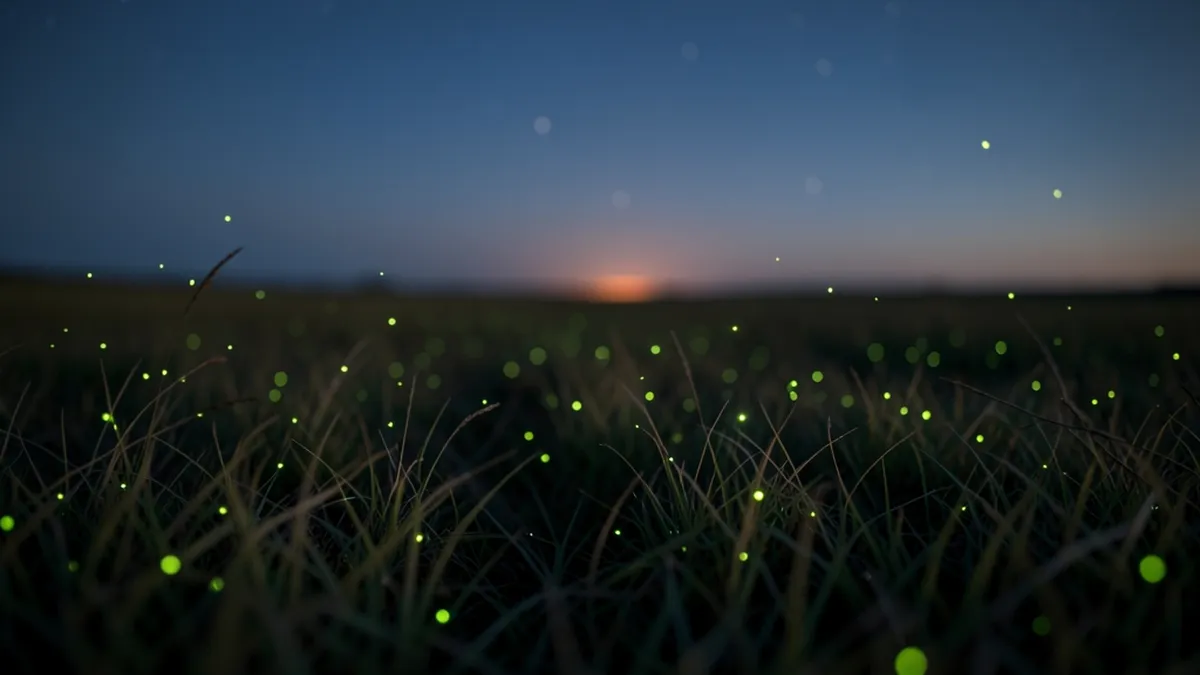
On a warm summer night, a field can fill with small green lights blinking on and off, as if someone had scattered stars across the grass. Far below the surface of the sea, in water so dark that sunlight has never reached it, fish and squid and jellyfish carry their own lamps. This is bioluminescence: light made by a living thing, from a chemical reaction inside its own body, with almost no heat at all.
Key takeaways on bioluminescence
- Bioluminescence is cold light. A molecule called luciferin reacts with oxygen, helped by an enzyme called luciferase, and the energy comes out as light instead of heat.
- It has evolved independently at least 40 times, and more than three in four deep-sea animals can make their own light.
- Fireflies use flashes as a private language. Each species has its own pattern, and in some species thousands of males flash in perfect time.
- In the deep sea, light is a tool for hiding, hunting and escaping: glowing bellies erase a fish’s shadow, and a lure of living bacteria draws prey close.
Cold light: the chemistry of a glow
Every glowing animal, from a firefly to a deep-sea fish, runs some version of the same trick. A small molecule called luciferin reacts with oxygen, and an enzyme called luciferase speeds the reaction along. The reaction leaves a molecule in an excited, high-energy state, and as it settles back down it releases the extra energy as a particle of light.
What makes the trick remarkable is how little is wasted. A normal light bulb turns most of its energy into heat. A firefly’s light organ gives off almost none, which is why the glow is called cold light, and why a firefly can carry its lantern in its own body without cooking itself. Fireflies switch the light on and off by controlling how much oxygen reaches the light organ, like opening and closing a tiny valve.
Fireflies and their secret code
Fireflies are the glow most of us know best, and they are not flies at all. They are soft-winged beetles, with more than 2,000 species around the world. On summer evenings, the males fly low and flash, and the females below flash back.
Each species has its own pattern, like a call sign. The common backyard firefly of North America, Photinus pyralis, is sometimes called the Big Dipper because the male flies in a dipping J shape, flashing for about a second every five seconds or so. The light probably began as a warning: fireflies taste bitter, and their glow tells predators to leave them alone. Only later did it become a love letter.
In a few places, the love letters arrive in chorus. In the Great Smoky Mountains, thousands of male Photinus carolinus flash together, five to eight quick pulses, then darkness, then the whole forest blinking as one. Each firefly watches its neighbours and nudges its own rhythm closer to theirs, until the whole swarm falls into step. Scientists tested this by showing females lights flashing in time, and others flashing at random. The females answered the synchronised display about 80 percent of the time, and the random one only about 10 percent.
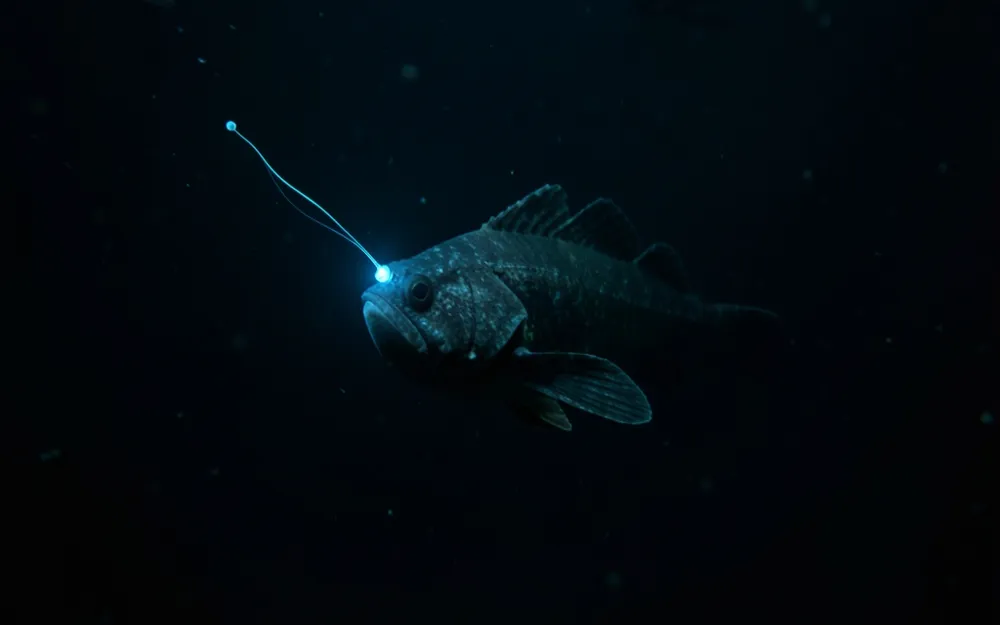
A living lantern, fished with. Image generated by AI.
The deep sea, lit from within
If fireflies are the glow we know, the deep sea is where the glow truly lives. In a survey spanning 17 years, researchers at the Monterey Bay Aquarium Research Institute found that more than three in four of the deep-sea animals they observed can produce their own light.
Down there, light is a matter of survival. The female anglerfish carries a lure at the end of a stalk on her forehead, a small pouch of glowing bacteria that she waves like a lantern to draw curious prey within reach of her teeth. She cannot make the light herself. She farms the bacteria that do, and they glow for her. The Hawaiian bobtail squid does the same in reverse: it hosts glowing bacteria in its belly and points their light downwards to match the moonlight, erasing its shadow. Each morning it flushes out about 95 percent of the bacteria, and by nightfall the colony has grown back a thousandfold.
Other animals use light to disappear. The hatchetfish, a small silver fish shaped like a kitchen hatchet, carries rows of light organs along its belly. From below, a fish swimming against the faint light from the surface would show up as a dark silhouette, so the hatchetfish matches its glow to the light above it, erasing its own shadow. This trick is called counterillumination.
Some animals use light to escape. The vampire squid, a gentle deep-sea creature, lives between 600 and 900 metres down, where oxygen is scarce. When it is startled, it turns itself inside out, flashes the glowing tips of its arms, and releases a cloud of glowing mucus that hangs in the water like fireworks while the squid slips away in the dark.
When the sea itself sparkles
You do not need to dive a kilometre down to see living light. On some warm nights, the waves themselves seem to glow. The light comes from dinoflagellates, plankton that flash when the water around them is disturbed. A breaking wave or a hand dragged through the water sets off tiny blue-green sparks.
Only a small share of dinoflagellate species can do this, about 70 out of more than 2,000. But where one glowing species gathers in huge numbers, the effect is unforgettable. In Mosquito Bay in Puerto Rico, one dinoflagellate fills a mangrove lagoon, and the water lights up at every touch.
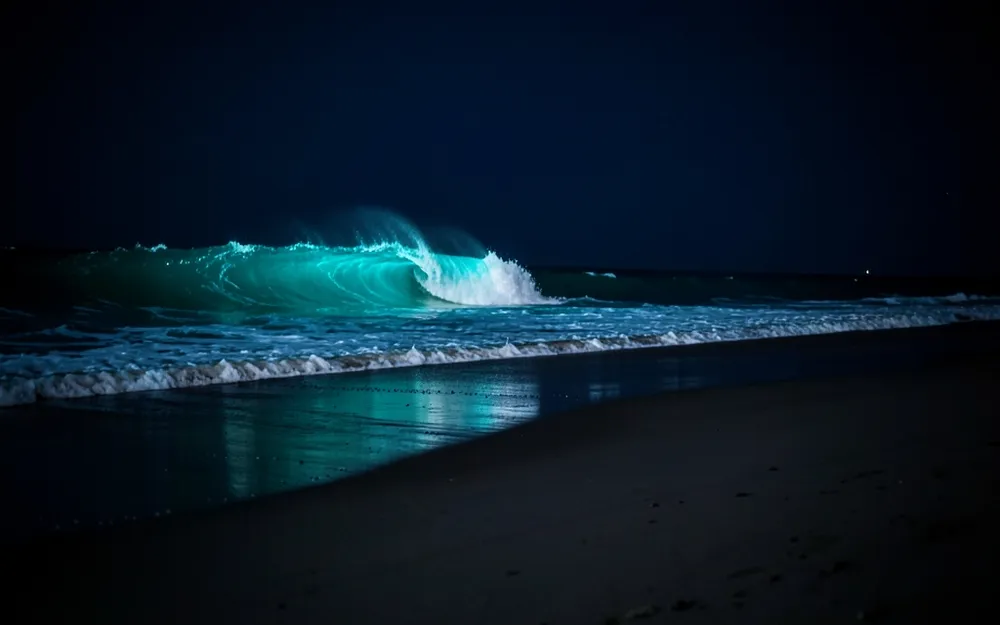
The sea sparkling where the waves break. Image generated by AI.
A jellyfish that changed medicine
The glow has done more than light up the dark. It has changed medicine. In the early 1960s, Osamu Shimomura began studying a crystal jellyfish called Aequorea victoria, which drifts off the west coast of North America.
The jellyfish makes blue light with a protein called aequorin, and Shimomura found a second protein beside it that turned that blue light green. It became known as green fluorescent protein, or GFP. Scientists can attach its gene to the gene of another protein, and wherever that protein goes in a living cell, it glows green, letting researchers watch life at work in real time. In 2008, Shimomura shared the Nobel Prize in Chemistry with Martin Chalfie and Roger Tsien for the discovery and development of GFP.
The lights are dimming
There is a sadder side to the story, and it is closest to home. Fireflies are fading from many of the places where they were once common. A 2021 assessment by the Xerces Society and the firefly specialist group of the International Union for Conservation of Nature looked at 132 North American species and found that about one in three may be at risk of extinction.
The causes are familiar: habitat lost to building and farming, pesticides, and above all light pollution. More than three-quarters of firefly species in the United States and Canada are active at night or at dusk, and their whole courtship depends on being able to see a small flash in the dark. In 2024, the Bethany Beach firefly of Delaware became the first firefly proposed for protection under the United States Endangered Species Act. Turning off outdoor lights when they are not needed, leaving a damp corner of the garden unmown, and skipping pesticides all give fireflies a better chance.
Why it matters
Bioluminescence is a reminder that nature solves problems in ways we would never think of. Faced with total darkness, life did not give up on light. It learned to make its own, again and again, in at least 40 separate evolutionary inventions, and then put that light to every use: finding a mate, catching dinner, hiding from danger, and sounding an alarm.
It is also a reminder of how much we still have to lose. These are not decorations on the world. They are working parts of it. Keep the nights dark, and the lights will keep coming back.
For another story about a hidden world close at hand, read The Subnivean Zone: The Secret World Beneath the Snow.
Frequently asked questions
Why do fireflies glow?
Fireflies glow to communicate. Males flash a pattern unique to their species, and females flash back if it is right. The glow probably began as a warning to predators, since fireflies taste bitter.
Can I see bioluminescence myself?
Yes, if you know where to look. Fireflies appear on warm summer evenings in meadows and gardens, and glowing bays and beaches light up when the water is disturbed on dark nights. Go on a moonless night and keep lights off so the glow can show.
Sources
- Bioluminescence, Wikipedia
- A Comprehensive Exploration of Bioluminescence Systems, Mechanisms, and Advanced Assays, International Journal of Molecular Sciences (2024)
- How Fireflies Glow, and What Signals They Are Sending, The Conversation via InnerSelf (Clyde Sorenson, North Carolina State University)
- Will Fireflies Light Up Summer Skies? Here Is Why They Are Fading, National Geographic (2025)
- Firefly Threats and Conservation Efforts, The Xerces Society
- How Are Cephalopods Adapted to the Dark, Deep World Below 1,000 Meters? NOAA Ocean Exploration
- Nobel Prize in Chemistry Linked to NSLS Protein Work, Brookhaven National Laboratory (2008)
- Dinoflagellate Bioluminescence and Its Circadian Regulation, J. Woodland Hastings, Photobiology.info









0 Comments