

An original TeaLamp explainer based on the sources listed below. Prepared by the TeaLamp Editorial Team with the help of AI.
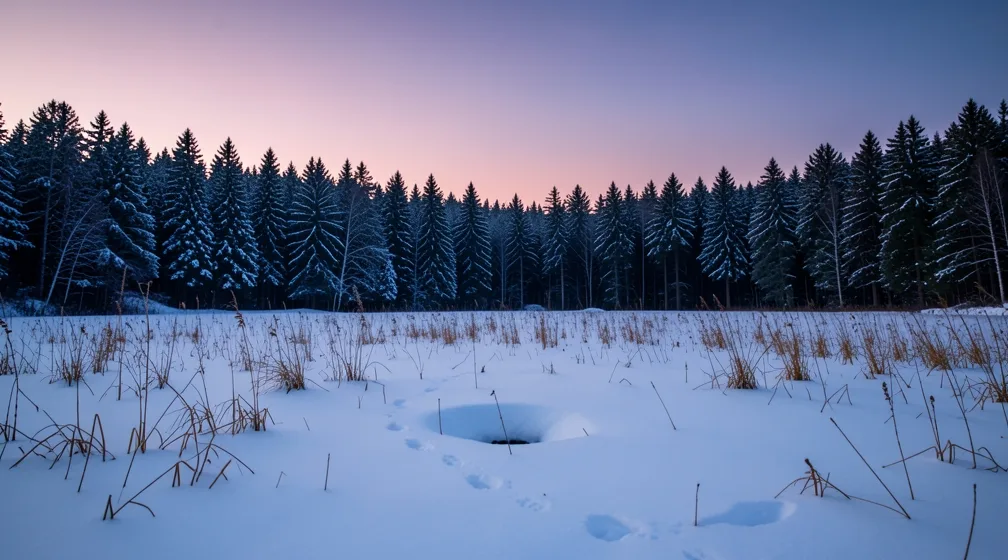
After the first lasting snowfall, a field can look empty and silent for months. It isn’t. Just beneath the white surface lies the subnivean zone, a thin, hidden world between the snow and the ground where mice, voles and shrews spend the winter in tunnels that stay close to freezing even when the air above is bitterly cold. Here is how this secret habitat forms, who lives there, who hunts there, and why warming winters are putting it at risk.
Key takeaways on the subnivean zone
- The subnivean zone is the space between the ground and the bottom of the snowpack; the name means “under the snow”.
- About 15 centimetres (6 inches) of snow is enough to create it, and below a deeper snowpack it stays near 0°C (32°F) whatever the weather above.
- Small mammals such as voles, mice, shrews and lemmings live, feed and travel there all winter.
- Owls, foxes and weasels have clever ways to hunt prey they cannot see.
- Shorter, thinner snow seasons are weakening this refuge, with knock-on effects for many plants and animals.
What the subnivean zone is
The word comes from the Latin sub, under, and nivis, snow. As the Northern Woodlands article on the subnivean zone explains, it is simply the area between the surface of the ground and the bottom of the snowpack. Scientists sometimes call it the subnivium. It exists wherever snow lies long enough, from northern prairies and forests to mountain meadows and the Arctic tundra.
The secret is that snow is a superb insulator. Freshly fallen snow is mostly air trapped between ice crystals. The overview of subnivean climate on Wikipedia notes that new snow with a density of about 0.1 grams per cubic centimetre insulates very well. Meanwhile the ground below still holds some of the warmth it soaked up in summer. The snow blanket traps that heat, much like a duvet traps your body heat on a cold night.
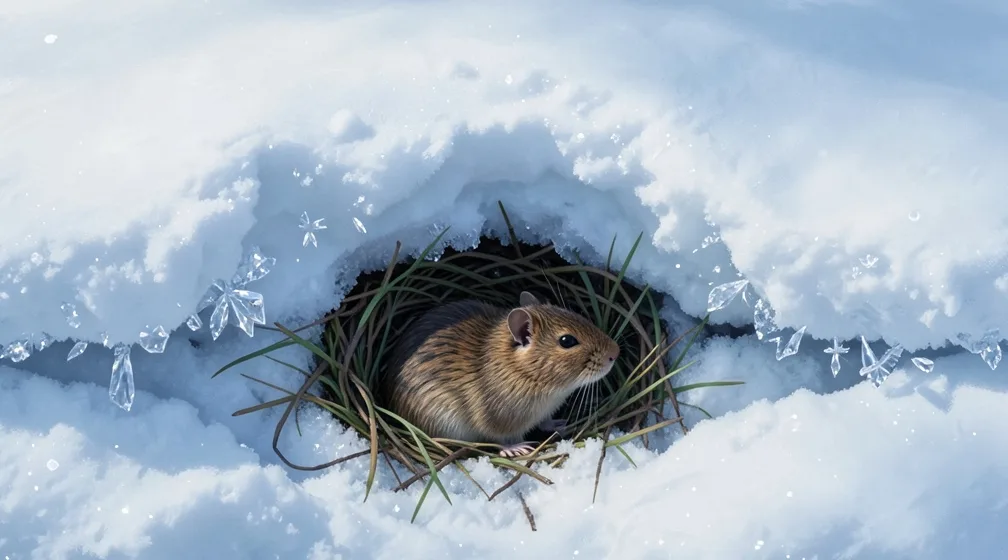
A vole in its grassy tunnel beneath the snowpack, where it stays near freezing all winter. Image generated by AI.
How the hidden world forms
The subnivean zone starts to take shape with the first snow that stays. Some of it lands on stiff, frozen grasses, low shrubs, fallen logs and rocks, which hold it up like little umbrellas and leave pockets of air beneath. Northern Woodlands describes how these gaps become ready-made runways and hideaways.
Then a quieter process begins. Heat rising from the soil turns some of the lowest snow into water vapour. In their 2013 paper on the subnivium as a deteriorating seasonal refugium, ecologist Jonathan Pauli and colleagues explain that this vapour moves upward, meets colder snow and freezes again. Over time this leaves a base layer of loose, granular snow at the bottom of the pack, with larger spaces between the grains. Small animals can push through it easily, a little like moving through coarse sugar.
Depth matters. According to Northern Woodlands, about 15 centimetres of snow gives small mammals a sturdy roof, and with a little more, the space below stays within a degree or two of freezing whatever is happening outside. On a Prairie night when the air drops to −30°C, that difference can be the line between life and death for an animal that weighs less than a teacup.
Who lives under the snow
The best-known residents are small mammals: meadow voles, deer mice, shrews and, in the far north, lemmings. Most of them are too small to hibernate, because they cannot store enough fat to sleep through a long winter. Instead, they stay active below the snow, where it is warmer, calm and out of the wind.
Life down there is surprisingly organised. Voles and mice dig networks of tunnels along the ground and add air shafts to the surface, which keep fresh air flowing. As National Geographic reports on snow-loving animals, ecologist Greg Breed describes the space as warm and humid and says snow cover actually improves these animals’ survival. Food is close at hand: grass stems, seeds, roots, bark and dormant insects, all preserved under the snow. Northern Woodlands even describes nests with separate sleeping areas, food stores and latrines.
The subnivean zone is not just for mammals. Many plants rely on the snow blanket to protect their roots and buds from deep frost, and some insects pass the winter beneath it in a resting state. In a way, a snowy field is a giant, living pantry with the lid on.
Hunting by ear: predators of the snowpack
A hidden world is not a perfectly safe one. Owls have extraordinary hearing, and the Cowling Arboretum at Carleton College notes that they can detect mice, voles and shrews scurrying under the snow from as far as about 30 yards (roughly 27 metres) away. An owl can plunge feet first through the crust to grab prey it has never seen.
Red foxes have a famous trick of their own, called mousing. A fox stands still, tilts its head to listen, then leaps high and dives nose first into the snow. In a 2011 study in Biology Letters, Jaroslav Červený and colleagues analysed records of 592 jumps by wild red foxes in the Czech Republic. Foxes tended to pounce in a roughly north-eastern direction, and in tall vegetation or snow, jumps aimed close to magnetic north succeeded about 72.5% of the time, while jumps in most other directions succeeded less than 18% of the time. The researchers suggest that foxes may use Earth’s magnetic field to help judge distance. It is an intriguing idea rather than a settled fact, because the study observed behaviour and did not test the magnetic sense directly.
Weasels and ermine take a more direct approach. They are slim enough to slip into the tunnels and chase prey right through their winter homes.
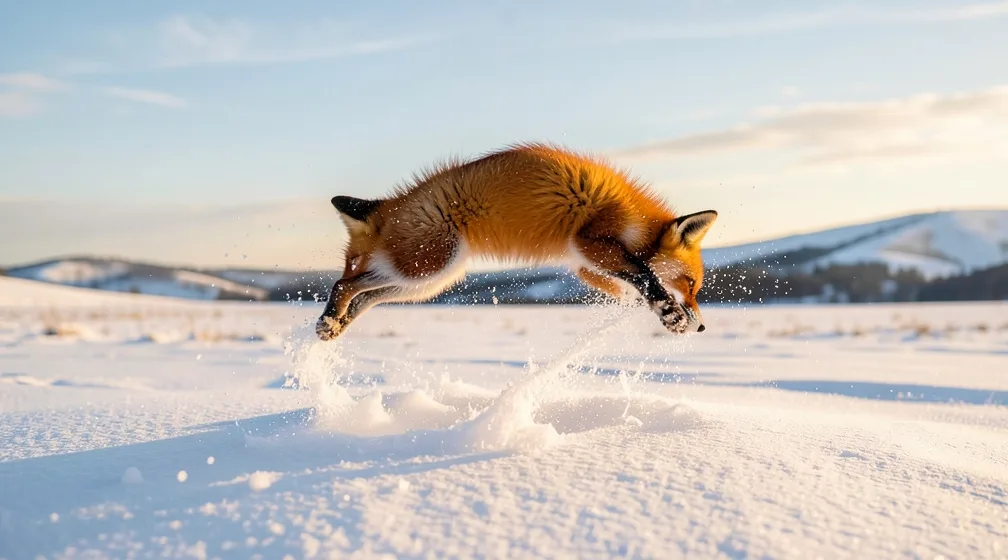
A red fox leaps before diving into the snow after prey it can hear but not see. Image generated by AI.
When the roof caves in
Spring brings new dangers. Thaws and rain can flood the tunnels, and repeated melting and refreezing weaken the snowpack until it collapses. People can cause collapses too: the Wikipedia overview notes that snowmobiles and ATVs can crush the subnivean space, while skis and snowshoes on deep snow are less likely to.
The bigger worry is a changing climate. Pauli and colleagues warn that warming winters are expected to bring shorter snow seasons and thinner snowpacks across much of the Northern Hemisphere. Thin, dense or patchy snow insulates poorly, so the ground can actually get colder and less stable without enough snow on top. Their paper argues that the subnivium is a widespread and crucial refuge that ecologists and land managers have tended to overlook. Small mammals are food for owls, foxes, hawks and many others, so changes beneath the snow can ripple through a whole ecosystem.
How to spot signs of the subnivean zone
You can explore this hidden world without disturbing it. On a winter walk, look for small round holes in the snow, often near a tree trunk, a rock or a clump of grass; these are often air shafts or entrances. Look for the fine stitching of tiny tracks that suddenly disappear, or the dramatic splash of a fox’s dive. And when the snow finally melts in spring, watch the lawn or meadow: you may see winding trails of flattened grass and little piles of clippings, the floor plan of a whole winter’s worth of vole life.
Why it matters
The subnivean zone is a reminder that winter is not a pause in nature but a different season of activity. A layer of snow just a hand’s width deep turns a frozen field into shelter, larder and highway for countless small animals, and those animals feed the larger wildlife we love to see. Understanding it helps us see why healthy, lasting snow cover matters, and why a quiet white field deserves a second look.
Related reading
For more winter nature, read our explainer on why some trees keep their dead leaves all winter, or meet another remarkable builder in our story of beaver dams and the wetlands they create.
Frequently asked questions
How warm is it under the snow?
Once there is enough snow, the space at ground level usually stays close to 0°C (32°F), even when the air above is far colder.
How much snow does the subnivean zone need?
Around 15 centimetres (6 inches) is often enough to form it, and deeper, fluffier snow insulates better.
Do animals hibernate in the subnivean zone?
Most of its best-known residents, such as voles, mice and shrews, do not hibernate. They stay active all winter, feeding and travelling through their tunnels.
Sources
- Northern Woodlands: The Subnivean Zone, Shelter in the Snow
- Pauli and colleagues (2013), Frontiers in Ecology and the Environment: The subnivium, a deteriorating seasonal refugium
- Červený and colleagues (2011), Biology Letters: Directional preference may enhance hunting accuracy in foraging foxes
- Carleton College Cowling Arboretum: Life in the Subnivean Zone
- National Geographic: Snow Day! 8 Surprisingly Snow-Loving Animals
- Wikipedia: Subnivean climate







0 Comments