

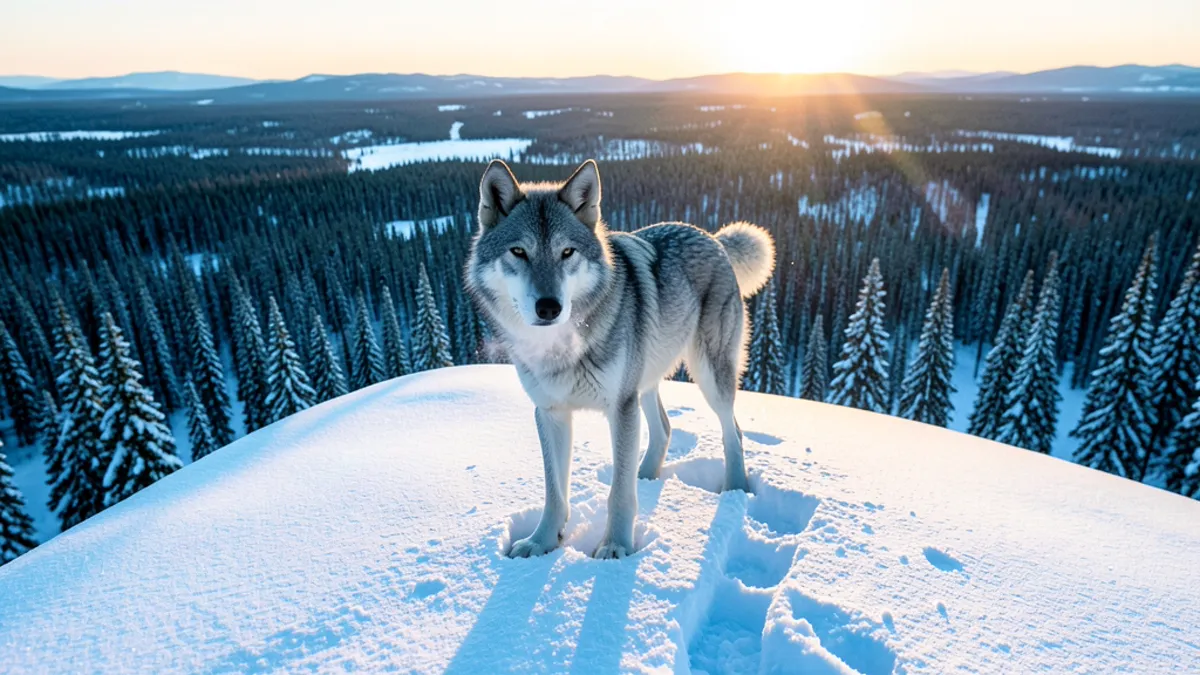
A TeaLamp book summary of White Fang by Jack London, first published in 1906. Written in our own words, with one short quoted line from the book. Prepared by the TeaLamp Editorial Team with the help of AI.
Some books tell you what a character thinks. White Fang does something stranger and better: it tells the whole story from inside the head of a dog. This White Fang summary follows a wolf-dog cub from a frozen den in the Yukon to a sunny garden in California, through hunger, cruelty and, at last, kindness. Jack London wrote it in 1906 as the mirror image of his earlier success, The Call of the Wild. Where that book sent a tame dog back to the wild, this one brings a wild creature in from the cold, and asks whether love can undo what fear has taught.
Key takeaways on White Fang summary
- White Fang is a wolf-dog, three parts wolf and one part dog, born in the Yukon during the Klondike Gold Rush of the 1890s.
- The novel is told largely from the animal’s point of view, so the reader learns the world as White Fang learns it: by hunger, pain and habit, not by words.
- Three masters shape him in turn: Grey Beaver, who is fair but hard; Beauty Smith, who is cruel; and Weedon Scott, who is kind.
- London wrote from first-hand experience: at twenty-one he spent a winter in the Klondike looking for gold and came home with stories instead.
- The book’s answer to its own question is hopeful: a creature made savage by violence can still learn to trust, and to love.
A cub born in the frozen North
The story opens before White Fang is even born, with two men, Bill and Henry, hauling a coffin on a sled through the frozen Yukon while a pack of starving wolves follows them through the dark. It is a hard, cold beginning, and it sets the rules of the world London is writing about: hunger is always close, and everything alive is either hunting or hunted. Among the wolves is a she-wolf named Kiche, herself half dog. She mates with a one-eyed wolf, and in a den by the Mackenzie River she gives birth to five cubs. Four of them die of hunger. Only one survives, a grey cub who will become White Fang.
The cub’s first lessons are the laws of the wild. He learns that meat is life, that the strong eat and the weak are eaten, and that the world beyond the den is full of things that can hurt him. His father, One Eye, is killed by a lynx while hunting for food, and his mother kills the lynx in turn, though she is badly hurt. London tells all of this from the cub’s side of things. The cub does not think in words. He learns by doing, by fear, and by the sting of his mother’s teeth when he wanders too far. It is a remarkable piece of writing: a whole world built out of smell, sound and instinct.
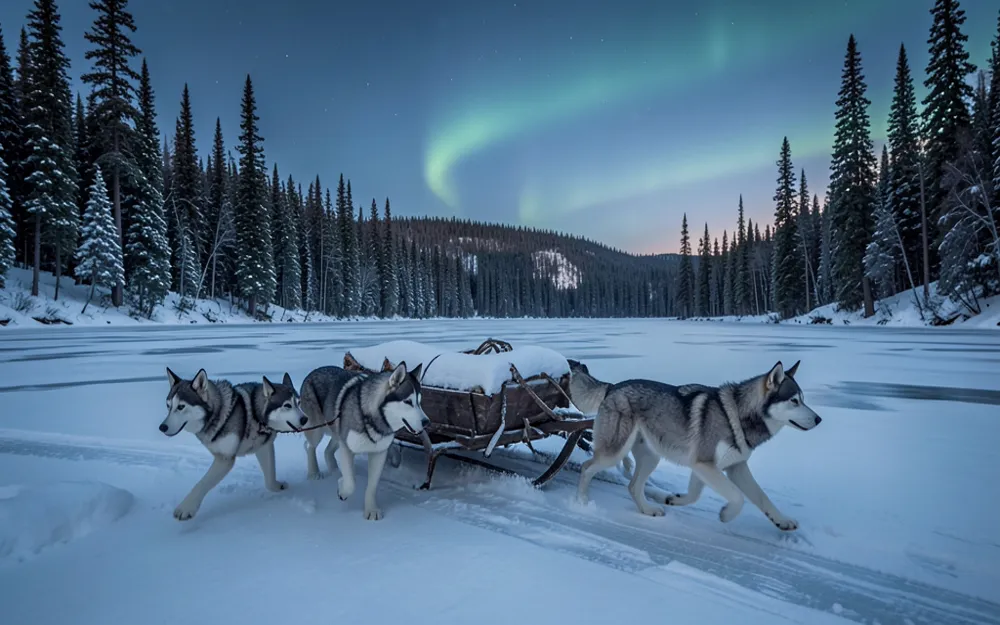
A sled dog team crossing a frozen river at dusk. Image generated by AI.
The makers of fire
Then the cub meets the other kind of power in the North: people. One day he follows his mother to a camp of Native people, and Grey Beaver, the man in charge, recognises Kiche as his dead brother’s dog. He takes them both in, and names the cub White Fang. To the young wolf-dog, these humans are something wonderful and terrible. They make fire from dead wood. They throw sticks and stones through the air. They bend the strongest dogs to their will. London puts the cub’s awe into one famous line: “They were fire-makers! They were gods.”
Life in the camp is hard in a new way. The camp dogs see White Fang as a wolf and attack him on sight, led by a bully named Lip-Lip. Grey Beaver is fair to him, but fairness in the camp means a club when he breaks a rule, and food when he obeys. White Fang learns the law of the camp the same way he learned the law of the wild: quickly, and at a price. He grows into a lean, solitary fighter, feared by the other dogs and trusted by none of them. When his mother is sold away to another camp, he is left alone with people and dogs who do not love him. He learns to hate, and to fight, and to expect nothing good from anyone.
The enemy of his kind
When White Fang is five years old, Grey Beaver takes him to Fort Yukon to trade with the gold hunters. There he falls into the hands of the worst master of all: Beauty Smith, a small, twisted man who keeps dogs to fight for money. Smith gets Grey Beaver drunk and buys White Fang with whisky. Under Smith, the wolf-dog becomes a fighting machine, winning match after match against dogs and wolves. The crowds cheer. White Fang grows more savage with every fight, until at last he meets a bulldog named Cherokee, who grips his throat and will not let go. White Fang is losing, and would have died, when a stranger steps into the ring and stops the fight.
The stranger is Weedon Scott, a mining engineer from California. He buys White Fang from Smith on the spot, and takes him home. Scott is the first person who has ever been kind to the wolf-dog on purpose, and White Fang does not know what to do with it. He snarls. He snaps. He waits for the blow that always follows a gentle hand. Scott waits too, patiently, day after day, speaking softly, offering food, and never striking back. Slowly, something in White Fang begins to change. The animal who had learned that the world is only teeth and clubs begins to learn a new law: that a hand can give as well as take.
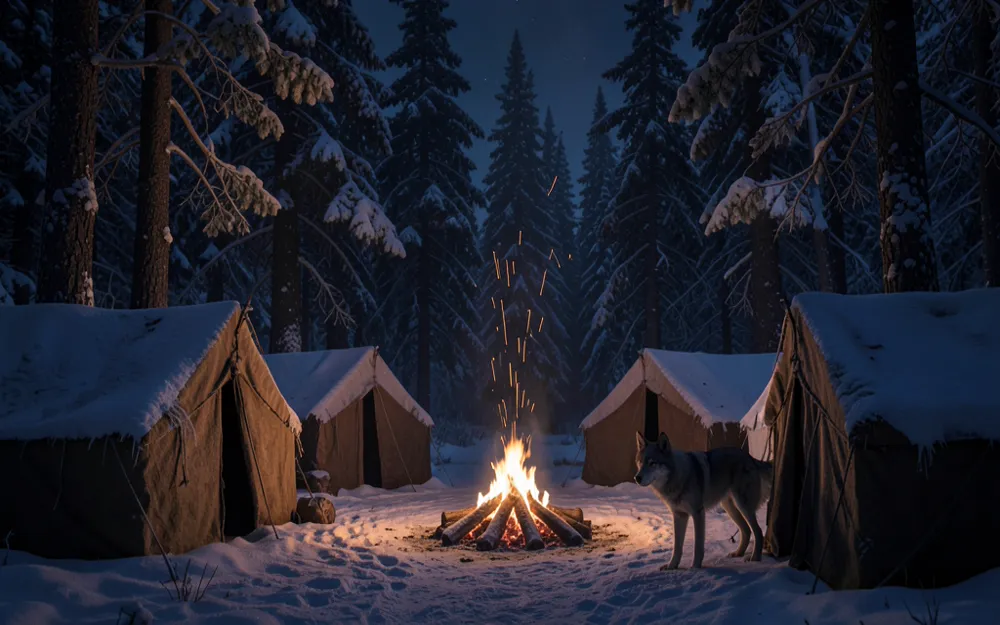
A campfire in a snowy Yukon camp, with a wolf-dog watching from the edge of the firelight. Image generated by AI.
The tame
When Scott’s work in the North is done, he plans to sail home to California alone. White Fang will not allow it. He breaks out of his pen, swims after the departing ship, and nearly drowns trying to follow his master. Scott takes him aboard, and the wolf-dog of the Yukon arrives at a green estate in Santa Clara Valley, where the sun is warm, the grass is soft, and the rules are entirely new. Here he must learn to live among sheepdogs and children, to leave the chickens alone, and to sleep by a fire that is never allowed to go out. The wild still lives in him, but it sleeps now, and love has taken its place.
The book’s ending tests everything White Fang has learned. An escaped convict named Jim Hall, who blames Scott’s father, the judge, for a prison sentence he says he did not deserve, breaks into the house one night to kill him. White Fang, old and scarred, throws himself at the intruder and saves the judge’s life, nearly dying in the fight. When he survives, the women of the house give him a new name: the Blessed Wolf. The story closes in sunlight, with White Fang resting on the lawn beside Collie, the sheepdog who has become his mate, watching their puppies play in the grass.
What London learned in the Klondike
White Fang feels true because so much of it was lived. In 1897, when he was twenty-one, Jack London sailed north with thousands of other hopefuls to look for gold in the Klondike. He carried his supplies over the Chilkoot Pass, spent a hard winter near Dawson City, and found no gold at all. What he found instead was material: the cold, the hunger, the sled dogs, the camps, and the men who lived by the law of club and fang. He came home and turned it into fiction, first with The Call of the Wild in 1903, then with White Fang three years later. Both books were immediate successes, and both are still read today.
London did not write the way other animal writers of his day did. He refused to give his animals human thoughts or pretty feelings. His animals learn by instinct, by pain and by habit, and he said so plainly in an essay of 1908, answering critics who called him a “nature faker”. President Theodore Roosevelt had attacked the bulldog fight in White Fang as absurd, but London stood by his story. He had seen dogs fight in the North, and he had seen what hunger and cruelty could make of them. That honesty is a large part of why the book still holds up: it never asks the reader to believe something London did not believe himself.
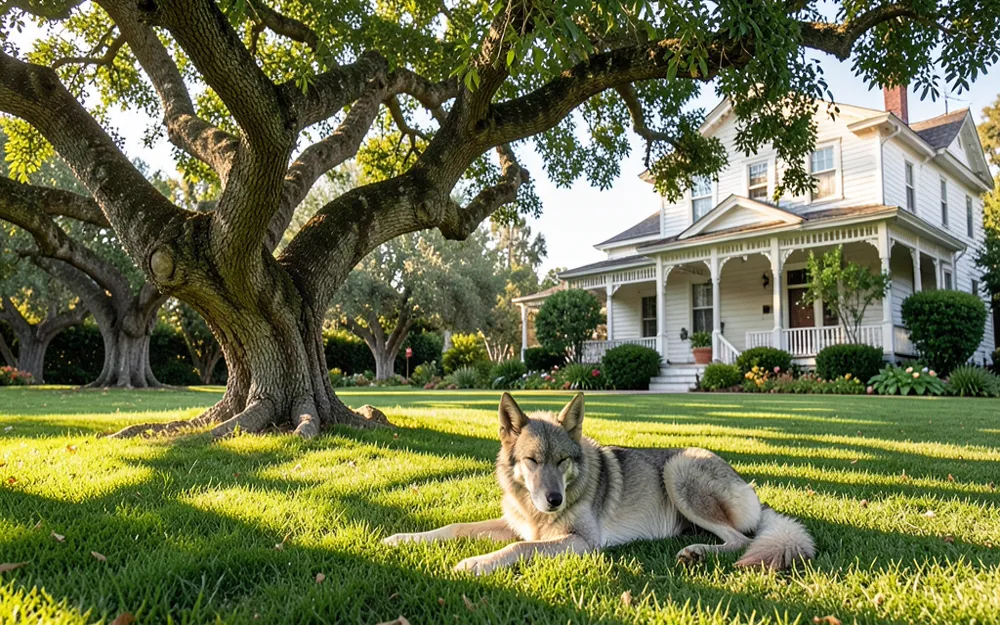
A wolf-dog resting in the sun on a California lawn. Image generated by AI.
Why it matters
White Fang matters because it asks a question that never goes out of date: can a creature shaped by violence be remade by kindness? London’s answer is careful. White Fang is not cured in a day, and the wild never quite leaves him. But love, patiently given, does what fear and force could not: it teaches him to trust. That is a hopeful ending for a book that begins in darkness and hunger, and it is why the novel has lasted. It is also why it suits young readers so well. A child can follow the adventure, the fights and the frozen rivers, while an older reader finds the deeper story underneath: that who we become depends, more than we like to admit, on who is kind to us along the way.
Related reading
For another animal’s story told in its own voice, see our summary of Anna Sewell’s Black Beauty, a horse who tells his own life story.
Frequently asked questions
Is White Fang based on a true story?
No, it is a novel, but it is built on real experience. Jack London spent the winter of 1897 to 1898 in the Yukon during the Klondike Gold Rush, and the cold, the hunger, the sled dogs and the camps in the book all come from what he saw there. White Fang himself is invented.
Do I need to read The Call of the Wild first?
No. The two books are companion pieces, not sequels. The Call of the Wild sends a tame dog back to the wild, while White Fang brings a wild creature into a home. Each stands on its own, though reading both shows how cleverly London mirrored the two journeys.
Is White Fang suitable for children?
Yes, for older children, roughly ten and up. The dog fights and the hunger in the opening chapters are described plainly but without gore, and the story ends warmly. Younger readers may need a grown-up nearby for the fighting-ring chapters.
Sources
White Fang — Wikisource (1906 first edition text)
White Fang — EBSCO Research Starters









0 Comments