

A TeaLamp reading list, written in our own words. Prepared by the TeaLamp Editorial Team with the help of AI.
When the days grow short and the first real snow settles in, books set in winter feel just right. A story full of frost and starlight makes a warm room and a hot cup of tea feel even cozier. This list gathers five snowy books from Denmark, the Netherlands, England, Finland and Alaska, written between 1844 and 2012. Some were written for children and some for adults, but every one of them can be enjoyed at any age, and all of them are spoiler-free below.
Key takeaways on these books set in winter
- Five stories in which snow and ice are more than scenery: they shape the plot, test the characters and bring them together.
- Three are classic children’s books, one is a much-loved fairy tale and one is a modern novel for adults that was a Pulitzer Prize finalist.
- They range from about thirty pages to around four hundred, so there is something for a single evening and something for a long weekend.
- Read in order of publication, they show how writers across nearly two centuries have used winter to talk about friendship, courage and hope.
How we chose these winter books
We looked for books in which winter is part of the story’s heart, not just the weather outside. We wanted a spread of countries and periods, titles that are easy to find in English, and stories with a warm core, even when the setting is cold. We left out tales that turn very dark, so the whole list suits a cozy evening.
1. The Snow Queen by Hans Christian Andersen (1844)
Hans Christian Andersen published this fairy tale in Copenhagen in December 1844, and it is one of his longest and richest. It is told in seven short “stories”. It begins with an enchanted mirror that shatters into countless splinters. When a tiny piece lodges in the eye and heart of a boy named Kai, he turns cold and mocking, and the beautiful Snow Queen carries him away to her palace in the far north. His friend Gerda sets out to find him.
What makes the tale so lasting is Gerda herself. She has no magic and no weapons, only loyalty and a kind heart, and she meets a talking crow, a fierce little robber girl and a reindeer who carries her across the snow. The story is a good reminder that warmth can be a kind of strength. It takes well under an hour to read and is lovely read aloud. Many readers know it today as one of the loose inspirations for the film Frozen, but the original has its own quiet, strange beauty.
2. Hans Brinker, or The Silver Skates by Mary Mapes Dodge (1865)
This American novel introduced generations of English-speaking readers to the frozen canals and speed skating of the Netherlands. Hans Brinker and his younger sister Gretel are poor children who skate on homemade wooden skates and dream of entering a great race on the ice, where the prize is a pair of silver skates. Their family is also struggling, because their father has been unwell for years after an accident.
Mary Mapes Dodge had never been to the Netherlands when she wrote the book. She studied Dutch history and listened to her Dutch neighbours, and the result is a warm portrait of early nineteenth-century Dutch life, full of skating trips, canals, windmills and village customs. The book was a bestseller in its first year, outsold only by Charles Dickens’s Our Mutual Friend, according to Dodge’s biographers. It also made famous the little story of a boy who saves his town by plugging a leaking dike with his finger, which appears in the novel as a tale read aloud in a classroom. It is a gentle, kind-hearted book, best for readers who enjoy a slower, old-fashioned style.
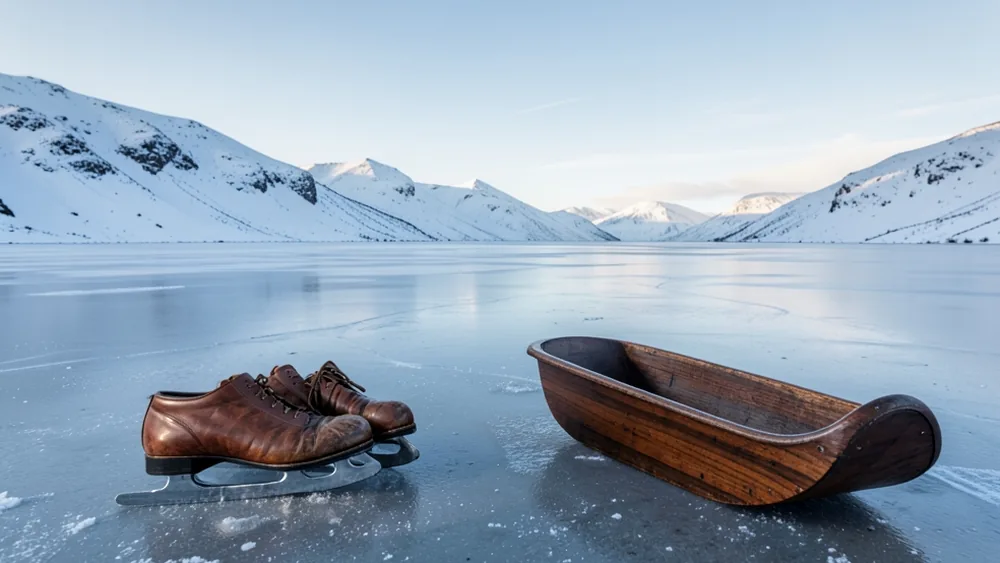
Old skates and a sledge on a frozen lake, the stuff of Dutch canal races and Lake District expeditions. Image generated by AI.
3. Winter Holiday by Arthur Ransome (1933)
This is the fourth book in Arthur Ransome’s Swallows and Amazons series, and the only one where the famous sailing boats stay mostly ashore. Two new children, Dick and Dorothea Callum, are spending the winter near a lake in the English Lake District. They meet the Swallows and the Amazons, the children from the earlier books, and are quickly drawn into a grand game of Arctic exploration.
The weather turns very cold, the lake freezes solid and the children plan an expedition across the ice to a spot they call the North Pole. Along the way there are signals with flags and lanterns, skating, sledging, an old houseboat that becomes their polar ship and an outbreak of mumps that keeps everyone home from school. Ransome drew on his own memories of the Great Frost of 1895, when a lake near his school froze over, and on the Arctic travels of the Norwegian explorer Fridtjof Nansen. You don’t need to have read the earlier books to enjoy it. It suits curious readers of about nine and up, and grown-ups who remember the joy of a snow day.
4. Moominland Midwinter by Tove Jansson (1957)
Tove Jansson, a Finnish author who wrote in Swedish, published this sixth Moomin book in 1957 as Trollvinter. Moomins sleep through the winter, but this time Moomintroll wakes up in the middle of it and cannot get back to sleep. His family is still dreaming, the sun has gone, and the valley he knows is buried under something cold, white and completely new to him.
At first he is lonely and a little frightened. Then he meets the calm, wise Too-ticky, watches the fearless Little My go sledging on his mother’s silver tea tray, and slowly learns that winter has its own beauty and its own guests. It is a book about facing the unfamiliar and finding your feet, and it has a slightly deeper, more thoughtful mood than the earlier Moomin stories. Many adults call it their favourite of the series. Jansson’s work later earned her the Hans Christian Andersen Award, which ties nicely back to the first book on this list.
Northern lights over a snowy valley during the long northern winter night. Image generated by AI.
5. The Snow Child by Eowyn Ivey (2012)
Eowyn Ivey’s debut novel moves a Russian folk tale about a girl made of snow to the Alaskan wilderness of the 1920s. Jack and Mabel are an older couple without children who have left their old life behind to start a homestead in the harsh north. One night, in a rare playful mood, they build a little girl out of snow. The next morning the snow girl is gone, and small footprints lead away into the trees.
Soon a real child, wild and quick, begins to appear at the edge of the forest. Is she a lost girl, or something stranger? Ivey keeps the question open with great care, and the book becomes a moving story about hope, love and making a life in a hard place. Its landscapes are so vivid you can almost feel the cold through the page. The novel was a finalist for the 2013 Pulitzer Prize for Fiction. It is best for adult readers who enjoy a quiet, lyrical pace and a touch of fairy-tale mystery, and it carries some sadness alongside its warmth.
Small red mittens on a snowy fence, a quiet nod to a story set in the Alaskan wilderness. Image generated by AI.
Tips for reading winter books on cold evenings
- Pair the length with the night. The Snow Queen fits one evening. Moominland Midwinter fits a weekend. The Snow Child is ideal for a week of slow reading.
- Read the children’s books aloud. Andersen, Ransome and Jansson all wrote with a speaking voice, and they shine when shared.
- Look for free editions. The Snow Queen and Hans Brinker are in the public domain in many countries, so free versions are easy to find through public libraries and digital archives.
- Keep a pot of tea nearby. Little My would approve, as long as the tray is free for sledging.
Why it matters
Winter can feel long, dark and isolating, especially in northern places. Stories like these give the season a different shape. They turn snow into a place of adventure, friendship and wonder, and they remind us that cold days are easier to face with company. Sharing a winter book with a child, a friend or a book club is a small, simple way to make the darkest months feel brighter.
Related reading
For more snowy evenings, try our list of classic mystery novels for winter. If you are curious about real life under the snow, read our explainer on the subnivean zone, the hidden world beneath the snow.
Sources
- The Snow Queen, in English translation (Hans Christian Andersen Centre, University of Southern Denmark)
- Hans Brinker, or The Silver Skates: background and reception (Wikipedia, citing Gannon and Thomson’s biography of Mary Mapes Dodge)
- Winter Holiday: background and influences (Wikipedia)
- Moominland Midwinter (Wikipedia, citing Boel Westin’s biography of Tove Jansson)
- The Snow Child, by Eowyn Ivey: 2013 Fiction finalist (The Pulitzer Prizes)
- Hans Christian Andersen Award winners, 1956 to 2022 (IBBY)

0 Comments