

An original TeaLamp explainer based on the sources listed below. Prepared by the TeaLamp Editorial Team with the help of AI.
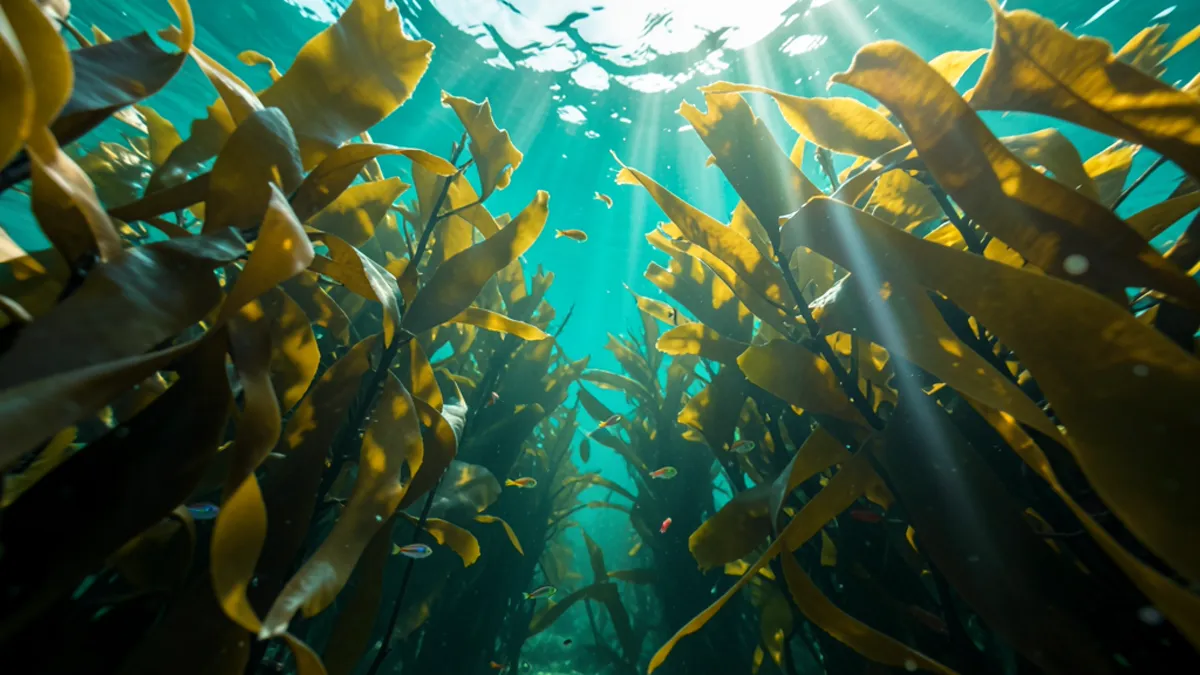
Picture a forest where the trees sway in slow motion, sunlight filters down through a golden canopy, and fish move between the trunks like birds. Now picture it underwater. That is what kelp forests are: towering, fast-growing forests of giant seaweed that line about a quarter of the world’s coastlines, shelter an astonishing variety of sea life, and do some of the hardest climate work on the planet.
Key takeaways on kelp forests
- Kelp forests are underwater forests of giant brown algae, not trees, and they grow in cool, shallow coastal water around the world.
- Giant kelp can grow up to 45 centimetres a day, making kelp forests among the most productive ecosystems on Earth.
- They shelter more than 800 species, store carbon, soften waves and support fisheries worth billions.
- More than a third of the world’s kelp forests have declined in the past fifty years, but restoration projects are bringing them back.
What exactly is a kelp forest?
Kelp looks like a plant, but it is not one. Kelp is a large brown alga, a kind of seaweed, and it grows in dense stands in cool, nutrient-rich water close to shore. Each plant anchors itself to rock with a root-like holdfast, sends up a flexible stem called a stipe, and spreads leaf-like blades toward the light. Together, thousands of plants form a layered forest, with a canopy at the surface and a busy seafloor below.
About thirty species of kelp grow in temperate and subpolar waters in both hemispheres, from Alaska to Baja California, from Norway to Tasmania. Because kelp needs sunlight, the forests stay in shallow water, rarely deeper than 15 to 40 metres. Around 740 million people live within 50 kilometres of these underwater forests, often without ever seeing one.
Charles Darwin saw them on his voyage around South America and marvelled at what he found. “The numbers of living creatures of all Orders whose existence intimately depends on kelp is wonderful,” he wrote in The Voyage of the Beagle, “I can only compare these great aquatic forests… with the terrestrial ones in the intertropical regions.”
A forest that grows faster than almost anything on land
The first thing to know about kelp is its speed. In ideal conditions, giant kelp can grow up to 45 centimetres in a single day. Some species reach 45 metres tall, as high as a fifteen-storey building, and a forest torn apart by a winter storm can begin growing back the following spring.
That speed makes kelp forests among the fastest-growing ecosystems on Earth, turning sunlight and seawater into food and shelter at a pace few land forests can match. The forest is never still: fronds sway with the tide, blades break off and drift away as food for creatures on the seafloor, and new growth replaces them.
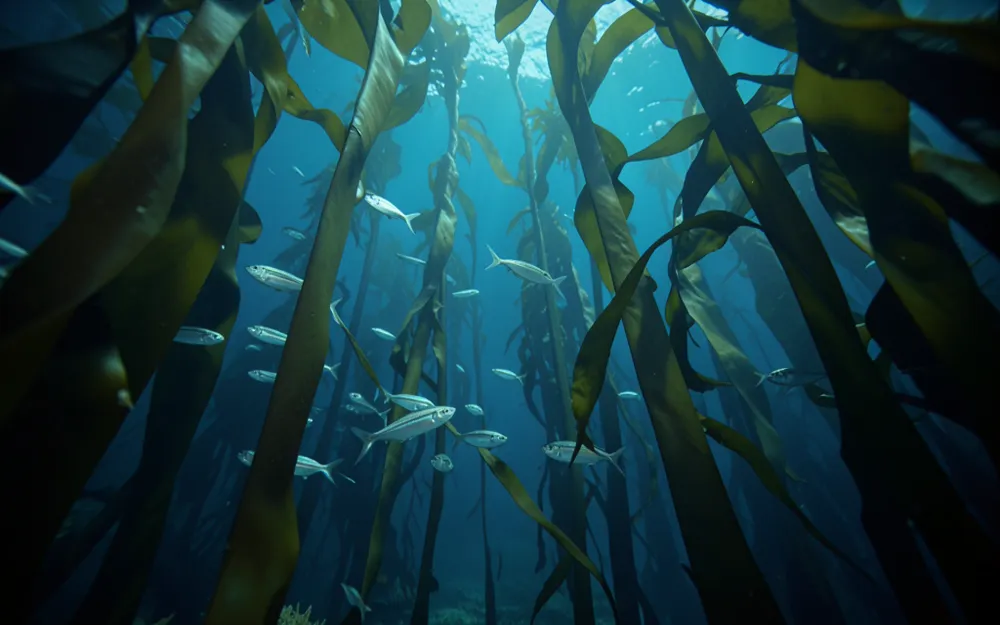
Kelp stipes rise like tree trunks, with a school of fish weaving between them. Image generated by AI.
A nursery, a pantry and a shelter
A kelp forest is a whole neighbourhood. The canopy shelters young fish from predators and rough weather. The blades feed snails, crabs and sea urchins. The holdfasts, tangled like tree roots, hide small animals that bigger fish hunt. Seals, sea lions, whales and sea otters all use the forest, and seabirds patrol above it.
NOAA, the American ocean agency, says kelp forests harbour a greater variety of plants and animals than almost any other ocean community. More than 800 species of fish, invertebrates and marine mammals depend on them. For people, the forest is a pantry too: it shelters commercially important fish such as cod, rockfish and abalone, and kelp itself has been harvested for centuries as food, fertiliser and a nutritional supplement. The thickening agent in ice cream, toothpaste and lotions often comes from giant kelp.
The forest also has a guardian. Sea otters eat sea urchins, and sea urchins eat kelp. Where otters are present, urchin numbers stay in check and the forest thrives. Where otters are gone, urchins can gather in great herds and graze a forest down to bare rock, advancing by about nine metres a month. Otters even wrap themselves in kelp while they sleep, so they do not drift away with the tide.
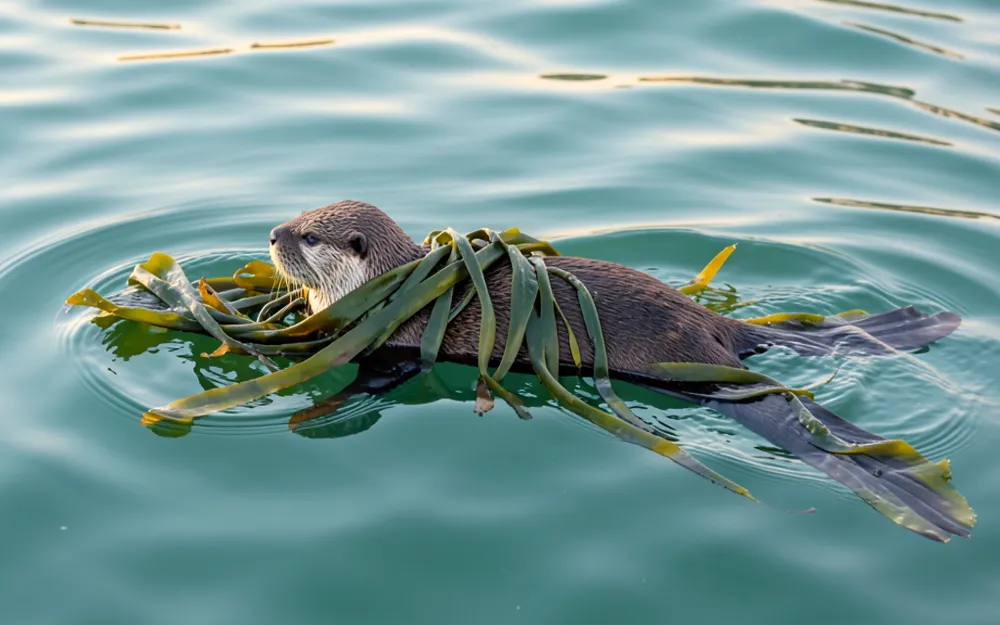
A sea otter rests in a raft of kelp, safe from drifting away. Image generated by AI.
Carbon, coastlines and calm water
Kelp forests do quiet work that reaches far beyond the shore. As they grow, they pull carbon dioxide out of the water, and some of it ends up buried in deep ocean sediments. A recent study by Conservation International, published in the journal Biological Reviews, found that kelp and seaweed forests may sequester as much carbon as the Amazon rainforest. The researchers estimate that protecting, restoring and better managing these forests could avoid up to 36 million tons of carbon dioxide, roughly the capture of 1.1 to 1.6 billion trees.
The forests also protect the coast itself. A dense stand of kelp softens incoming waves, steadies sediments and helps shield the shore from erosion and storm damage. The value of everything kelp forests provide has been estimated at between 500,000 and 1,000,000 dollars per kilometre of coastline. In Australia, the Great Southern Reef, one interconnected kelp system stretching 8,000 kilometres around the southern coast, contributes as much as 10 billion dollars a year to the economy.
When the forests vanish
For all their speed and strength, kelp forests are fragile. A global study published in 2016 in the Proceedings of the National Academy of Sciences looked at kelp records from 1,138 sites in 34 regions over half a century. It found kelp declining in 38 percent of the regions, increasing in 27 percent, and unchanged in the rest. The losses were often driven by several pressures acting together: warming water, nutrient pollution, overfishing and hungry grazers.
The most dramatic losses have come in sudden collapses. Along North America’s Pacific coast, a sea star wasting disease that began in 2013 wiped out sunflower stars, the main predator of the purple sea urchin. With their predators gone, urchin numbers exploded, and 95 percent of the region’s kelp forests vanished in seven years, from Monterey Bay in California to Vancouver Island in Canada. In northern California alone, more than 90 percent of the bull kelp canopy disappeared within a single year, in 2014. The red abalone fishery had to be suspended because the snails that depend on kelp were starving.
On England’s Sussex coast, trawling and storm damage wiped out 96 percent of the kelp forests since the late 1980s. In Tasmania, warming water has pushed giant kelp to the edge. When a kelp forest goes, it is rarely replaced by something as rich. More often the reef becomes a carpet of small algae, or a bare urchin desert.
Bringing the forests back
The hopeful part is that kelp forests can come back, and people are learning how to help. In 2021, Sussex banned trawling along a stretch of its coast, creating one of the largest trawling-free zones in the United Kingdom, and the Sussex Kelp Recovery Project is now watching for signs of regrowth. Divers and fishermen already report mussel beds, dolphins and rays returning to the area.
In Australia and Norway, scientists have found a cleverer way to replant a forest. The method is called green gravel: tiny kelp plants are grown in a laboratory until they glue themselves to small rocks, and the rocks are then scattered from a boat onto the reef. Some species reach full canopy height within about a year, and the technique is now being trialled in more than fifteen regions across eight countries. In Tasmania, researchers are breeding kelp that can cope with warmer water, and along the Pacific coast divers cull urchins by hand.
Protection works too. In Argentina, the Peninsula Mitre reserve now safeguards more than 30 percent of the country’s remaining kelp forests. Where the pressures are lifted, the forest’s own speed does the rest.
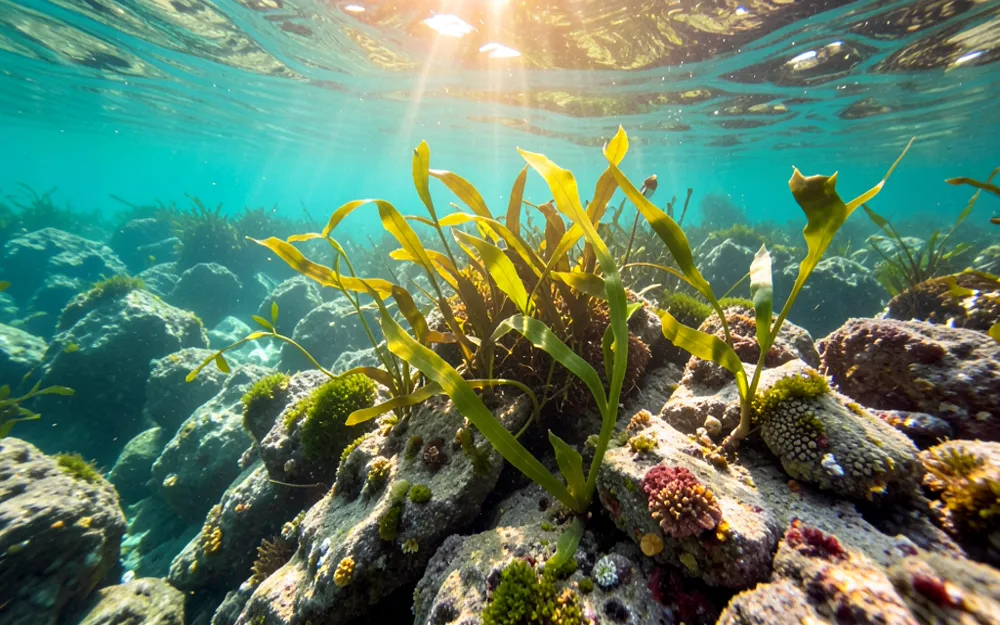
Young kelp takes hold on the reef, the first step in bringing a forest back. Image generated by AI.
Why it matters
Kelp forests matter because they pack so much life, food and climate help into one ecosystem. They feed coastal towns, shelter the fish those towns depend on, soften the waves that batter their shores, and lock away carbon while they do it. Losing them would mean losing a nursery, a pantry and a breakwater all at once.
The good news is that kelp grows fast, and so does hope. Every restored patch of forest is a place where fish return, where otters can feed, and where the sea can breathe a little easier. The underwater forests have survived storms, ice ages and hungry urchins for millions of years. With a little help, they can survive us too.
For another story about the ocean and what protects it, read Saving the Seas: What Works (and Why it Matters).
Frequently asked questions
Is kelp a plant?
No. Kelp is a large brown alga, a kind of seaweed. It has no true roots, stems or leaves, though its holdfast, stipe and blades do similar jobs. It photosynthesises like a plant, but belongs to a different group of organisms.
How fast does kelp grow?
Giant kelp can grow up to 45 centimetres a day in ideal conditions, among the fastest growth rates of any organism on Earth. That speed lets a damaged forest regrow within a season.
Can kelp forests really help fight climate change?
Yes, within limits. Kelp absorbs carbon dioxide as it grows, and some of that carbon reaches deep water or sediments where it stays. Researchers estimate that protecting and restoring kelp and seaweed forests could avoid up to 36 million tons of carbon dioxide. It is a real contribution, but no substitute for cutting emissions.
Sources
- NOAA Ocean Service, “What is a kelp forest?”
- Oceanographic Magazine, “Kelp forests — the rainforests of the sea” (Meg Severide, International League of Conservation Photographers)
- Krumhansl et al., “Global patterns of kelp forest change over the past half-century”, Proceedings of the National Academy of Sciences, 2016
- University of Western Australia, “Finding solutions to help kelp damaged by climate change” (green gravel)
- World Economic Forum, “How scientists are restoring the world’s kelp forests”
- SeaFacts, “Kelp forest: what it is, what lives there and why some are vanishing”
- NOEMA, “Part of our ocean is dying” (Thomas Wernberg and Karen Filbee-Dexter)
- Oceana, “Kelp Forest”






0 Comments