


An original TeaLamp explainer based on the sources listed below. Prepared by the TeaLamp Editorial Team with the help of AI.
The spacing effect is one of the oldest and most reliable findings in the science of memory: if you spread your study or practice out over time, you remember far more than if you pack the same amount of effort into one long session. It sounds almost too simple. Yet most of us still cram before exams, binge-read before meetings and try to learn a language in a single burst of enthusiasm. Here is where the idea came from, what the best studies show, why cramming feels better than it works, and how to put “little and often” to use in everyday life.
Key takeaways on the spacing effect
- Spreading learning across several sessions leads to much better long-term memory than massing it into one, even when the total time is the same.
- The effect was first measured by Hermann Ebbinghaus in the 1880s and has been confirmed in hundreds of experiments since.
- The best gap between sessions depends on how long you want to remember something: the longer the goal, the longer the gap.
- Cramming can work for a test tomorrow, but the knowledge fades quickly, and it fools learners into feeling more confident than they should.
- Spacing works best when paired with retrieval practice, meaning you test yourself rather than simply rereading.
A scientist who memorised nonsense
The story begins with a German psychologist, Hermann Ebbinghaus, who in the late 1870s and early 1880s set himself an unusual task. To study memory without the help of meaning, he invented lists of nonsense syllables, short sound combinations such as a consonant, a vowel and another consonant, and he learned them himself, again and again, timing how long it took. He then measured how much effort he saved when relearning a list hours or days later.
His results, published in 1885 in a short book usually translated as Memory: A Contribution to Experimental Psychology, gave us the famous “forgetting curve”: we lose a large share of new material quickly, within the first hours and days, and then the loss slows down. Ebbinghaus also noticed something that would become just as important. Repetitions spread over several days held up much better than the same number of repetitions crowded into one sitting. In other words, the timing of practice mattered, not only the amount.
More than a century later, in 2015, two researchers at the University of Amsterdam, Jaap Murre and Joeri Dros, repeated his forgetting-curve experiment with modern methods and found a strikingly similar shape. For a study done by one man with a metronome and a notebook, it has aged remarkably well.

A metronome and a notebook: the simple tools of the first memory experiments. Image generated by AI.
What hundreds of studies show
Since Ebbinghaus, the spacing effect has been tested with vocabulary, facts, maths problems, musical and sports skills, and medical training, in laboratories and in classrooms. In 2006 a team led by Nicholas Cepeda pulled together this huge literature in a review in the journal Psychological Bulletin. Across hundreds of experiments, the pattern was consistent: spaced practice beat massed practice for long-term retention.
Two years later, Cepeda and colleagues ran one of the most ambitious tests of the idea. More than 1,350 people learned a set of obscure but true trivia facts online. Each person then had a review session after a gap that ranged from no delay at all to three and a half months, and a final test after a further delay of up to a year. The researchers found that the right gap made an enormous difference. For a fixed amount of study time, the best gap improved final recall by about 64 percent compared with reviewing on the same day.
They also found that there is a “sweet spot”, and that it moves. Too short a gap gives little benefit; too long a gap means you have forgotten so much that the review feels like starting again. As a rough rule from their data, the ideal gap was about a fifth to two fifths of the time you want to remember something when that time is a week, falling to about a tenth or less when the goal is a year. So if you want to remember something for a week, review it after a day or two. If you want to remember it for a year, a review after three or four weeks works better than one the next morning.
Why cramming feels better than it works
If spacing is so effective, why do so many of us cram? Part of the answer is that massed practice feels productive. When you go over the same material again and again in one sitting, it becomes familiar and easy to recall in that moment, and we mistake that ease for real learning.
A 2009 study by the psychologist Nate Kornell showed this neatly. Students learned word pairs with flashcards, either as one large stack studied over several days (spaced) or as small stacks studied in quick bursts (massed). Spacing was more effective than massing for 90 percent of the participants. Yet after their first session, 72 percent of them believed that massing had worked better. Their feeling of progress pointed in exactly the wrong direction.
Cramming is not useless. If the exam is tomorrow morning, a late evening review will help you tomorrow morning. The trouble comes afterwards: knowledge that was crammed tends to fade fast, which is a problem for anything that builds on itself, from a language to a musical instrument to the next unit of a course.

Like a long climb, learning goes further when taken in steps with rests between. Image generated by AI.
The perfect partner: testing yourself
Spacing has a close cousin known as the testing effect, or retrieval practice. Instead of rereading notes, you close the book and try to recall what you learned. In a well-known 2006 study, Henry Roediger and Jeffrey Karpicke at Washington University in St. Louis asked students to learn short prose passages. Some reread the passages several times; others read once and then practised recalling them. On a test five minutes later, the rereaders did slightly better. A week later the picture had flipped: in one experiment the self-testing group remembered about 61 percent of the material, compared with about 40 percent for the group that had only reread, even though the rereaders had gone through the passage many more times.
A large 2013 review of study techniques led by John Dunlosky, published in Psychological Science in the Public Interest, compared ten popular strategies. Only two earned its top rating for usefulness: practice testing and distributed (spaced) practice. Highlighting and rereading, two of students’ favourite habits, were rated as having low utility. Put spacing and testing together, recalling material at well-timed gaps, and you have what many teachers and app designers call spaced retrieval.
How to use the spacing effect in everyday life
The good news is that you do not need special equipment, just a calendar and a little patience. A few practical ideas drawn from the research:
- Split one long session into several short ones. Three 20-minute sessions on different days usually beat one hour in a single evening.
- Review before you forget everything, but after you forget a little. A slight struggle to remember is a sign the gap is working, not that you are failing.
- Stretch the gaps as you go. Review new material after a day, then after a few days, then after a week or two. Many flashcard methods, such as the Leitner box system and spaced-repetition apps, do this automatically.
- Test, do not just reread. Cover your notes and explain the idea aloud, answer practice questions or write down everything you remember before checking.
- Mix topics. Rotating between subjects within a week naturally creates gaps for each one.
- Plan backwards from the date that matters. For an exam in a month, start reviewing now with weekly gaps instead of waiting for the final weekend.
The same idea applies outside school. Learning a few phrases of a language each day, practising an instrument for a short spell most evenings, or revisiting a recipe until you can cook it without the book are all ways of letting time do part of the work.
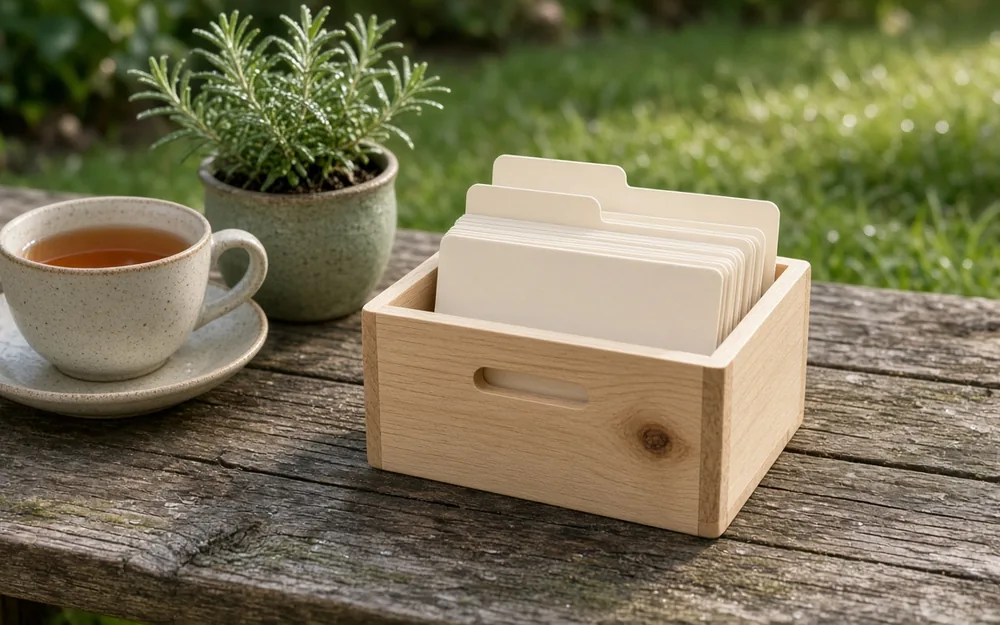
A simple card box can space out reviews for you. Image generated by AI.
Why it matters
The spacing effect is a reminder that memory is not a recording but a living process that strengthens each time we reach back for something. Cepeda’s team concluded that many common teaching practices, which present a topic once and then move on, are “highly inefficient”. For learners, the lesson is kinder than it sounds: you do not have to study harder, only spread it out. A little effort, returned to at the right moments, tends to stay with you for a long time.
If you enjoy the science of how our minds work, read our piece on why a walk helps you think more clearly, or explore the case for boredom and the idle, creative mind.
Frequently asked questions
How long should I wait between study sessions?
It depends on how long you want to remember the material. For a test in a week, a gap of a day or two works well. For knowledge you want to keep for months or longer, gaps of several weeks are better. When in doubt, review when the material feels slightly hard to recall.
Does the spacing effect work for skills as well as facts?
Yes. Researchers have found spacing benefits for motor and musical skills, sports and professional training, as well as for vocabulary and facts, although the best schedule can vary with the task.
Sources
- Memory: A Contribution to Experimental Psychology, by Hermann Ebbinghaus (1885; English translation 1913, Classics in the History of Psychology)
- Replication and analysis of Ebbinghaus’ forgetting curve, by Jaap Murre and Joeri Dros (PLOS ONE, 2015)
- Distributed practice in verbal recall tasks: a review and quantitative synthesis (Psychological Bulletin, 2006)
- Spacing effects in learning: a temporal ridgeline of optimal retention (Psychological Science, 2008)
- Optimising learning using flashcards: spacing is more effective than cramming, by Nate Kornell (Applied Cognitive Psychology, 2009)
- Repeated test-taking better for retention than repeated studying (Washington University in St. Louis, on Roediger and Karpicke, 2006)
- Improving students’ learning with effective learning techniques (Psychological Science in the Public Interest, 2013)










0 Comments